
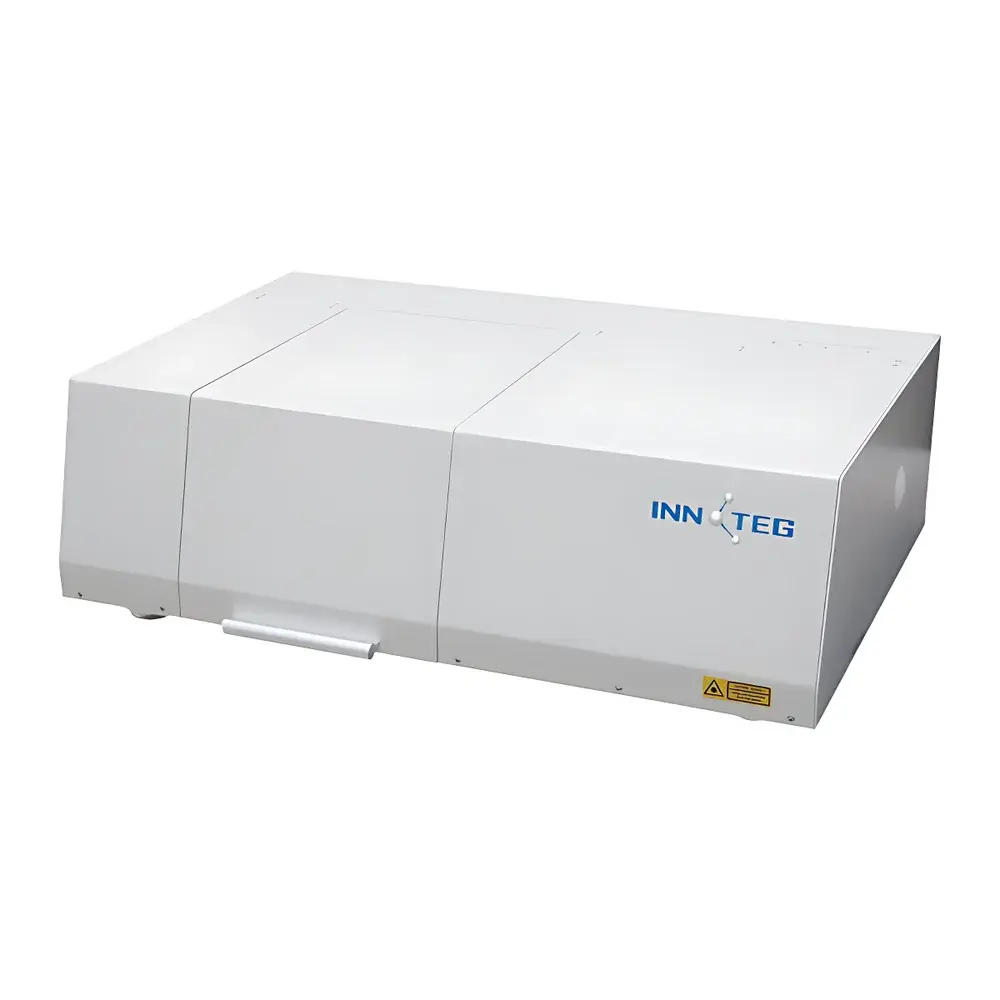
Innoteg InnoFTIR10 Fourier Transform Infrared (FTIR) Spectrometer
| Brand | Innoteg |
|---|---|
| Origin | Guangdong, China |
| Manufacturer Type | Authorized Distributor |
| Origin Category | Domestic (China-made) |
| Model | InnoFTIR10 |
| Instrument Type | Laboratory FTIR Spectrometer |
| Wavenumber Range | 7800–350 cm⁻¹ |
| Spectral Resolution | Better than 1.0 cm⁻¹ |
| Signal-to-Noise Ratio (S/N) | 45,000:1 (peak-to-peak, 2100 cm⁻¹, 4 cm⁻¹ resolution, 1-minute acquisition) |
| Beam Diameter | 10 mm |
| Beamsplitter | Imported multi-layer germanium-coated KBr, Ø60 mm with anti-humidity coating |
| Source | Imported high-intensity air-cooled ceramic IR source |
| Detector | Imported low-noise deuterated triglycine sulfate (DLATGS) detector |
| Interferometer | Oscillating-mirror interferometer (space-derived optical architecture) |
| Baseline Flatness | ≤0.1% T |
| Dimensions (W×D×H) | ≥590 × 355 × 185 mm |
| Sample Compartment Size (W×D×H) | ≥200 × 255 × 150 mm |
| Weight | 26 kg |
| Interface | USB |
| Power Supply | AC 220 V / DC 12 V, 40 W |
| Operating System | Windows 10 (64-bit or later) |
| Ambient Temperature | 15–28 °C |
| Relative Humidity | <65% RH (non-condensing) |
| Optional Features | N₂ purge port, built-in desiccant chamber with visual indicator, heater-assisted humidity control, adjustable interferometer energy output |
Overview
The Innoteg InnoFTIR10 is a laboratory-grade Fourier Transform Infrared (FTIR) spectrometer engineered for precision molecular identification and quantitative analysis across diverse scientific and industrial domains. Based on the Michelson-type interferometric principle—specifically implemented via a robust oscillating-mirror interferometer architecture—the instrument acquires full-spectrum interferograms through optical path difference modulation, followed by fast Fourier transformation to yield high-fidelity absorbance, transmittance, or radiance spectra. Its design integrates space-derived optical stability concepts, including a dynamically balanced oscillating mirror mechanism that maintains alignment integrity under minor mechanical perturbations—eliminating reliance on active feedback loops while ensuring long-term wavenumber accuracy and reproducibility. The system operates over a broad spectral range of 7800–350 cm⁻¹, covering fundamental vibrational transitions of organic functional groups (e.g., O–H, N–H, C=O, C–O), inorganic bonds (e.g., Si–O, P–O), and lattice modes in crystalline materials.
Key Features
- Oscillating-mirror interferometer with passive thermal and mechanical stability—no moving parts requiring realignment; superior抗震 performance vs. conventional flexure-based designs.
- Gold-coated optical mirrors enhancing reflectivity (>98% across mid-IR), thermal inertia, and resistance to oxidation—critical for baseline consistency over extended operation.
- Imported 60-mm-diameter multi-layer Ge-coated KBr beamsplitter with hydrophobic anti-humidity coating—maximizes throughput and minimizes spectral artifacts from ambient moisture absorption.
- High-output air-cooled ceramic infrared source delivering stable radiant flux over >10,000 hours of continuous use.
- Low-noise DLATGS detector with optimized thermoelectric cooling—enabling reliable detection of trace analytes without liquid nitrogen dependency.
- Integrated desiccation system: heated sample compartment + visible desiccant window + optional N₂ purge port—reducing atmospheric H₂O and CO₂ interference during high-resolution scans.
- Modular sample compartment (200 × 255 × 150 mm) accommodating standard ATR, transmission, reflection, and variable-angle accessories—including large-area reflectance stage for 300 × 300 × 20 mm glass substrates.
Sample Compatibility & Compliance
The InnoFTIR10 supports solid, liquid, and gaseous samples via interchangeable sampling modules compliant with ASTM E1421, ISO 18380, and USP . Its optical configuration meets GLP/GMP documentation requirements when paired with audit-trail-enabled software (see Software section). The instrument’s baseline flatness (≤0.1% T) and spectral resolution (<1.0 cm⁻¹) satisfy pharmacopeial criteria for raw material identification per ICH Q5 and EP 2.2.24. For environmental applications, it aligns with EPA Method 320 for organic vapor analysis and ASTM D7419 for polymer characterization. All optical components are RoHS-compliant; electrical safety conforms to IEC 61010-1.
Software & Data Management
The InnoFTIR10 operates with proprietary Windows-based acquisition and processing software supporting spectral subtraction, peak integration, library searching (built-in 12,000+ compound database), PCA, and multivariate calibration (PLS, PCR). Raw interferogram and spectrum files adhere to JCAMP-DX v6.00 format for cross-platform compatibility. Audit trail functionality logs user actions, parameter changes, and calibration events—fully compliant with FDA 21 CFR Part 11 when deployed with Windows domain authentication and electronic signature modules. Data export supports CSV, ASCII, and .spc formats; batch processing enables automated QA/QC workflows for pharmaceutical release testing or incoming material verification.
Applications
- Pharmaceutical QC: Identification of API polymorphs, excipient compatibility studies, counterfeit drug screening, and residual solvent quantification.
- Polymer science: Characterization of copolymer composition, degradation kinetics, crosslink density, and additive migration.
- Environmental monitoring: Quantification of free silica (SiO₂) in airborne dust per NIOSH 7602, hydrocarbon profiling in soil extracts, and microplastic identification in water matrices.
- Materials engineering: Hydroxyl content measurement in fused quartz, hemispherical emittance evaluation of architectural glazing, and thin-film thickness determination via interference fringe analysis.
- Geoscience & gemology: Discrimination of natural vs. synthetic gemstones (e.g., emerald, ruby), carbonate mineral fingerprinting, and fluid inclusion analysis.
- Food & packaging: Detection of plasticizer migration (e.g., DEHP, DINP) into food simulants and authentication of edible oils via fatty acid profile mapping.
FAQ
What interferometer architecture does the InnoFTIR10 employ?
It uses a patented oscillating-mirror interferometer derived from spaceborne spectroscopic platforms—offering passive alignment stability and immunity to low-frequency vibrations.
Is the instrument suitable for regulated pharmaceutical environments?
Yes—when configured with audit-trail software and validated operational protocols, it meets 21 CFR Part 11, EU Annex 11, and WHO TRS 992 requirements for data integrity.
Can the InnoFTIR10 perform quantitative analysis without external standards?
Quantitative results require calibration curves or internal standards; however, its high S/N ratio (45,000:1) and baseline stability support sub-1% RSD repeatability in validated methods.
Does the system support ATR measurements out-of-the-box?
Yes—the standard sample compartment accepts commercial single-bounce and multi-bounce ATR accessories with automatic accessory recognition and spectral correction algorithms.
How is humidity controlled inside the optical bench?
A combination of sealed optical housing, heated purge gas channel (N₂-compatible), and replaceable desiccant with visual indicator ensures dew-point suppression below −20 °C.




