
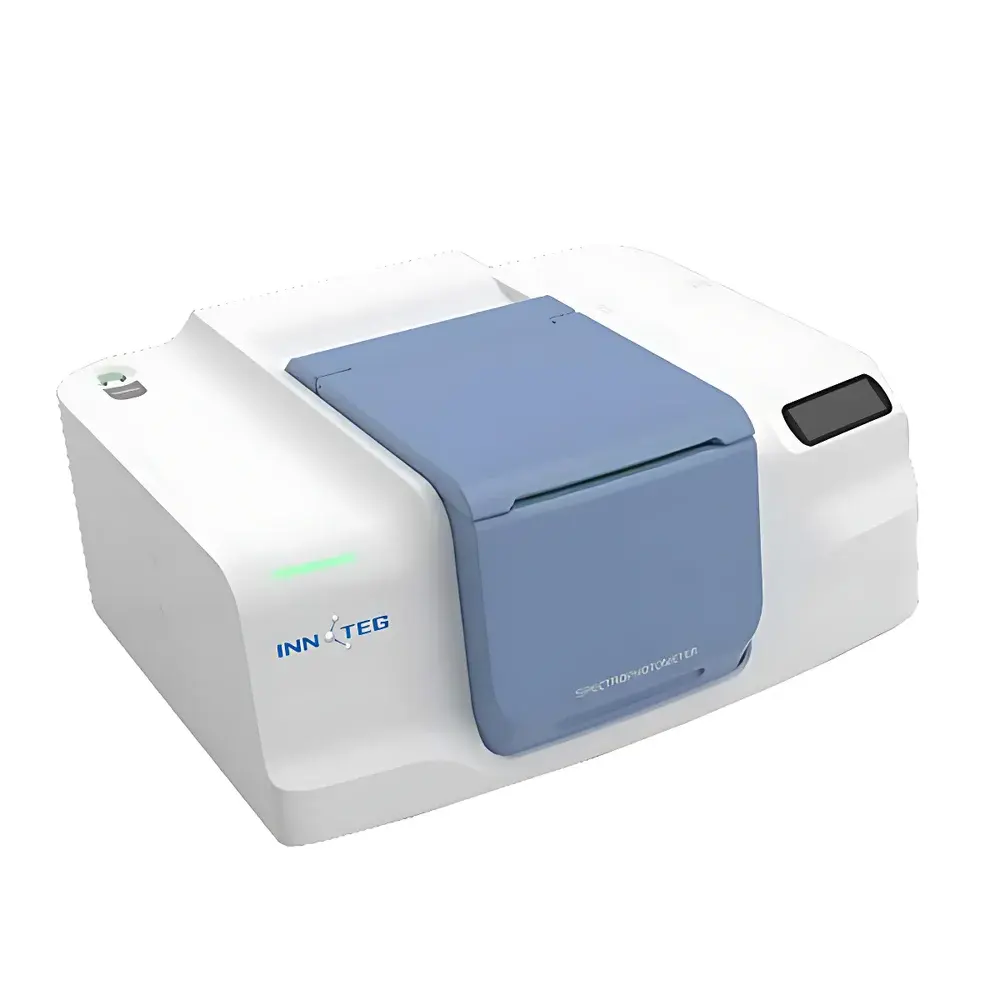
Innoteg InnoFTIR15 Fourier Transform Infrared (FTIR) Spectrometer
| Brand | Innoteg |
|---|---|
| Origin | Guangdong, China |
| Manufacturer Type | Authorized Distributor |
| Origin Category | Domestic (China-made) |
| Model | InnoFTIR15 |
| Instrument Type | Laboratory FTIR Spectrometer |
| Wavenumber Range | 7800–350 cm⁻¹ |
| Spectral Resolution | <1.0 cm⁻¹ |
| Signal-to-Noise Ratio (S/N) | 30,000:1 (peak-to-peak, 2100 cm⁻¹, 4 cm⁻¹ resolution, 60 s acquisition) |
| Beam Diameter | 15 mm |
| Beamsplitter | Multi-layer Ge-coated KBr (imported) |
| Source | High-intensity air-cooled ceramic IR source (imported) |
| Interferometer | Michelson-type, self-compensating, automated alignment |
| Detector | Low-noise deuterated triglycine sulfate (DLATGS) detector (imported) |
| Baseline Flatness | ≤0.1% T |
| Measurement Modes | Transmittance, Absorbance, Radiant Energy |
| Dimensions (W×D×H) | 486 × 406 × 230 mm |
| Sample Compartment Size | 200 × 170 × 145 mm |
| Weight | 23 kg |
| Interface | USB 2.0 |
| Power Supply | AC 220 V / DC 12 V, 40 W |
| OS Compatibility | Windows 10 (64-bit or later) |
| Operating Environment | 15–28 °C, RH <65% (non-condensing) |
Overview
The Innoteg InnoFTIR15 is a laboratory-grade Fourier Transform Infrared (FTIR) spectrometer engineered for precision molecular identification and quantitative analysis across academic, pharmaceutical, and industrial research environments. Based on the Michelson interferometer architecture, the system acquires full-spectrum interferograms via rapid scanning of a moving mirror, followed by digital Fourier transformation to generate high-fidelity absorbance or transmittance spectra. Its optical design integrates an air-cooled ceramic infrared source, multi-layer germanium-coated KBr beamsplitter, and a low-noise DLATGS detector — collectively ensuring exceptional thermal stability, long-term spectral reproducibility, and robust signal fidelity. With a wavenumber range spanning 7800–350 cm⁻¹ and resolution better than 1.0 cm⁻¹, the InnoFTIR15 meets the spectral discrimination requirements defined in ISO 18384, ASTM E1421, and USP for mid-IR characterization of organic functional groups, polymers, and inorganic materials.
Key Features
- Mechanically stable Michelson interferometer with self-compensation and automated real-time alignment correction — minimizes drift and eliminates manual recalibration during routine operation.
- High-output air-cooled ceramic IR source offering >10,000-hour operational lifetime and superior intensity stability over time, critical for long-duration kinetic or temperature-dependent studies.
- Imported low-noise DLATGS detector with optimized thermal management delivers S/N ratio of 30,000:1 (P-P, 2100 cm⁻¹, 4 cm⁻¹, 60 s), enabling reliable detection of trace analytes in complex matrices.
- Multi-layer Ge-coated KBr beamsplitter provides extended spectral throughput and enhanced resistance to ambient humidity — reducing baseline artifacts and improving long-term measurement consistency.
- Integrated environmental monitoring module displays real-time internal temperature and relative humidity, supporting proactive desiccant replacement and compliance with GLP-controlled storage protocols.
- Modular sample compartment (200 × 170 × 145 mm) accommodates standard accessories including single-reflection ATR, transmission cells (KBr, CaF₂), specular reflectance stages, and variable-angle accessories — facilitating method transfer between solid, liquid, and thin-film samples.
- Front-access push-pull inspection window above the interferometer allows visual verification of beam path integrity and quick energy-level adjustment without disassembly.
Sample Compatibility & Compliance
The InnoFTIR15 supports diverse sampling modalities without hardware modification: bulk solids (KBr pellet, Nujol mull), liquids (sealed cells, flow cells), films (on reflective substrates), and surface-bound species (via ATR). Its optical configuration complies with ISO/IEC 17025 requirements for analytical instrument qualification, and its data acquisition workflow aligns with FDA 21 CFR Part 11 principles through audit-trail-enabled software logging (user actions, parameter changes, spectrum metadata). The system satisfies minimum performance criteria outlined in EP 2.2.24 and JP 2.11 for pharmaceutical excipient identity testing, as well as ASTM D7212 for polymer identification and ASTM D6262 for asphalt binder compositional analysis.
Software & Data Management
Controlled via Windows 10–compatible native software, the InnoFTIR15 platform includes spectral preprocessing tools (zero-filling, apodization, phase correction), quantitative algorithms (classical least-squares, PLS regression), and library search engines compliant with the Sadtler IR database format. All raw interferograms and processed spectra are stored in vendor-neutral .SPA or .CSV formats. Software enforces user-level access control, electronic signatures, and timestamped audit trails — fulfilling documentation requirements under GLP and GMP frameworks. Batch processing, report generation (PDF/Excel), and integration with LIMS via ODBC are supported.
Applications
- Pharmaceutical QA/QC: Raw material identification (API vs. excipient), counterfeit drug screening, and residual solvent quantification per ICH Q2(R2).
- Polymer science: Crystallinity assessment, copolymer composition mapping, oxidation index calculation (carbonyl band at 1710 cm⁻¹), and degradation kinetics.
- Environmental analysis: Quantitative determination of petroleum hydrocarbons in soil extracts (EPA Method 418.1), free silica (quartz) detection in airborne dust (NIOSH 7602).
- Materials engineering: Hydroxyl content in fused silica (3650 cm⁻¹ band), hemispherical emittance of architectural glass coatings (ASTM C1371), and PVC/PU leather differentiation via ester vs. carbonyl peak ratios.
- Geoscience & forensics: Gemstone provenance analysis (inclusion fingerprinting), coal rank evaluation (aliphatic/aromatic C–H ratio), and mineral phase identification (e.g., carbonates, silicates).
FAQ
What is the recommended maintenance schedule for the InnoFTIR15?
Routine maintenance includes monthly desiccant replacement (indicated by humidity display ≥50% RH), quarterly optical path inspection via the front window, and annual calibration verification using NIST-traceable polystyrene film.
Does the system support ATR measurements out-of-the-box?
Yes — the large sample compartment accepts standard single-bounce diamond or ZnSe ATR accessories; no optical reconfiguration is required.
Can spectral data be exported for third-party chemometric analysis?
Absolutely — all spectra export in ASCII (.CSV) or universal spectroscopic format (.SPA), compatible with Unscrambler, MATLAB, Python (SciPy), and R-based modeling workflows.
Is the instrument suitable for regulated pharmaceutical laboratories?
Yes — when paired with validated software and documented IQ/OQ/PQ protocols, the InnoFTIR15 meets baseline requirements for identity testing under USP , EP 2.2.24, and FDA guidance on analytical instrument qualification.
What environmental conditions must be maintained during operation?
Ambient temperature must remain within 15–28 °C, with non-condensing relative humidity below 65%; active climate control is advised in high-humidity regions to preserve beamsplitter coating integrity.
Related Products






