
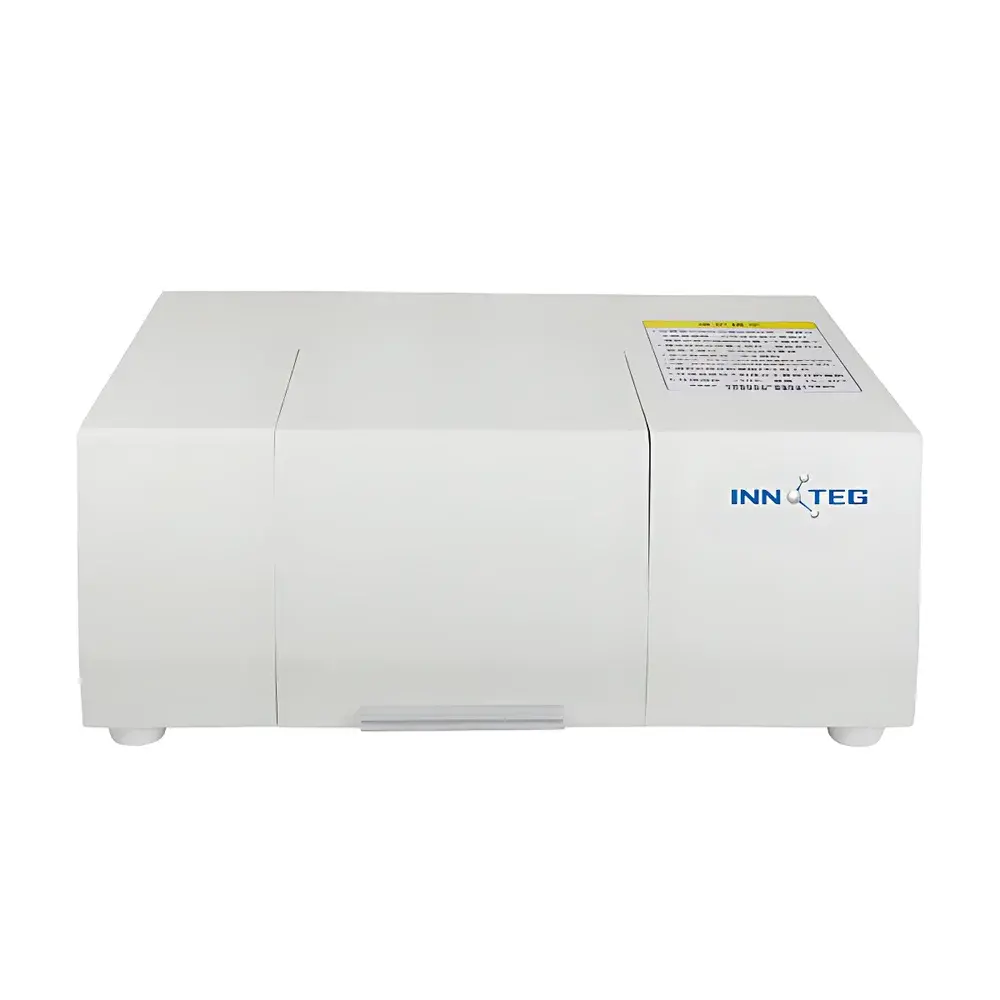
Innoteg InnoFTIR15C Fourier Transform Infrared (FTIR) Spectrometer
| Brand | Innoteg |
|---|---|
| Origin | Guangdong, China |
| Manufacturer Type | Authorized Distributor |
| Regional Classification | Domestic (China) |
| Model | InnoFTIR15C |
| Instrument Type | Laboratory FTIR Spectrometer |
| Wavenumber Range | 4000–400 cm⁻¹ |
| Signal-to-Noise Ratio (S/N) | 15,000:1 (at 4 cm⁻¹ resolution, 1 min scan) |
| Wavenumber Accuracy | ±0.01 cm⁻¹ |
| Optical System | Michelson Interferometer with KBr Multilayer Beam Splitter (Ge-coated, anti-humidity) |
| Detector | High-Sensitivity DLATGS |
| Source | High-Intensity Air-Cooled Ceramic IR Source |
| Enclosure | Electromagnetically Shielded Metal Housing |
| Included Accessory | Integrated Desiccant Dry Box |
| Software | Building Glass Compliance Suite (GB/T 2680–2021, JGJ/T 151–2008 compliant) |
Overview
The Innoteg InnoFTIR15C is a purpose-engineered Fourier Transform Infrared (FTIR) spectrometer optimized for quantitative optical and thermal property characterization of architectural glazing materials. Unlike general-purpose FTIR systems, the InnoFTIR15C implements a calibrated, traceable measurement architecture grounded in Michelson interferometry, enabling high-fidelity spectral acquisition across the mid-infrared range (4000–400 cm⁻¹). Its design centers on compliance-driven metrology—specifically targeting the determination of corrected emissivity, solar heat gain coefficient (SHGC), shading coefficient (SC), visible transmittance (Tvis), direct solar transmittance (Tsolar,dir), total solar transmittance (Tsolar,total), and ultraviolet transmittance (TUV). The instrument satisfies the spectral resolution, wavenumber accuracy (±0.01 cm⁻¹), and signal fidelity (S/N ≥ 15,000:1 at 4 cm⁻¹, 60 s acquisition) required by GB/T 2680–2021 (“Determination of Optical Properties of Flat Glass”) and JGJ/T 151–2008 (“Technical Specification for Testing Building Envelope Thermal Performance”). All optical components—including the Ge-coated, multi-layer KBr beam splitter with hydrophobic anti-humidity treatment—are selected to maintain long-term spectral stability under ambient laboratory humidity fluctuations.
Key Features
- High-stability air-cooled ceramic infrared source delivering uniform spectral radiance and extended operational lifetime without active water cooling.
- DLATGS (Deuterated L-Alanine Triglycine Sulfate) detector with thermoelectric cooling, optimized for dynamic range and low-noise response in the 4000–400 cm⁻¹ region.
- Electromagnetically shielded aluminum alloy chassis minimizing RF interference and ensuring measurement repeatability in shared lab environments with adjacent instrumentation.
- Integrated desiccant dry box (included) maintains internal optical path humidity below 5% RH during storage and idle periods—critical for preserving beam splitter coating integrity and preventing KBr hygroscopic degradation.
- Pre-aligned interferometer with precision-machined retroreflector mounts and passive thermal stabilization, reducing drift-induced baseline artifacts over extended acquisition sequences.
Sample Compatibility & Compliance
The InnoFTIR15C accepts standard 25 × 75 mm or 50 × 50 mm flat glass specimens up to 19 mm thickness, accommodating both monolithic and laminated architectural glazing configurations. Sample positioning is facilitated via a motorized, repeatable stage with adjustable tilt compensation for normal-incidence transmission measurements. All calibration protocols—including background acquisition, reference correction, and emissivity inversion—are embedded within the software workflow and aligned with ISO 9050:2003 (Glass in building — Determination of light and solar characteristics) and EN 410:2011 (Glass in building — Determination of luminous and solar characteristics). The system supports full audit trail generation per GLP and GMP requirements, with user-level access control and electronic signature capability compliant with FDA 21 CFR Part 11 Annex 11 principles.
Software & Data Management
The bundled Building Glass Analysis Suite (v3.2+) provides an integrated environment for spectral acquisition, multi-parameter regression modeling, and regulatory report generation. It implements ASTM E1980–21–based algorithms for solar-weighted transmittance calculation and applies Kirchhoff’s law-based emissivity correction using measured reflectance spectra. Data files are stored in HDF5 format with embedded metadata (operator ID, timestamp, instrument serial number, calibration certificate ID). Audit logs record all parameter changes, spectrum reprocessing events, and report exports. Role-based permissions (Administrator, Analyst, Reviewer) enforce separation of duties; all electronic signatures are cryptographically hashed and time-stamped. Raw interferograms and processed spectra are exportable in JCAMP-DX and ASCII formats for third-party validation.
Applications
- Quantitative determination of corrected hemispherical emissivity (εc) of low-emissivity (low-E) coated glass according to GB/T 2680–2021 Annex B.
- Calculation of shading coefficient (SC) and solar heat gain coefficient (SHGC) for fenestration energy modeling per ISO 15099 and ASHRAE Handbook Fundamentals.
- Verification of UV-blocking performance of laminated interlayers and spectrally selective coatings.
- Batch-to-batch quality control of coated glass products in manufacturing QA labs.
- Research into spectral selectivity of novel nanocomposite glazing materials under controlled environmental conditions.
FAQ
Does the InnoFTIR15C support ATR (Attenuated Total Reflectance) accessories for non-transparent samples?
No—the InnoFTIR15C is configured exclusively for transmission-mode analysis of planar glazing specimens. ATR functionality is not supported due to optical path constraints and regulatory scope alignment.
Is factory calibration traceable to NIM or NIST standards?
Yes—each unit ships with a Certificate of Calibration traceable to the National Institute of Metrology (NIM), China, covering wavenumber accuracy and photometric linearity verification against certified polystyrene and polyethylene reference films.
Can the software generate reports compliant with LEED or BREEAM documentation requirements?
Yes—the reporting module exports structured XML and PDF outputs containing all parameters required for LEED v4.1 MRc2 (Building Product Disclosure and Optimization – Sourcing of Raw Materials) and BREEAM Mat 03 (Responsible Sourcing of Construction Products) submissions.
What maintenance intervals are recommended for optimal performance?
We recommend quarterly verification of wavenumber accuracy using NIST-traceable reference films and annual inspection of desiccant cartridge saturation status. No optical realignment is required under normal operating conditions due to rigid interferometer mounting.
Is remote diagnostic support available for troubleshooting?
Yes—instrument firmware includes secure SSH-enabled diagnostics; Innoteg technical support can initiate encrypted remote sessions (with user consent) for log review, spectral artifact analysis, and configuration validation.
Related Products





