
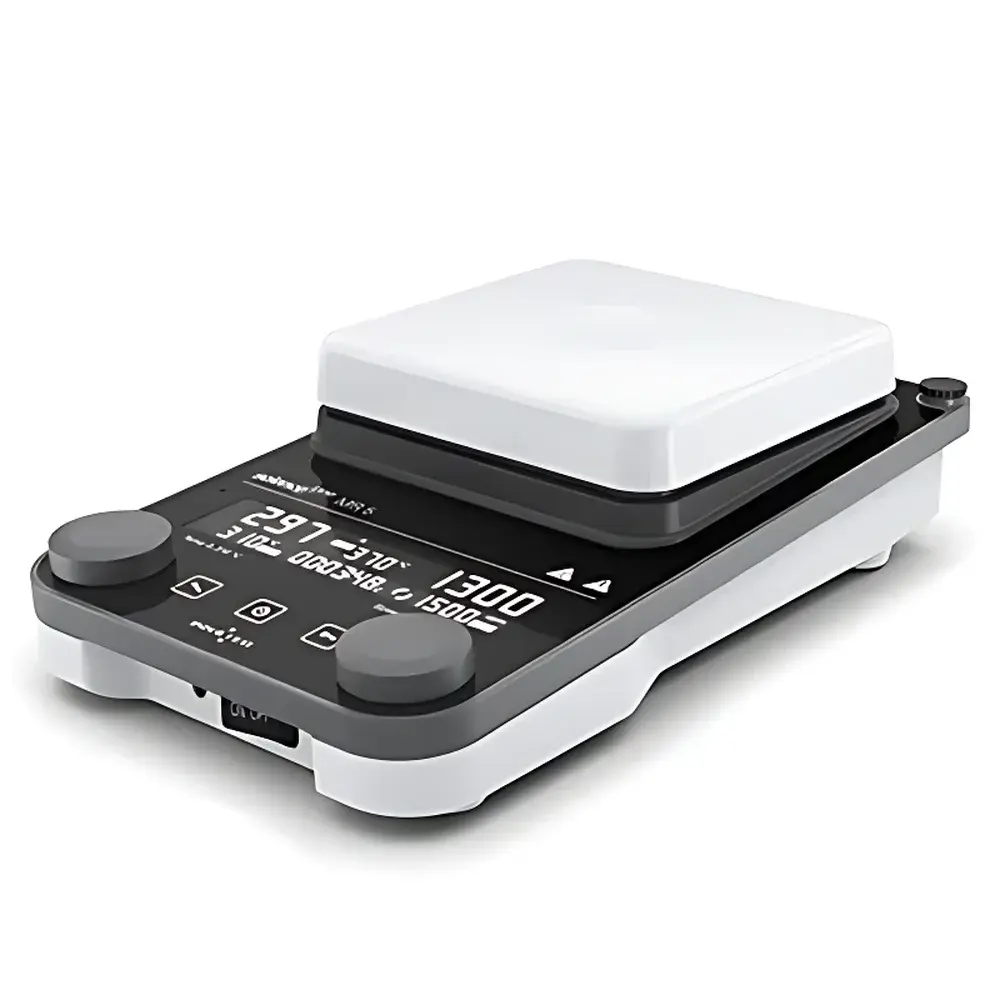
Innoteg MR5 Magnetic Stirrer with Heating
| Brand | Innoteg |
|---|---|
| Origin | Germany |
| Model | MR5 |
| Instrument Type | Magnetic Stirrer |
| Maximum Stirring Volume | 20 L |
| Speed Range | 50–1500 rpm |
| Temperature Control Range | Ambient to 310 °C |
| Heating Power | 800 W |
| Plate Material | Enamel-coated Aluminum Alloy |
| External Temperature Sensor Compatibility | PT1000, ETS-D5, ETS-D6 |
| Safety Temperature Limit Adjustable | 50–370 °C |
| Operating Modes | 3 Safety-Configurable Modes |
| Stirring Direction | Clockwise/Counterclockwise Selectable |
| Intermittent Operation Mode | Yes |
| Viscosity Trend Monitoring | Real-time Display via LCD |
Overview
The Innoteg MR5 Magnetic Stirrer with Integrated Heating is a precision-engineered laboratory instrument designed for reliable, reproducible mixing and temperature-controlled reactions in research, quality control, and analytical laboratories. Based on the principle of magnetic coupling—where a rotating permanent magnet beneath the heated plate induces rotation of a magnetic stir bar immersed in the sample—the MR5 delivers consistent torque transfer without mechanical contact, eliminating seal wear and contamination risks associated with overhead stirrers. Its robust enamel-coated aluminum alloy heating plate ensures rapid thermal response, uniform heat distribution, and high resistance to chemical corrosion from common solvents, acids, and bases. Engineered for applications requiring simultaneous heating and stirring up to 20 L volumes, the MR5 supports demanding protocols including dissolution testing, catalyst activation, polymerization initiation, and crystallization studies where precise thermal and rotational control is critical.
Key Features
- High-power 800 W heating system enabling stable temperature maintenance from ambient to 310 °C with ±1 °C typical accuracy (at setpoint, under standard load conditions)
- Wide-speed range of 50–1500 rpm with digital feedback control, ensuring consistent rotational performance across viscosity gradients
- Bi-directional stirring capability (clockwise/counter-clockwise) optimized for controlled nucleation and crystal growth in supersaturated solutions
- Programmable intermittent operation mode allowing user-defined on/off cycles—ideal for stepwise reaction kinetics or energy-sensitive samples
- LCD display showing real-time setpoints and actual values for both speed and plate temperature; optional external temperature monitoring via PT1000 or ETS-D5/D6 probes enables sample-core temperature validation
- Triple-layer safety architecture: adjustable overtemperature cutoff (50–370 °C), automatic thermal shutdown, and three configurable safety modes compliant with IEC 61010-1 for laboratory equipment
- Chemically inert enamel coating on aluminum alloy plate provides long-term durability against aggressive reagents while maintaining optimal thermal conductivity
Sample Compatibility & Compliance
The MR5 accommodates a broad range of sample types—including aqueous buffers, organic solvents, suspensions, and low-to-medium viscosity emulsions—within its 20 L maximum capacity. It is suitable for use with standard glassware (e.g., beakers, flasks, crystallization dishes) placed directly on the plate surface. The device conforms to international safety standards IEC 61010-1:2010 and carries CE marking for electromagnetic compatibility (EMC) and low-voltage directive compliance. While not certified for hazardous area use (e.g., ATEX), its design meets general laboratory requirements under GLP and ISO/IEC 17025 environments when operated within specified parameters. No intrinsic calibration certificate is supplied; users are advised to perform periodic verification using NIST-traceable thermometers and tachometers per internal SOPs.
Software & Data Management
The MR5 operates as a standalone instrument with no embedded PC interface or proprietary software. All parameter inputs and status monitoring occur via the front-panel LCD interface. For laboratories requiring audit trails or electronic record retention, integration with external data loggers (via analog voltage outputs or optional RS232/USB modules, sold separately) supports 21 CFR Part 11–compliant workflows when paired with validated third-party acquisition platforms. The unit retains last-used settings after power cycling, facilitating repeatable method execution without reconfiguration.
Applications
- Dissolution testing in pharmaceutical QC labs per USP and Ph. Eur. 2.9.3 guidelines
- Preparation of homogeneous catalyst slurries for heterogeneous reaction screening
- Controlled crystallization experiments requiring directional shear and thermal ramping
- Buffer equilibration and reagent blending in molecular biology and biochemistry workflows
- Heating/stirring of viscous media such as agarose gels, polymer precursors, or ceramic slurries
- Method development for ASTM D2196 (viscosity of paints) and ISO 2555 (resin solutions) where thermal stability during measurement is essential
FAQ
Does the MR5 support external temperature probe feedback for closed-loop control?
Yes—it accepts PT1000, ETS-D5, and ETS-D6 sensors for sample-integrated temperature monitoring; however, active PID correction based on probe input requires optional firmware upgrade (contact technical support for compatibility details).
Can the MR5 be used under inert atmosphere or in gloveboxes?
The unit is not rated for inert gas environments; operation inside gloveboxes is possible only if the base unit remains outside and only the plate surface extends through an airlock port—verify thermal clearance and electrical feedthrough specifications prior to installation.
Is calibration documentation provided with shipment?
No factory calibration certificate is included. Users must establish traceable calibration procedures aligned with their quality management system (e.g., ISO/IEC 17025) using accredited reference standards.
What maintenance is recommended for long-term reliability?
Wipe the enamel plate with non-abrasive, pH-neutral cleaner after each use; inspect stir bars for chipping or demagnetization quarterly; verify speed accuracy annually using optical tachometry.



