
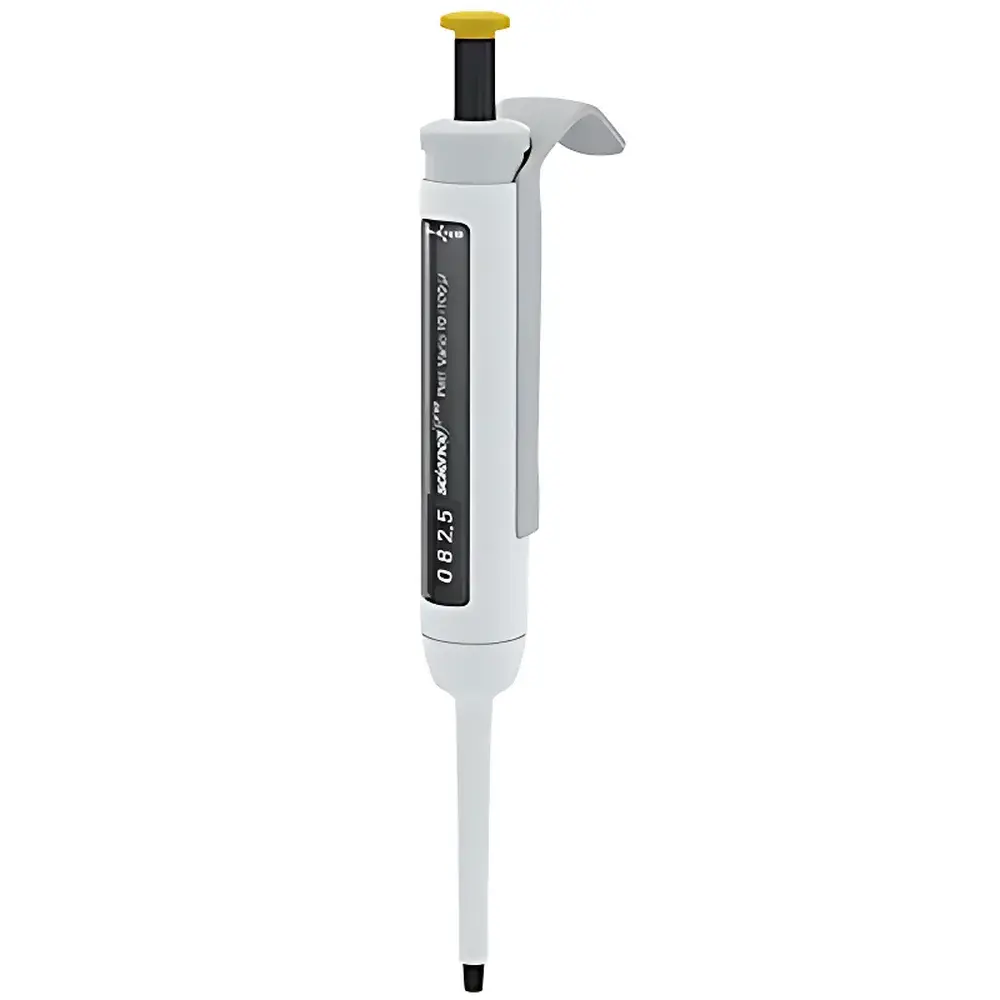
INNOTEG Pett Vario Manual Single-Channel Adjustable-Volume Pipette
| Brand | INNOTEG |
|---|---|
| Origin | Germany |
| Model | Pett Vario |
| Type | Manual Single-Channel Pipette |
| Maximum Volume | 10 mL |
| Sterilization | Full-Autoclavable (121°C, 20 min) |
| Tip Compatibility | Universal Conical Tips (ISO 8655-compliant) |
| Display | Large Backlit LCD |
| Ergonomic Options | Interchangeable Grip Inserts (Soft-Grip Polymer & Textured Rubber) |
| Piston & Cone Coating | Diamond-Like Carbon (DLC) |
| Volume Range Coverage | 0.1–2 µL to 1–10 mL (model-dependent) |
Overview
The INNOTEG Pett Vario is a precision-engineered manual single-channel adjustable-volume pipette designed for high-reproducibility liquid handling in regulated and research-intensive laboratory environments. Built upon ISO 8655-compliant metrological principles, it employs a gas-tight air displacement mechanism with a DLC-coated piston and conical tip interface—ensuring minimal hysteresis, low carryover, and long-term volumetric stability across repeated cycles. Each unit undergoes robotic calibration at the factory under controlled environmental conditions (20 ± 1 °C, 45–65% RH), traceable to national standards, delivering as-shipped accuracy within ±0.8% CV for volumes ≥10% of nominal capacity. Its full-autoclavability (121 °C, 20 min, saturated steam) supports compliance with GLP, GMP, and clinical lab workflows requiring routine decontamination without disassembly.
Key Features
- Fully autoclavable design—entire pipette body, including internal piston assembly and tip ejector, withstands standard steam sterilization cycles without recalibration or performance degradation.
- Diamond-like carbon (DLC) coating on both piston and cone surface—enhances wear resistance, reduces surface adhesion of viscous or protein-rich samples, and maintains dimensional integrity over >100,000 actuation cycles.
- Ergonomic modularity—two interchangeable grip inserts included: soft-grip polymer for extended use and textured rubber for high-friction control; thermally isolating design minimizes heat transfer from hand to pipette barrel, mitigating thermal expansion effects on volume delivery.
- Large, non-reflective backlit LCD display—positioned for unobstructed line-of-sight reading during right- or left-handed operation; digits remain legible under hood lighting and ambient lab illumination.
- Tool-free volume adjustment—smooth dual-knob system enables precise setting across the full range (e.g., 1–10 mL variant); tactile feedback and audible click confirm each increment change, reducing mis-setting risk.
- ISO 8655-compliant tip ejection force—consistent, low-force ejection prevents tip leakage or accidental dispensing during removal; compatible with universal conical tips meeting ISO 8655-3 mechanical interface specifications.
Sample Compatibility & Compliance
The Pett Vario is validated for aqueous solutions, buffers, diluted acids/bases, ethanol/water mixtures, and low-viscosity biological reagents (e.g., serum, cell culture media, PCR master mixes). It is not recommended for highly volatile solvents (e.g., chloroform, acetone), concentrated strong oxidizers, or viscous liquids (>100 mPa·s) without pre-wetting and slow aspiration/dispense protocols. All models comply with ISO 8655 Parts 1–5 (volumetric performance, mechanical requirements, testing methods), EN ISO 13485:2016 (medical device quality management), and support audit-ready documentation for FDA 21 CFR Part 11–aligned electronic records when used with compliant LIMS or ELN systems.
Software & Data Management
While the Pett Vario operates manually without embedded electronics or connectivity, its calibration history, maintenance logs, and verification reports integrate seamlessly into laboratory quality management systems. Each unit ships with a unique serial-numbered calibration certificate (traceable to PTB or DAkkS-accredited reference standards), including gravimetric test data at three volume points (10%, 50%, and 100% of maximum). Users may document routine verification (e.g., daily/weekly checks per ISO 8655-6) using standardized forms compatible with paper-based or electronic QMS platforms supporting GLP/GMP record retention requirements.
Applications
- Quantitative sample preparation for HPLC, GC, and ICP-MS analysis—where consistent delivery of 1–10 mL diluent volumes impacts calibration curve linearity.
- Cell culture workflow—accurate transfer of media, trypsin, and cryoprotectants across multiwell plates and bioreactor inoculation steps.
- Clinical diagnostics—reagent dispensing in ELISA, lateral flow assay development, and molecular pathology workflows requiring ISO 15189-aligned pipetting consistency.
- Method validation studies—supporting precision testing (repeatability, intermediate precision) per ICH Q2(R2) guidelines when paired with certified reference weights and Class A glassware.
- Teaching laboratories—robust construction and intuitive volume adjustment support student training in fundamental pipetting technique and metrological awareness.
FAQ
Is the Pett Vario suitable for use with corrosive or organic solvents?
It is validated for common aqueous and polar solvents (e.g., ethanol, methanol, PBS, Tris-HCl). Avoid prolonged exposure to halogenated hydrocarbons, concentrated mineral acids, or strong bases; consult the Chemical Compatibility Guide before use.
Does the pipette require recalibration after autoclaving?
No—full autoclaving (121 °C, 20 min) has been validated to maintain volumetric accuracy within ISO 8655 tolerance limits; no post-sterilization recalibration is necessary.
Can the grip inserts be replaced with third-party alternatives?
Only INNOTEG-certified grip inserts are guaranteed to preserve thermal isolation properties and ergonomic alignment; use of non-OEM parts may compromise metrological integrity and void warranty coverage.
What volume ranges are available in the Pett Vario series?
Six models cover overlapping ranges: 0.1–2 µL, 0.5–10 µL, 2–20 µL, 10–100 µL, 100–1000 µL, and 1–10 mL—all featuring identical ergonomics, DLC coating, and autoclave compatibility.
How is traceability maintained for calibration records?
Each pipette includes a serialized calibration certificate issued by an ISO/IEC 17025-accredited laboratory, with uncertainty budgets reported per EURAMET cg-18 and NIST SP 256 guidelines. Digital copies are available upon request for integration into institutional QA archives.
Related Products



