
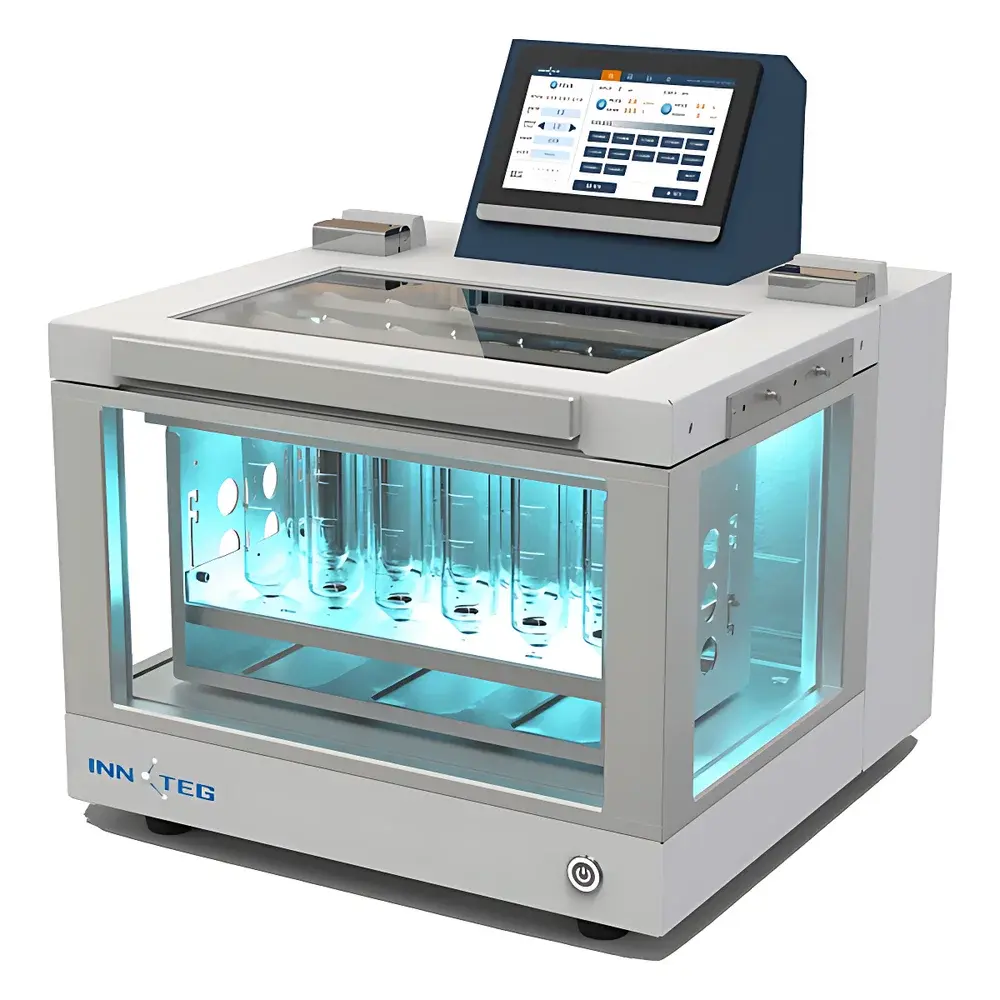
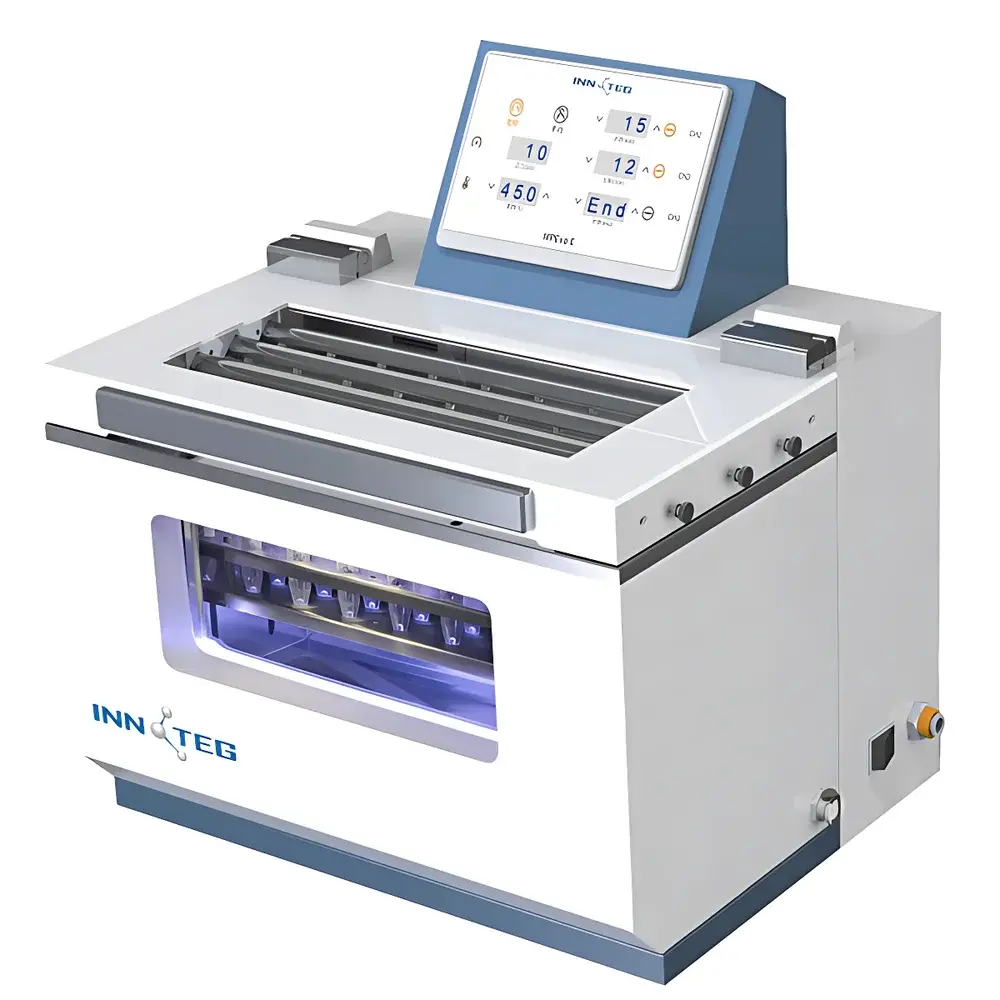
INNOTEG SmartEvap Series Tilted-Flow Parallel Nitrogen Evaporator
| Brand | INNOTEG |
|---|---|
| Origin | Guangdong, China |
| Manufacturer Type | Authorized Distributor |
| Regional Classification | Domestic (China) |
| Model | SmartEvap-E / SmartEvap-G / SmartEvap-Q |
| Instrument Type | Vacuum-Assisted Parallel Nitrogen Evaporator |
| Temperature Control | PID-regulated, ±1 °C accuracy |
| Gas Delivery | Non-submerged tilted nitrogen nozzles with vortex airflow generation |
| Sample Positioning | Independent thermal zones per position |
| Flow Uniformity | ≤5% inter-channel flow deviation |
| Quantitation | Integrated liquid-level sensors per position, auto-stop on target volume |
| Compatible Vessels | 15 mL centrifuge tubes (down to ~0.2 mL), 50/100/200 mL specialized evaporation tubes |
| Compliance | Designed for GLP-compliant workflows |
Overview
The INNOTEG SmartEvap Series is a vacuum-assisted parallel nitrogen evaporator engineered for high-reproducibility solvent removal in regulated laboratory environments. Unlike conventional vertical nitrogen blow-down systems, the SmartEvap employs a patented tilted-flow vortex gas delivery architecture: nitrogen is directed at an oblique angle across the surface of each sample tube, inducing controlled rotational turbulence within the liquid phase. This hydrodynamic mechanism enhances mass transfer at the air–liquid interface while minimizing solute adhesion to tube walls—thereby improving analyte recovery and reducing carryover risk. The system operates under programmable vacuum conditions (typically 5–15 kPa absolute) to lower solvent boiling points, enabling gentle yet efficient concentration of thermally labile compounds. Its modular platform accommodates three configurations—SmartEvap-E (entry-level), SmartEvap-G (GLP-optimized), and SmartEvap-Q (quantitative endpoint-focused)—each sharing the same core fluidic and thermal architecture.
Key Features
- Tilted-flow nitrogen delivery: Nozzle tips remain external to sample vessels, eliminating physical contact, cross-contamination, and post-run cleaning requirements.
- PID-controlled heating block: Independent temperature regulation per sample position ensures ≤±1 °C uniformity across all channels—critical for method reproducibility in multi-sample workflows.
- Vortex-enhanced evaporation: Oblique gas impingement generates laminar rotational flow inside tubes, increasing effective surface area and accelerating solvent removal without foaming or splashing.
- Quantitative endpoint detection: Capacitive liquid-level sensors monitor volume loss in real time per channel; system triggers automatic gas shutoff or transitions to hold mode upon reaching user-defined final volumes (e.g., 0.2 mL in 15 mL centrifuge tubes).
- Modular tube adaptability: Interchangeable sub-base/mother rack assemblies allow rapid reconfiguration for varying vessel heights—no disassembly or recalibration required.
- Low-flow nitrogen optimization: Precision-machined micro-nozzles reduce typical N₂ consumption by up to 40% versus standard parallel evaporators, supporting cost-efficient operation over extended batch runs.
Sample Compatibility & Compliance
The SmartEvap platform accepts standardized consumables including 15 mL conical centrifuge tubes, 50 mL polypropylene tubes, and custom-designed tapered evaporation tubes (200 mL, 100 mL, 50 mL). All configurations maintain consistent thermal and pneumatic performance across vessel types. From a regulatory standpoint, the SmartEvap-G and SmartEvap-Q models are designed to support compliance with ISO/IEC 17025 analytical validation requirements and align with Good Laboratory Practice (GLP) principles—including traceable calibration records, instrument usage logs, and electronic signature support when integrated with INNOTEG LabControl Suite. While the hardware itself does not require FDA 510(k) clearance (as a Class I general-purpose lab device), its operational parameters and data handling protocols are structured to meet documentation expectations under 21 CFR Part 11 when used in pharmaceutical QC or clinical research settings.
Software & Data Management
The SmartEvap series operates via embedded firmware with optional PC-based control through INNOTEG LabControl Suite (v3.2+). This validated application provides full parameter logging—including setpoints, actual temperatures, vacuum levels, elapsed time, and sensor-triggered events—with timestamped, immutable records stored in encrypted SQLite databases. Audit trails capture operator ID, method changes, and system alerts. Export options include CSV and PDF reports compliant with LIMS integration standards. For laboratories requiring electronic signatures, LabControl Suite supports role-based access control and digital signing workflows aligned with ALCOA+ data integrity principles.
Applications
The SmartEvap is routinely deployed in analytical chemistry laboratories performing sample preparation prior to GC, HPLC, LC-MS/MS, and ICP-MS analysis. Its precision and low carryover make it especially suitable for residue analysis in food safety testing (e.g., pesticide multiresidue methods per EU SANTE/11312/2021), pharmaceutical impurity profiling (ICH Q2(R2)-aligned method development), environmental monitoring of PAHs and PCBs in water and soil extracts, forensic toxicology (blood, urine, tissue homogenates), and biomarker quantification in clinical proteomics and metabolomics workflows. The ability to achieve consistent sub-0.5 mL endpoints without manual intervention significantly reduces technician variability in high-throughput screening operations.
FAQ
Does the SmartEvap require external vacuum pumping equipment?
Yes—a compatible vacuum pump (≤15 kPa ultimate pressure, oil-free preferred) must be connected via standard 8 mm barbed fittings.
Can the system be validated for GxP use?
Yes—the SmartEvap-G and SmartEvap-Q models include IQ/OQ documentation templates and support third-party qualification services; full PQ depends on site-specific SOPs and integration with validated software.
Is nitrogen purity critical for optimal performance?
For trace-level analyses, ≥99.999% (5.0 grade) nitrogen is recommended to avoid background interference; standard 99.99% (4.0 grade) suffices for most routine applications.
What maintenance intervals are recommended?
Heating block calibration verification every 6 months; nozzle inspection and cleaning every 200 operational hours; vacuum line filter replacement quarterly.
Are consumables proprietary or industry-standard?
All sample tubes and racks conform to ANSI/SLAS dimensional standards; only the quantitative sensor modules are proprietary.



