
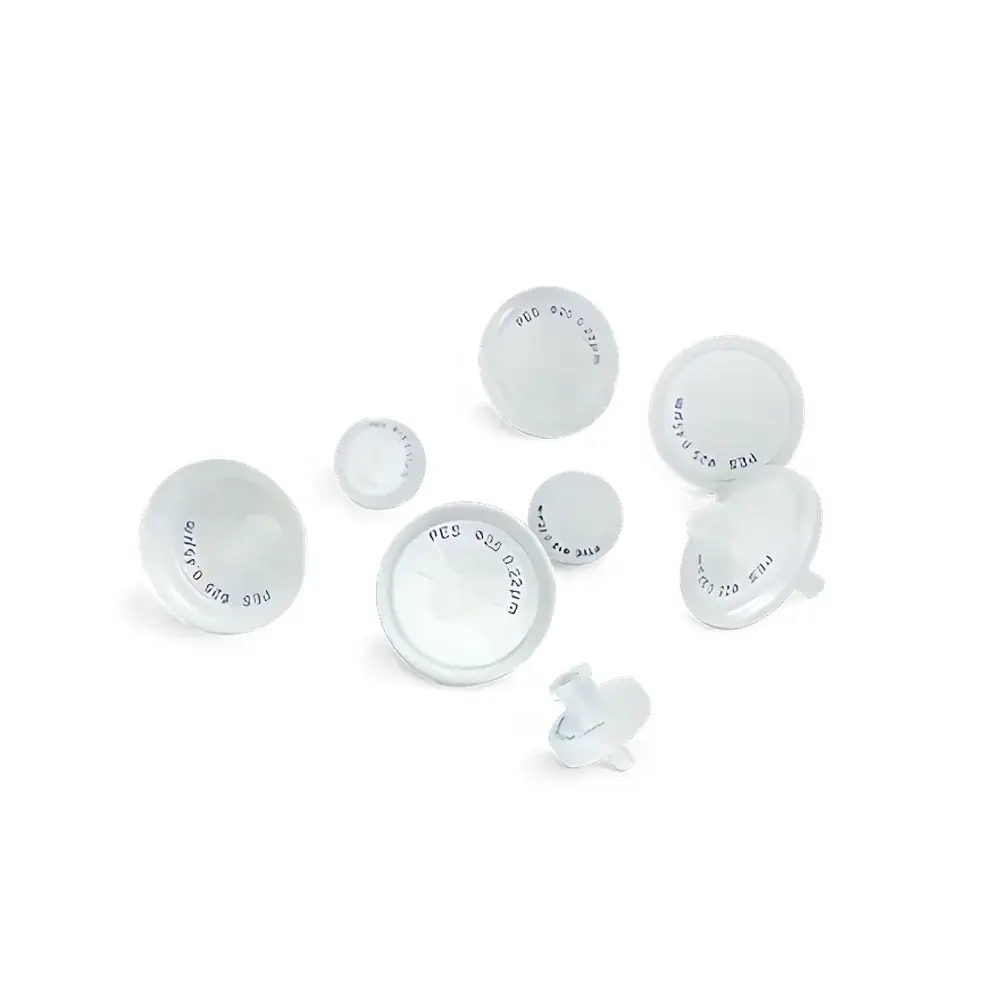
INNOTEG Syringe Filters
| Brand | INNOTEG |
|---|---|
| Origin | Guangdong, China |
| Manufacturer Type | Authorized Distributor |
| Product Category | Domestic |
| Model | INNOTEG Syringe Filters |
| Pricing | Available Upon Request |
| Membrane Materials | Nylon 66, Hydrophobic PTFE, Hydrophilic PTFE, Polyethersulfone (PES), Polyvinylidene Fluoride (PVDF), Mixed Cellulose Ester (MCE) |
| Pore Sizes | 0.22 µm and 0.45 µm |
| Diameters | 13 mm and 25 mm |
| Connector Type | Luer Lock / Luer Slip Compatible |
| Packaging | 100 units per canister |
Overview
INNOTEG Syringe Filters are precision-engineered single-use filtration devices designed for reliable sample preparation in pharmaceutical quality control, biopharmaceutical process development, and analytical laboratory workflows. These filters operate on the principle of pressure-driven membrane filtration—utilizing controlled manual or automated syringe force to separate particulates, microorganisms, and undissolved aggregates from liquid samples prior to injection into HPLC, UHPLC, GC, or microbial enumeration systems. Engineered for compatibility with both aqueous and organic solvents, each filter features a low-extractable, high-flow membrane housed in a chemically inert polypropylene housing with integrated pre-filtration support. Their consistent pore structure and validated integrity ensure reproducible filtration performance critical for regulatory-compliant testing under USP , USP , ISO 8573-7, and EU GMP Annex 1 requirements.
Key Features
- Five certified membrane chemistries: Polyethersulfone (PES) for broad-spectrum aqueous compatibility; Mixed Cellulose Ester (MCE) for general-purpose sterilization-grade filtration; Nylon 66 for enhanced chemical resistance in organic solvents; Hydrophobic and hydrophilic PTFE for aggressive solvent applications; and PVDF for high-protein binding resistance and low extractables.
- Two standardized pore sizes (0.22 µm and 0.45 µm) meet common validation thresholds for sterile filtration (0.22 µm) and particulate removal (0.45 µm), aligned with ASTM F838-22 and ISO 4074 for bacterial retention testing.
- Dual diameter options (13 mm and 25 mm) accommodate varying sample volumes—from small-volume QC injections (≤5 mL) to larger preparative filtrations (up to 100 mL)—while maintaining laminar flow profiles and minimizing hold-up volume.
- Luer-lock and Luer-slip compatible design ensures secure, leak-free connection to standard glass or plastic syringes (1–60 mL), eliminating cross-contamination risks and operator variability during manual filtration.
- Manufactured under cleanroom conditions (ISO Class 7), each batch undergoes rigorous quality control including bubble point testing, extractables profiling (per USP ), and endotoxin testing (<0.25 EU/mL), supporting GLP/GMP documentation requirements.
Sample Compatibility & Compliance
INNOTEG Syringe Filters demonstrate verified compatibility across pharmacopeial-relevant matrices—including buffer solutions, cell culture supernatants, protein formulations, organic mobile phases (acetonitrile, methanol, THF), and viscous excipients (e.g., polysorbate 80, propylene glycol). Membrane selection is guided by application-specific criteria: PES for routine aqueous HPLC sample cleanup; hydrophilic PTFE for acidic or basic aqueous solutions requiring low protein binding; hydrophobic PTFE for non-aqueous solvents; and PVDF for high-molecular-weight biologics where minimal adsorption is essential. All configurations comply with ISO 13485:2016 manufacturing standards and support audit readiness for FDA 21 CFR Part 11–enabled data management systems when used within validated SOPs.
Software & Data Management
While inherently hardware-based, INNOTEG Syringe Filters integrate seamlessly into digitally governed laboratory environments. Each product SKU (e.g., 51-0001, 51-0022) is traceable via serialized lot numbers enabling full chain-of-custody documentation in LIMS platforms such as LabWare LIMS or Thermo Fisher SampleManager. Batch certificates of analysis (CoA), including pore size verification reports, bubble point values, and bioburden test results, are available upon request in PDF or XML format—facilitating electronic record retention per ALCOA+ principles. For automated workflows, filters are compatible with robotic liquid handlers (e.g., Hamilton STAR, Tecan Fluent) equipped with syringe-based dispensing modules.
Applications
- HPLC/UHPLC sample clarification prior to column injection to prevent frit clogging and backpressure spikes
- Sterile filtration of culture media, vaccines, and ophthalmic solutions under aseptic processing conditions
- Pre-filtration of environmental water samples for EPA Method 1603 (E. coli detection) and ISO 9308-1
- Removal of particulates from nanoparticle suspensions and liposomal drug formulations prior to DLS or TEM analysis
- Final filtration of mobile phase solvents to extend pump seal life and reduce system downtime
- Microbial recovery in membrane filtration assays per USP and ISO 11731 for water and pharmaceutical product testing
FAQ
What is the maximum recommended operating pressure for INNOTEG syringe filters?
The polypropylene housing and membrane support structure are rated for up to 6 bar (87 psi) at 25°C—sufficient for manual syringe use and compatible with most benchtop vacuum manifolds.
Are these filters certified for sterility?
Sterile versions (gamma-irradiated, SAL ≤10⁻⁶) are available under separate SKUs; non-sterile filters are intended for use in controlled environments where terminal sterilization is performed post-filtration.
Can I use hydrophobic PTFE filters for aqueous solutions?
Only after pre-wetting with alcohol (e.g., 70% IPA) followed by aqueous equilibration; hydrophilic PTFE or PES membranes are preferred for direct aqueous use.
Do INNOTEG syringe filters meet USP particulate matter testing requirements?
Yes—when used with validated methods and appropriate membrane selection (0.45 µm PES or MCE), they fulfill sample preparation criteria for light obscuration and microscopic particle count testing.
Is there lot-to-lot consistency in pore size distribution?
Each production lot undergoes scanning electron microscopy (SEM) imaging and bubble point correlation testing to ensure nominal pore size tolerance remains within ±5% of stated value (0.22 or 0.45 µm).





