
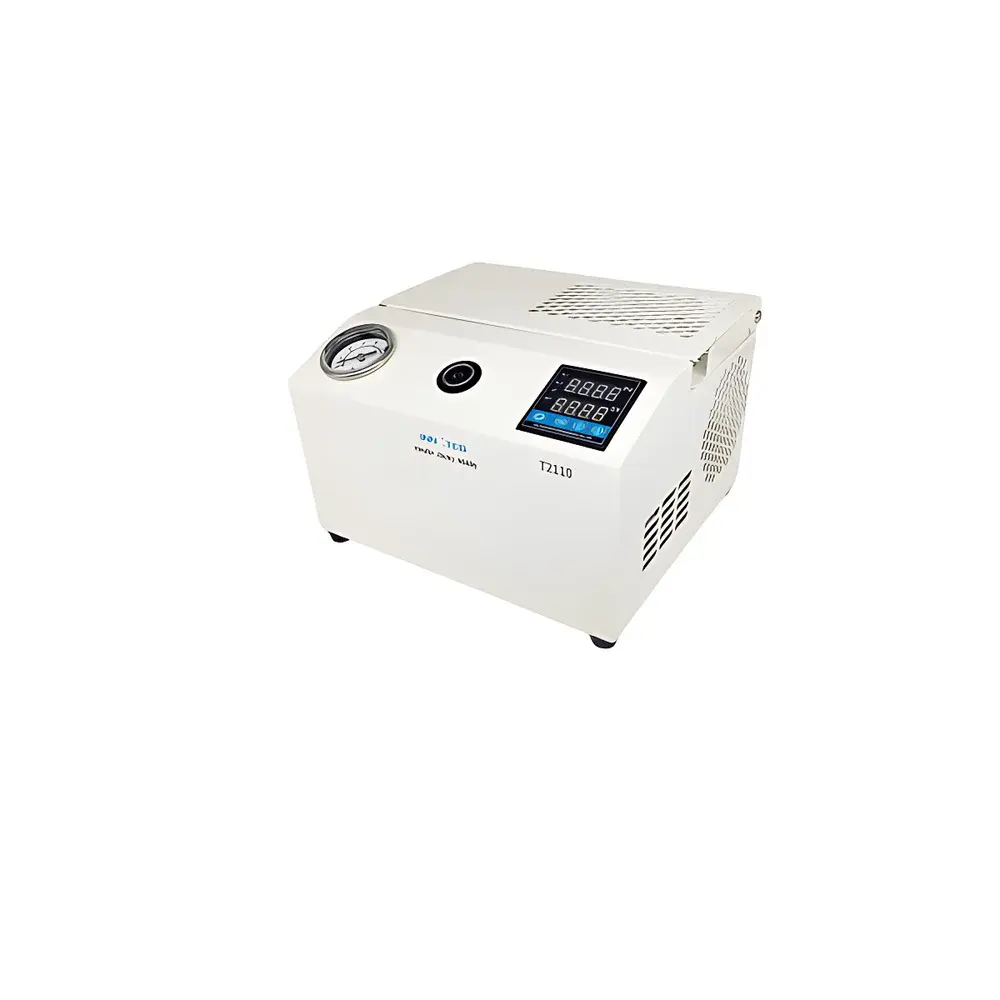
INNOTEG T2110 Adsorption Tube Aging Instrument
| Brand | INNOTEG |
|---|---|
| Origin | Guangdong, China |
| Manufacturer Type | Authorized Distributor |
| Country of Origin | China |
| Model | T2110 |
| Temperature Range | Ambient to 400 °C |
| Gas Flow Rate | 0–200 mL/min |
| Tube Capacity | 10 tubes |
Overview
The INNOTEG T2110 Adsorption Tube Aging Instrument is a dedicated thermal conditioning system engineered for the rigorous pretreatment of sorbent-packed adsorption tubes prior to thermal desorption–gas chromatography/mass spectrometry (TD–GC/MS) analysis. It operates independently from the analytical GC/MS platform, eliminating cross-contamination risks during tube conditioning and ensuring baseline integrity for trace-level volatile organic compound (VOC) and semi-volatile organic compound (SVOC) quantification. The instrument applies controlled resistive heating combined with precisely regulated inert gas purging—typically high-purity nitrogen—to thermally desorb residual contaminants, moisture, and volatile background species from sorbent beds (e.g., Tenax TA, Carbopack B/C, graphitized carbon black). This process stabilizes tube performance, enhances reproducibility across batches, and extends sorbent lifetime by preventing irreversible adsorption site saturation or thermal degradation during subsequent analytical runs.
Key Features
- Tool-free plug-and-play tube insertion and removal via modular bayonet-style fixtures—enabling rapid tube exchange without mechanical fasteners or alignment tools.
- Dual-stage overtemperature protection: independent thermal cutoff switch and microprocessor-based temperature monitoring ensure automatic power interruption if setpoint exceeds safety threshold (≥410 °C).
- Dedicated moisture purge mode: programmable low-temperature (50–120 °C), high-flow (150–200 mL/min) nitrogen sweep to remove physisorbed water prior to high-temperature aging—critical for hydrophobic sorbents and humidity-sensitive applications.
- Integrated real-time timer with audible alert (programmable buzzer): supports up to 99 hours 59 minutes countdown with pause/resume functionality and non-volatile memory retention after power loss.
- High-pressure, low-flow gas distribution architecture: maintains ±1.5% flow stability across full 0–200 mL/min range using precision mass flow control valves and pressure-compensated manifold design.
- Multi-parameter front-panel display: simultaneously shows actual/setpoint temperature, elapsed time, remaining time, current flow rate, and system pressure—no menu navigation required.
- Integrated analog pressure gauge (0–0.6 MPa range): provides immediate visual verification of inlet gas supply integrity and regulator output consistency.
- Parallel equal-flow gas routing: proprietary multi-channel distributor ensures identical volumetric flow (±3 mL/min) to each of up to 10 tubes—no flow redistribution or inter-tube interference—even under partial loading (1–10 tubes active).
- Rapid thermal ramping: achieves 350 °C from ambient in ≤180 seconds using optimized heater geometry and low-thermal-mass aluminum block construction.
- Passive accelerated cooldown: engineered heat-sink design and thermal isolation enable ambient-temperature recovery within 10 minutes post-cycle—no active cooling required, minimizing standby energy consumption.
Sample Compatibility & Compliance
The T2110 accommodates standard 1/4″ OD stainless steel or glass adsorption tubes (6 cm × 1/4″, 9 cm × 1/4″, and 11 cm × 1/4″ formats), including fused-silica-lined variants. It supports all common sorbent combinations used in EPA Method TO-17, ISO 16017-1, and ASTM D6196 workflows. While not certified as a GLP/GMP instrument per se, its operational repeatability (±0.5 °C temperature uniformity across all tube positions; ±2 mL/min flow consistency) meets method validation requirements for laboratory-developed protocols. Data logging capability (via optional RS-232/USB interface) enables audit-ready records compliant with FDA 21 CFR Part 11 when paired with validated third-party software.
Software & Data Management
The T2110 operates as a standalone benchtop unit with embedded firmware controlling all thermal and pneumatic parameters. Optional serial or USB connectivity allows integration into laboratory information management systems (LIMS) or custom Python/Matlab scripts for automated batch logging. Exported CSV files include timestamp, setpoint temperature, actual temperature (per zone average), total elapsed time, final pressure reading, and cycle completion status—sufficient for internal QA documentation and ISO/IEC 17025 accreditation reporting. No proprietary software installation is required for basic operation; advanced scheduling and remote monitoring require external host configuration.
Applications
- Ambient and stack air monitoring per EPA TO-17 for C2–C12 VOCs
- Indoor air quality assessment (IAQ) in commercial buildings, schools, and healthcare facilities
- Forensic trace evidence analysis of arson accelerants, illicit drug volatiles, and decomposition markers
- Consumer product emissions testing (e.g., furniture, flooring, adhesives) under CA Prop 65 and EU REACH Annex XVII
- Flavor and fragrance profiling in food, beverage, and cosmetic matrices
- In-vehicle air quality evaluation per ISO 12219-1 and GB/T 27630–2011 standards
FAQ
What sorbent tube formats are compatible with the T2110?
Standard 1/4″ OD metal or glass tubes with lengths of 6 cm, 9 cm, or 11 cm—including multi-bed configurations—are fully supported. Custom-length tubes may be accommodated with optional adapter inserts.
Can the T2110 be used with helium instead of nitrogen?
Yes—provided gas purity ≥99.999% and pressure regulation meets instrument inlet specifications (0.2–0.6 MPa); helium flow calibration must be performed separately due to viscosity differences.
Is validation documentation provided for method transfer?
INNOTEG supplies factory calibration certificates for temperature and flow sensors (traceable to NIST standards), IQ/OQ templates, and a complete user manual with maintenance schedules and failure mode analysis.
How often should the internal filter be replaced?
Under normal use (≤5 cycles/day), the particulate filter requires replacement every 6 months; more frequent replacement is recommended in high-dust environments or when operating above 350 °C for extended durations.
Does the T2110 support programmable multi-step aging protocols?
No—the instrument executes single-setpoint thermal conditioning only. Multi-ramp protocols require external controller integration via analog I/O or digital communication interfaces.




