
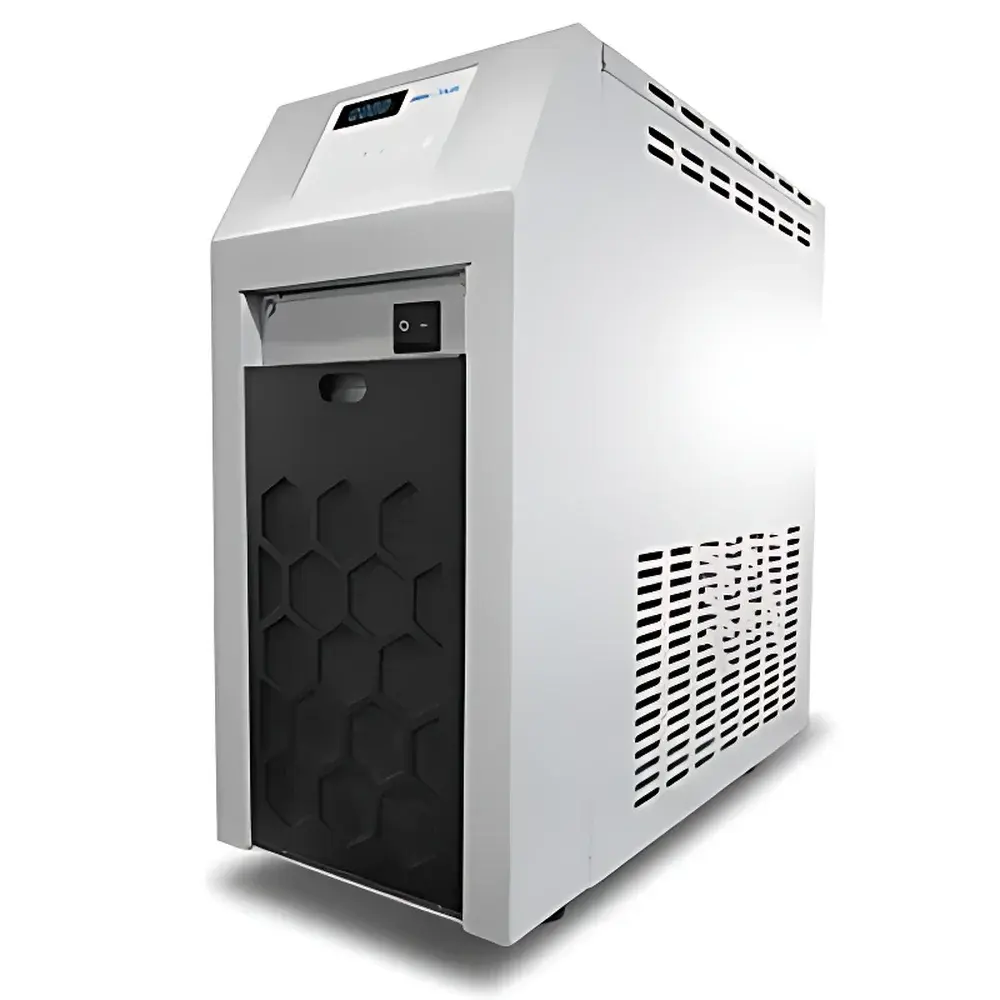
INNOTEG TCS-3 Laboratory Refrigerated Circulating Chiller
| Brand | INNOTEG |
|---|---|
| Origin | Guangdong, China |
| Model | TCS-3 |
| Instrument Type | Constant-Temperature Bath Chiller |
| Circulation Mode | External Circulation |
| Temperature Control | Refrigeration & Heating |
| Bath Volume | 5 L |
| Temperature Range | −20 °C to Ambient |
| Temperature Stability | ±0.3 K |
| Pump Type | Pressure/Suction Dual-Mode |
| Refrigeration Power | 0.45 kW @ 10 °C |
| Dimensions (W×D×H) | 222 × 480 × 495 mm |
| Weight | 25 kg |
| Temperature Sensor | PT100 |
| Display | High-Brightness LED |
| Safety Features | Over-Temp, Low-Level, Dry-Run, and Over-Pressure Protection |
Overview
The INNOTEG TCS-3 Laboratory Refrigerated Circulating Chiller is a compact, dual-mode (refrigeration and heating) temperature control system engineered for precision thermal management in analytical, synthetic, and process-critical laboratory environments. Based on vapor-compression refrigeration with proportional-integral (PI) temperature regulation, the TCS-3 maintains stable thermal conditions across external equipment—including rotary evaporators, spectrophotometers, calorimeters, and reaction blocks—via closed-loop external circulation. Its −20 °C to ambient operating range, combined with ±0.3 K stability at setpoint, meets stringent requirements for reproducible low-temperature experimentation in R&D labs, pharmaceutical QC, biotech incubation support, and semiconductor material testing. The unit’s fully sealed bath design eliminates evaporation losses and cross-contamination risks, while its integrated pressure/suction pump ensures consistent flow delivery (up to 12 L/min nominal) under variable backpressure conditions typical of coiled condensers or jacketed reactors.
Key Features
- Proportional temperature control algorithm dynamically modulates compressor output and heater duty cycle to minimize overshoot and stabilize temperature within ±0.3 K—verified per ISO 17025-accredited calibration protocols.
- Dual-mode pressure/suction pump supports both pressurized delivery (for elevated head applications) and vacuum-assisted suction (for low-resistance loops), enabling compatibility with glassware systems requiring gentle fluid handling.
- Sealed 5 L stainless-steel bath with transparent level window and PT100 Class A sensor (IEC 60751) ensures traceable, drift-compensated temperature measurement and long-term bath integrity without maintenance intervals.
- Independent status monitoring: Real-time LED display shows setpoint, actual bath temperature, pump RPM, and fault codes; separate indicators confirm refrigeration, heating, and circulation activation.
- Comprehensive safety architecture includes dry-run protection (flow sensor + current monitoring), low-bath-level cutoff, over-temperature lockout (>5 K above setpoint), and over-pressure relief—critical for safeguarding fragile glass reactors and condensers.
- IP54-rated front panel with waterproof membrane keypad and high-luminance LED interface ensures operability in humid or splash-prone lab zones, supporting GLP-compliant manual operation logs.
Sample Compatibility & Compliance
The TCS-3 is designed for non-corrosive aqueous and water-glycol coolant mixtures (up to 30% v/v ethylene glycol). It complies with IEC 61010-1:2010 for electrical safety in laboratory equipment and meets EMC immunity requirements per IEC 61326-1:2020. While not certified for hazardous area use (ATEX/IECEx), its sealed refrigerant circuit (R134a, GWP 1430) and absence of exposed high-voltage components make it suitable for general-purpose laboratories operating under ISO/IEC 17025, USP , and FDA 21 CFR Part 11–aligned workflows where instrument qualification (IQ/OQ/PQ) documentation is required. Optional RS485 Modbus RTU interface enables integration into centralized lab infrastructure for audit-ready temperature logging.
Software & Data Management
The TCS-3 operates autonomously via its embedded controller and does not require proprietary software for basic function. However, optional communication modules support ASCII command protocol over RS485, allowing third-party SCADA or LIMS platforms (e.g., LabWare, Thermo Fisher SampleManager) to poll real-time temperature, pump status, and alarm events. All parameter changes and fault triggers are timestamped internally and retained in non-volatile memory for ≥30 days—satisfying GLP data retention mandates. No cloud connectivity or remote firmware updates are implemented, preserving air-gapped operation for regulated environments.
Applications
- Condenser cooling for rotary evaporation (reducing solvent bumping and improving recovery yield at sub-ambient temperatures)
- Temperature stabilization of HPLC column ovens and detector cells during gradient elution
- Thermal conditioning of photomultiplier tubes and CCD detectors in spectroscopy systems
- Process cooling for small-scale crystallization studies and controlled exothermic reaction quenching
- Support of cell culture bioreactors requiring precise thermal ramping profiles (−10 °C to +30 °C)
- Calibration reference baths for thermocouple and RTD verification against NIST-traceable standards
FAQ
What coolant fluids are compatible with the TCS-3?
Deionized water or water–ethylene glycol mixtures (≤30% v/v) are recommended. Avoid alcohols, oils, or chlorinated solvents, which may degrade seals or impair heat transfer.
Can the TCS-3 maintain temperature under continuous external load?
Yes—its compressor and dual-mode pump are rated for continuous duty at full capacity within the specified ambient range (15–30 °C) and maximum head pressure (0.3 MPa).
Is the unit suitable for use with glass vacuum systems?
Yes—the suction-capable pump and dry-run protection prevent implosion risk during sudden vacuum release; however, mechanical vacuum traps are still advised upstream.
Does the TCS-3 support 21 CFR Part 11 compliance?
It provides audit-ready local event logging and configurable password-protected parameter access, but full Part 11 compliance requires integration with validated third-party electronic record systems.
What is the expected service interval for preventive maintenance?
No scheduled maintenance is required per manufacturer specification; only periodic visual inspection of coolant level and inlet filter is advised every 6 months.



