
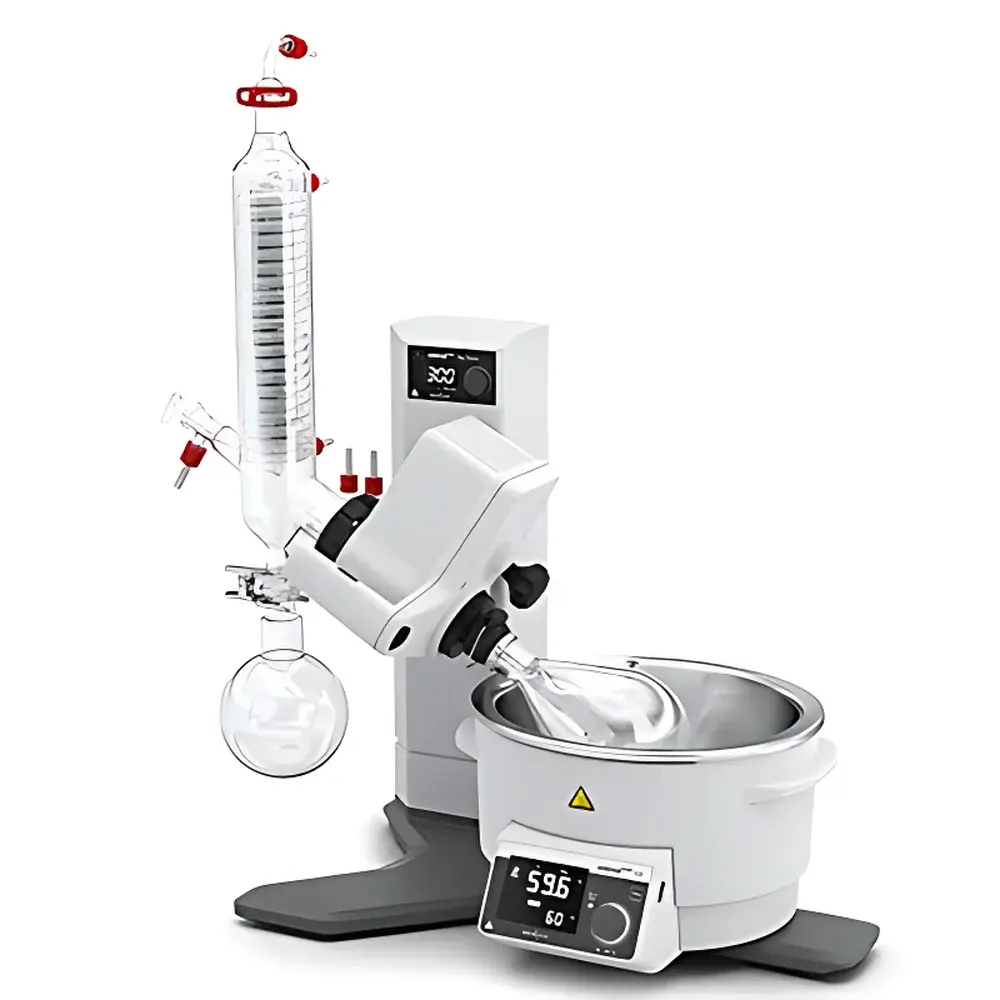
INNOTEG Vap Basic Rotary Evaporator
| Brand | INNOTEG |
|---|---|
| Origin | Germany |
| Model | Vap Basic |
| Rotational Speed Range | 5–300 rpm |
| Heating Bath Temperature Range | Ambient to 180 °C |
| Condenser Cooling Surface Area | 1500 cm² |
| Bath Capacity | 4 L |
Overview
The INNOTEG Vap Basic Rotary Evaporator is an entry-level, manually operated benchtop system engineered for routine solvent removal, concentration of heat-sensitive compounds, crystallization, and preparative purification in academic, industrial, and quality control laboratories. It operates on the principle of reduced-pressure distillation: by rotating the sample flask under vacuum, a thin, uniform film of liquid is formed along the inner wall, maximizing surface area for efficient evaporation while minimizing thermal degradation. The system integrates a precisely temperature-controlled heating bath (ambient to 180 °C), a vertical condenser with 1500 cm² active cooling surface, and a robust mechanical lifting mechanism. Designed for reliability and ease of use—not automation—the Vap Basic delivers consistent performance across standard organic, pharmaceutical, and analytical workflows where reproducibility, safety, and operational simplicity are prioritized over programmable multi-step protocols.
Key Features
- Manually actuated vertical lift with dual-position mechanical lock—enabling secure positioning at any height within the 120 mm travel range; ergonomic front-mounted handle allows intuitive one-handed operation with both left- and right-hand accessibility.
- Triple-path vertical condenser coil architecture—optimized for high-efficiency vapor condensation across diverse solvent polarities and boiling points, including low-boiling solvents (e.g., diethyl ether, dichloromethane) and higher-boiling media (e.g., ethylene glycol, silicone oil).
- Heating bath with tapered geometry (narrow base, widened top)—enhances thermal convection and reduces time-to-target temperature by up to 25% compared to cylindrical baths of equivalent volume.
- Dedicated keypad with lock function—prevents accidental parameter changes during operation; temperature setpoint accuracy maintained within ±1 °C across the full 0–180 °C range.
- Automatic flask elevation upon power failure—a passive safety feature that lifts the evaporation flask out of the heating bath within <2 seconds, preventing thermal decomposition or bumping of residual sample.
- Universal bath compatibility—supports both water and oil as heating media; rated for continuous operation at 180 °C with 1300 W heating power and integrated overtemperature cutoff.
Sample Compatibility & Compliance
The Vap Basic accommodates standard ground-glass jointed glassware (ISO 29761-compliant), including 1 L, 2 L, and 4 L round-bottom flasks. Its design conforms to IEC 61010-1:2010 for electrical safety in laboratory equipment and incorporates IP20-rated enclosure protection. While not certified for GMP production environments, the system supports GLP-aligned documentation practices when paired with external digital vacuum controllers (e.g., INNOTEG VACSTAR series) and calibrated temperature probes traceable to NIST standards. It meets common requirements for sample preparation prior to HPLC, GC-MS, and LC-MS analysis per ASTM D86, ISO 661, and USP guidelines.
Software & Data Management
The Vap Basic is a stand-alone analog-operated instrument with no embedded firmware, touchscreen interface, or data logging capability. All operational parameters—including rotation speed (5–300 rpm), bath temperature, and lift position—are set and monitored manually. This architecture eliminates software validation burdens and ensures long-term operational stability without dependency on firmware updates or cybersecurity patches. For labs requiring audit-ready records, integration with third-party digital vacuum controllers (e.g., VACSTAR digital) enables real-time vacuum logging, while external PT100 probes connected to calibrated data loggers support 21 CFR Part 11-compliant temperature tracking when used in regulated QC/QA settings.
Applications
- Routine concentration of natural product extracts, polymer solutions, and synthetic reaction mixtures.
- Removal of volatile solvents (e.g., acetone, hexane, THF) prior to lyophilization or further chromatographic analysis.
- Crystallization initiation via controlled solvent evaporation under reduced pressure.
- Preparative isolation of thermolabile compounds—such as peptides, vitamins, and enzyme inhibitors—where precise thermal management is critical.
- Sample cleanup in environmental testing (e.g., EPA Method 3510C for pesticide residue extraction) and food safety labs (AOAC 991.22).
- Integration into modular purification platforms alongside secondary condensers, cold traps, and variable-speed vacuum pumps for enhanced recovery of high-volatility analytes.
FAQ
Is the Vap Basic compatible with corrosive solvents such as hydrochloric acid or nitric acid?
No. Standard glassware and PTFE seals are not resistant to strong mineral acids. Use only with organic solvents, aqueous buffers, and mild acids/bases within pH 2–12.
Can the heating bath accommodate a 4 L flask without instability?
Yes—the bath’s wide upper diameter and reinforced support ring ensure stable rotation of 4 L flasks at speeds up to 180 rpm without wobble or resonance.
Does the unit include a vacuum pump or refrigerated circulator?
No. Vacuum generation and coolant supply require external components; recommended pairings include the INNOTEG VACSTAR digital vacuum controller and TCS-3 recirculating chiller.
What maintenance is required for long-term reliability?
Biannual inspection of PTFE rotary seal integrity, annual lubrication of lift mechanism gears, and periodic calibration of bath temperature sensor using a traceable reference thermometer.
Is CE marking valid for use in the United States?
CE marking indicates compliance with EU directives only. For U.S. installation, verify local electrical codes (NEC Article 500/505) and confirm grounding continuity per UL 61010-1 requirements.



