
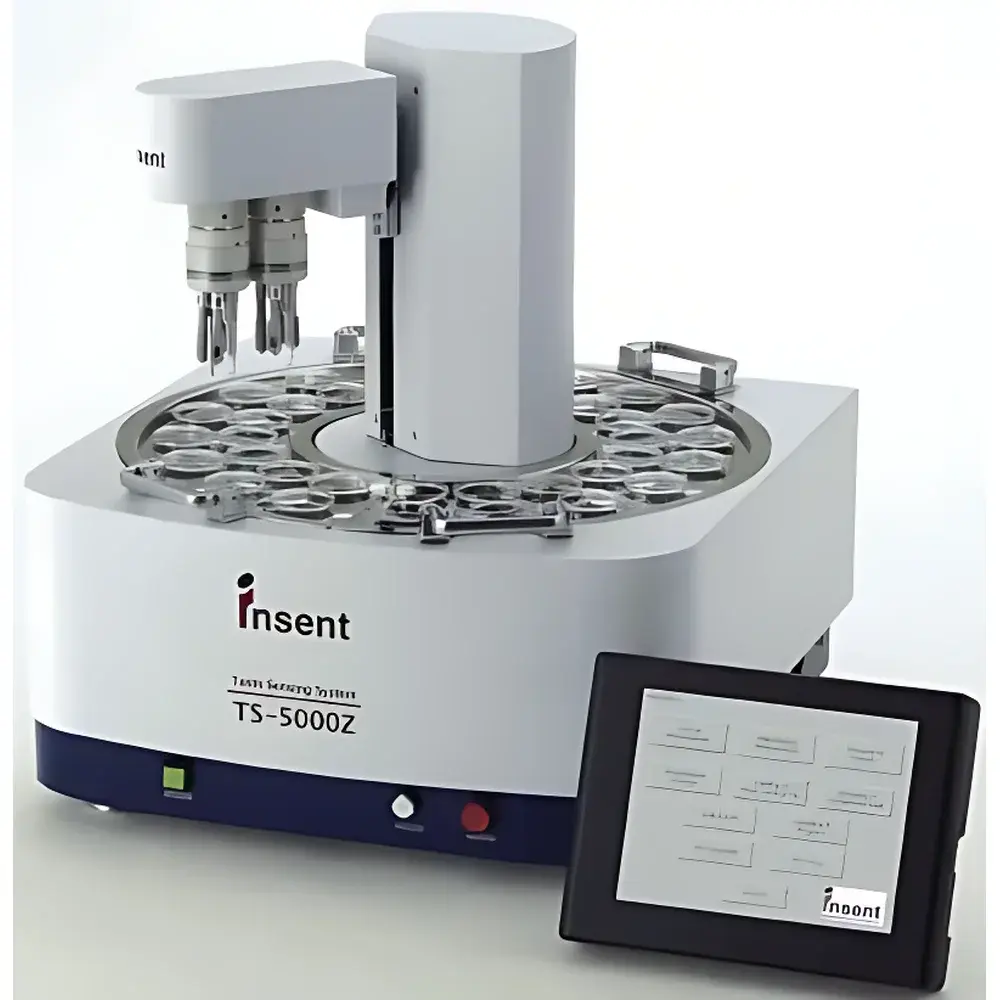
INSENT TS-5000Z Sensory Intelligent Analysis System (Electronic Tongue)
| Brand | INSENT |
|---|---|
| Origin | Japan |
| Model | TS-5000Z |
| Product Type | Electronic Tongue / Taste Sensing System |
| Compliance | Designed for GLP-compliant sensory evaluation environments |
| Sensor Technology | Artificial lipid-membrane sensor array mimicking human taste receptor response |
Overview
The INSENT TS-5000Z Sensory Intelligent Analysis System is a high-fidelity electronic tongue platform engineered for objective, quantitative assessment of taste attributes in liquid and semi-liquid samples. Unlike conventional chemical assays that target individual compounds, the TS-5000Z operates on the principle of cross-reactive lipid-polymer membrane sensors—each sensor exhibits broad, partially overlapping sensitivity to multiple taste substances (e.g., acids, amino acids, bitter alkaloids, salts, polyphenols), replicating the biological redundancy and pattern-recognition mechanism of human gustatory epithelium. This biomimetic architecture enables multivariate taste profiling without sample derivatization or chromatographic separation. The system delivers reproducible, instrument-based taste fingerprints expressed as multidimensional vectors in taste space, supporting discriminant analysis, principal component mapping, and temporal response modeling—including aftertaste kinetics (e.g., lingering bitterness or umami persistence). It is deployed in R&D laboratories, QC departments, and regulatory support units where sensory data must be traceable, auditable, and integrated into digital quality management systems.
Key Features
- Biomimetic sensor array comprising seven independent lipid-polymer membrane electrodes, each tuned to respond differentially to sour (H⁺), salty (Na⁺), sweet (sugars/amino acids), bitter (quinine, caffeine), umami (glutamate, nucleotides), astringent (tannins), and metallic/complex taste modalities.
- Real-time temporal response acquisition with 100 ms sampling resolution, enabling kinetic profiling of taste onset, peak intensity, and decay—critical for quantifying aftertaste duration and recovery profiles.
- Integrated touchscreen interface with guided workflow navigation, context-sensitive help, and macro scripting capability to standardize multi-step protocols across operators and shifts.
- Electromagnetic interference (EMI)-hardened analog front-end and shielded sensor chamber, ensuring signal stability under variable laboratory electromagnetic conditions per IEC 61326-1 compliance requirements.
- Automated sensor conditioning, cleaning, and calibration routines executed via programmable sequences—reducing operator dependency and enhancing inter-day repeatability (RSD < 3.2% for reference solutions over 30 days).
- Embedded data encryption and role-based access control aligned with FDA 21 CFR Part 11 Annex 11 expectations for electronic records and signatures in regulated environments.
Sample Compatibility & Compliance
The TS-5000Z accepts aqueous extracts, beverages, oral suspensions, hydrolysates, and homogenized food slurries within pH 2.5–7.5 and conductivity < 20 mS/cm. Viscosity tolerance extends up to 500 cP with optional flow-cell configuration. Sample volume requirement is 10–20 mL per measurement. All sensor contact surfaces are constructed from USP Class VI-certified materials. The system supports audit trail generation, electronic signature capture, and raw data archiving in vendor-neutral formats (CSV, HDF5), facilitating alignment with ISO/IEC 17025:2017 clause 7.7 (result reporting) and ASTM E2893-22 (standard guide for electronic tongue validation in food applications).
Software & Data Management
The proprietary TS-5000Z Analysis Suite (v4.2+) provides PCA, DFA, hierarchical clustering, and Mahalanobis distance mapping for sample discrimination. Flavor wheel visualization dynamically maps taste vector magnitudes onto standardized sensory axes. Time-series overlays enable comparative kinetic analysis across batches or formulations. Data management server (optional) enables centralized storage, version-controlled method libraries, and automated report generation compliant with GLP Annexes and internal SOPs. Raw sensor voltage logs, processed taste scores, and metadata are stored with SHA-256 hashing for integrity verification.
Applications
- Accelerated development of taste-masked pediatric and geriatric pharmaceutical formulations through quantitative bitter suppression screening.
- Objective shelf-life determination by tracking temporal shifts in sour/sweet balance or umami degradation in fermented products.
- Competitive benchmarking of commercial beverages using Euclidean distance metrics in taste-space to quantify perceptual differentiation.
- Root-cause analysis of consumer complaints related to off-taste or metallic aftertaste via retrospective sensor response pattern matching.
- Supporting patent documentation with instrumentally derived taste descriptors admissible under USPTO guidelines for functional claims in food science.
FAQ
What sample preparation is required prior to analysis?
Samples must be filtered (0.45 µm PVDF), degassed (if volatile), and temperature-equilibrated to 25 ± 0.5 °C. No dilution or pH adjustment is needed unless outside operational range.
Can the TS-5000Z replace human sensory panels?
It does not replace trained panels for hedonic assessment but serves as a validated orthogonal method for analytical sensory profiling—widely accepted in ISO 29901:2021 for instrumental taste screening.
How often do sensors require replacement?
Lipid-membrane sensors maintain performance for ≥ 500 measurements under routine use; lifetime is tracked automatically and flagged when signal drift exceeds ±5% baseline variance.
Is method validation support available?
Yes—INSENT provides IQ/OQ/PQ documentation templates, linearity/ruggedness studies, and participation in collaborative inter-laboratory trials per AOAC Official Method guidelines.
Related Products






