
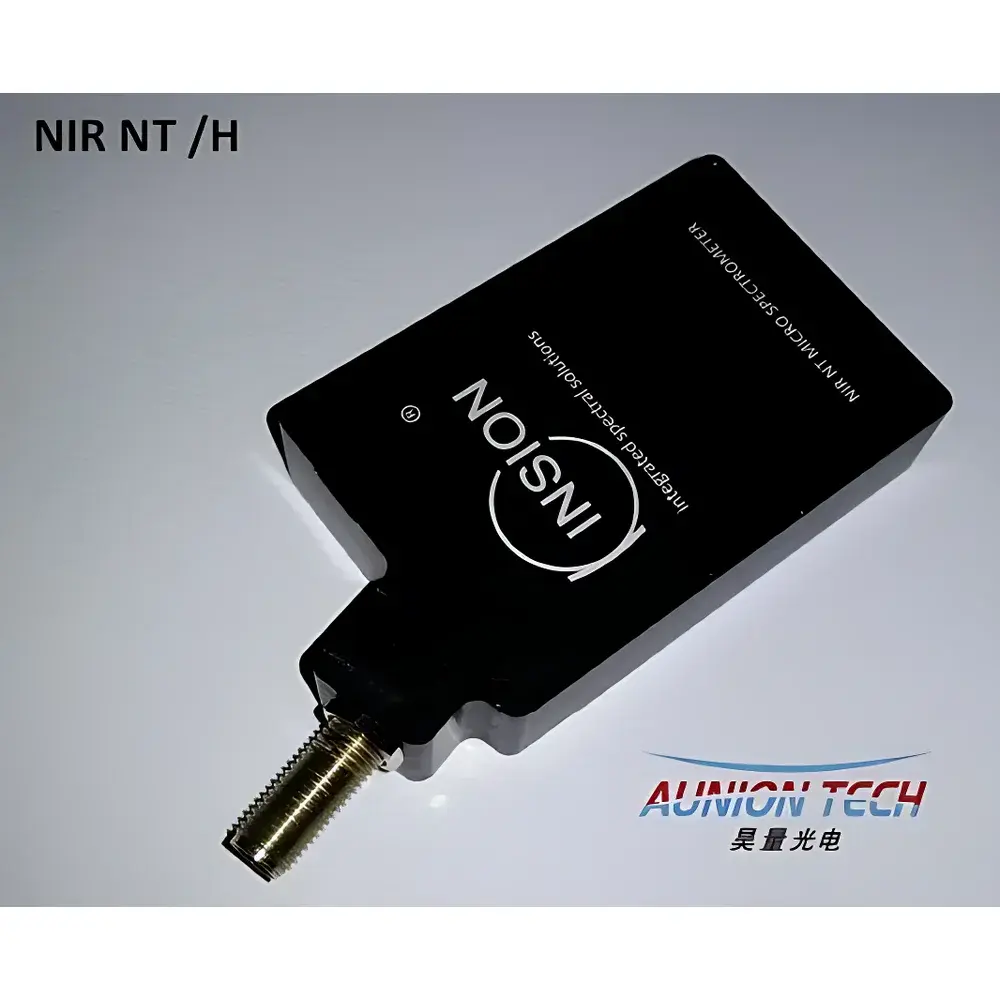
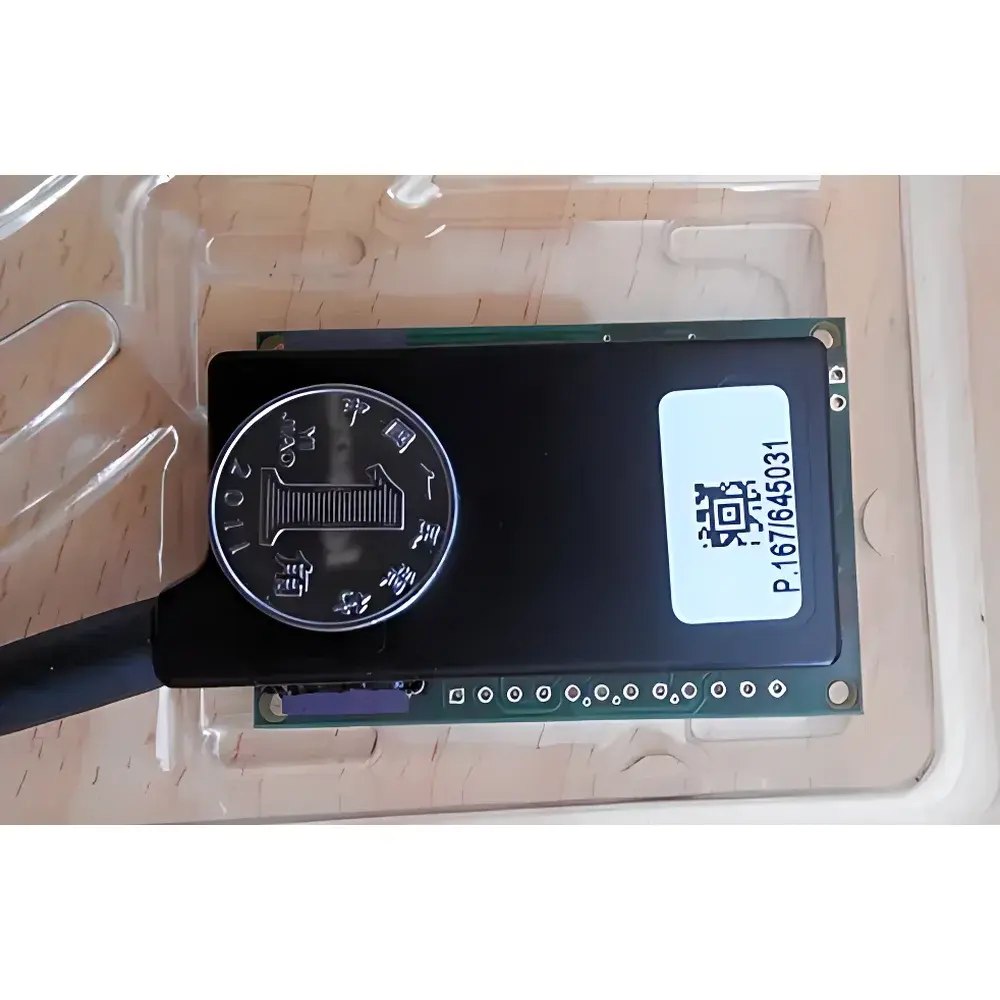
INSION UV2NIR+ Compact Fiber Optic Spectrometer
| Brand | INSION |
|---|---|
| Origin | Germany |
| Model | UV2NIR+ |
| Spectral Range | 330–1700 nm |
| Resolution | 10 nm (UV/VIS), 16 nm (NIR) FWHM |
| Sensitivity | 80 E12 cts·nm/W·s (UV/VIS), 150 E12 cts·nm/W·s (NIR) |
| SNR | ≥ 5000 at T<sub>integration</sub> = 2 ms |
| Dynamic Range | 900–1700 nm |
| Stray Light | 3.5 nm/pixel |
| Dimensions | 165 × 60 × 36 mm |
| Detector | Dual-channel Hamamatsu S11639 (UV/VIS) + InGaAs linear array (NIR) |
| Optical Architecture | Monolithic planar waveguide with integrated cavity optics |
| Calibration Stability | Lifetime calibration-free operation |
| Compliance | RoHS, CE, ISO 9001 manufacturing environment |
Overview
The INSION UV2NIR+ Compact Fiber Optic Spectrometer is a dual-channel, monolithic planar waveguide-based spectrometer engineered for robust, high-stability spectral acquisition across the ultraviolet–visible–near-infrared (UV–VIS–NIR) spectrum—from 330 nm to 1700 nm. Unlike conventional Czerny–Turner or crossed-beam optical bench designs, the UV2NIR+ employs a proprietary micro-injection molded silica-on-silicon waveguide platform where all optical functions—including dispersion, collimation, and detection coupling—are embedded in a single passive chip. This eliminates moving parts, mechanical alignment dependencies, and thermal drift pathways. The system integrates two independent optical channels: a UV/VIS channel based on a Hamamatsu S11639 back-thinned CMOS sensor (330–1000 nm), and a dedicated NIR channel using a thermoelectrically stabilized InGaAs linear array (900–1700 nm). The absence of adjustable optics, gratings, or slit mechanisms ensures intrinsic wavelength fidelity and long-term repeatability—enabling true lifetime calibration-free operation under industrial or field-deployed conditions.
Key Features
- Monolithic planar waveguide architecture fabricated via precision micro-injection molding—no discrete lenses, mirrors, or alignment-sensitive mounts
- Dual-spectrum acquisition in a single compact housing: UV/VIS (330–1000 nm) and NIR (900–1700 nm) channels operate simultaneously with hardware-synchronized integration
- Hermetically sealed optical path with integrated bandpass filtering to suppress VIS leakage into the UV channel and NIR bleed into the VIS detector
- Thermally stabilized InGaAs detector (Peltier-cooled to –5 °C) enabling low-noise NIR performance with ≤0.5% pixel-to-pixel non-uniformity
- Compact footprint (165 × 60 × 36 mm) and shock-resistant construction (tested to IEC 60068-2-27, 50 g, 11 ms half-sine pulse)
- USB 2.0 interface with embedded firmware supporting trigger-in, trigger-out, and external clock synchronization for time-resolved measurements
- Factory-characterized radiometric response traceable to NIST-traceable standards; spectral responsivity data delivered with each unit
Sample Compatibility & Compliance
The UV2NIR+ accepts standard SMA 905 fiber inputs (core diameters 50–400 µm) and supports both reflection and transmission configurations via optional cuvette holders, integrating spheres (e.g., Labsphere ISN-200), or fiber-coupled probe assemblies. Its fixed optical geometry ensures consistent focal spot positioning and étendue matching across wavelengths—critical for quantitative absorbance, reflectance, and fluorescence ratio measurements. The device complies with CE marking requirements for electromagnetic compatibility (EN 61326-1) and safety (EN 61010-1). Manufacturing adheres to ISO 9001:2015 protocols, and full optical test reports—including dark current maps, linearity curves (R² > 0.9999 over 4-decade intensity range), and spectral calibration residuals (< ±0.3 nm RMS)—are supplied with every instrument. While not certified for GMP or FDA 21 CFR Part 11 out-of-the-box, the firmware and SDK support audit trail logging, user access control, and electronic signature integration when deployed within validated laboratory information management systems (LIMS).
Software & Data Management
INSION provides the cross-platform INSIGHT SDK (C/C++, Python, MATLAB, LabVIEW APIs) and INSIGHT Studio GUI application. The software enables real-time spectral acquisition, multi-channel overlay, peak identification with sub-pixel centroiding, and export to CSV, HDF5, or JCAMP-DX formats. All raw spectra include embedded metadata: timestamp, integration time, detector temperature, firmware version, and serial-number-referenced calibration coefficients. Batch processing modules support ASTM E1712-compliant spectral averaging, baseline correction (asymmetric least squares), and multivariate preprocessing (SNV, MSC, derivatives). For regulated environments, the SDK supports deterministic memory allocation, deterministic acquisition timing (jitter < 10 µs), and cryptographic hash generation for raw data integrity verification.
Applications
- Process analytical technology (PAT) for real-time monitoring of chemical reactions, polymerization kinetics, and crystallization endpoints in pharmaceutical and fine chemical manufacturing
- Material characterization of thin-film coatings, photovoltaic absorbers (e.g., perovskite, CIGS), and quantum dot dispersions via reflectance and transmittance spectroscopy
- Food and agriculture QA/QC: moisture, protein, and starch quantification in grains, dairy powders, and leaf tissue using NIR absorption bands (1100–1650 nm)
- Environmental sensing: dissolved organic carbon (DOC) estimation in water via UV254 absorbance and chlorophyll-a detection in algal blooms (650–700 nm)
- Biomedical point-of-care: hemoglobin oxygen saturation (SpO₂) estimation using dual-wavelength ratiometric analysis at 660/940 nm
- Defect detection in semiconductor wafers and display panels through photoluminescence mapping in the visible–NIR range
FAQ
Is the UV2NIR+ suitable for quantitative absorbance measurements?
Yes—the system delivers radiometrically calibrated responsivity and exhibits <0.2% linearity deviation up to 3 OD, validated per ISO 17025-accredited procedures.
Can it be synchronized with external light sources or cameras?
Yes—hardware TTL trigger input/output pins enable precise gating of pulsed LEDs, lasers, or gated ICCD cameras with sub-microsecond jitter.
What is the maximum recommended integration time for stable NIR acquisition?
For optimal SNR and thermal stability, integration times between 1 ms and 5 s are supported; beyond 2 s, thermoelectric cooling maintains detector temperature within ±0.1 °C.
Does the spectrometer require periodic recalibration in the field?
No—monolithic waveguide design and hermetic packaging eliminate mechanical drift; factory calibration remains valid over the full operating temperature range (5–40 °C).
Is OEM integration supported?
Yes—compact form factor, low power consumption (<2.5 W), and SPI/I²C-compatible control interface enable seamless embedding into handheld analyzers, robotic platforms, or inline process sensors.






