
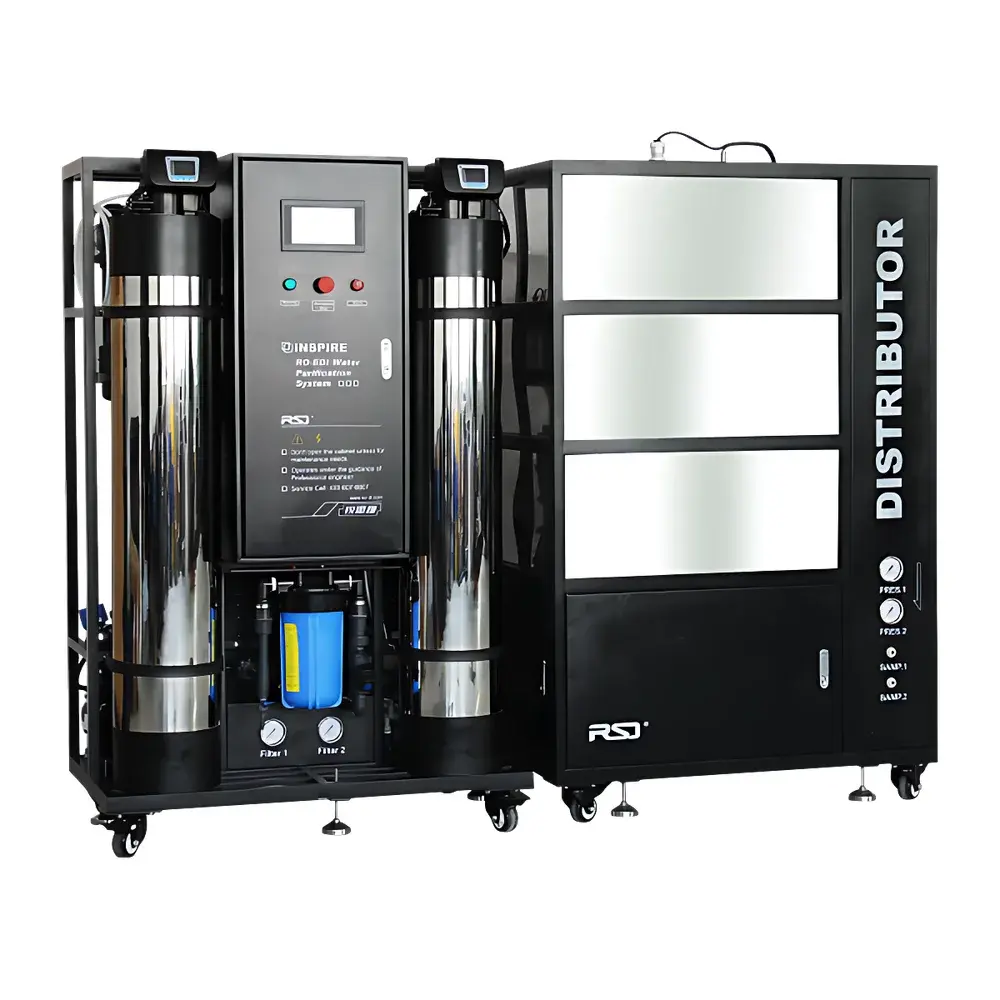
INSPIRE Compact Central Pure Water System
| Brand | RSJ (Reesee) |
|---|---|
| Origin | Fujian, China |
| Manufacturer Type | OEM/ODM Manufacturer |
| Country of Origin | China |
| Model | INSPIRE |
| Pricing | Upon Request |
| Purified Water Grade | GB/T 6682–2008 Grade II |
| Resistivity | ≥10 MΩ·cm @ 25 °C |
| Conductivity | <0.1 μS/cm (after optional DI polishing) |
| Production Capacity | 70–300 L/h (RO-only or RO+EDI configurations) |
| Storage Tank Options | 350–1000 L, SUS304/SUS316L sanitary design |
| Control System | Siemens PLC + 7″ color touchscreen HMI |
| Data Logging | SD card storage with USB export |
| Compliance | Meets GB/T 6682–2008, supports GLP/GMP traceability via audit-ready event logs |
Overview
The INSPIRE Compact Central Pure Water System is an integrated, factory-assembled central purification platform engineered for laboratories and pilot-scale facilities requiring reliable, continuous supply of Type II pure water (per GB/T 6682–2008) and optionally upgraded to ultrapure water (≥18 MΩ·cm) via post-RO deionization. Utilizing a dual-stage reverse osmosis (RO+RO) or RO+electrodeionization (RO+EDI) core architecture, the system achieves stable resistivity ≥10 MΩ·cm at 25 °C — with typical performance ranging 10–15 MΩ·cm under standard feedwater conditions (TDS < 500 ppm, temperature 5–35 °C). Its compact footprint (W1070 × H1700 × D650 mm for main unit), modular scalability, and fully automated operation make it suitable for centralized distribution across multi-point lab networks, analytical instrument clusters, and small-to-midsize bioprocessing or pharmaceutical R&D environments.
Key Features
- Automated pre-treatment management: Integrated sand filtration, ion exchange softening (auto-regenerating), and disposable activated carbon cartridges with quick-change housing — minimizing manual intervention and downtime.
- Constant-flow delivery: Variable-frequency pump control ensures consistent output pressure (1–5 bar adjustable) and flow rate (1–5 T/H), independent of demand fluctuations or network backpressure.
- Digital process intelligence: Siemens S7-1200 PLC governs all critical functions — including RO recovery optimization, EDI current regulation, UV lamp duty cycling, and chemical/ozone dosing schedules — via a 7″ color touchscreen HMI with multilingual UI (English default).
- Comprehensive data governance: All operational events (e.g., cartridge replacement alerts, conductivity excursions, disinfection cycles, pump run hours) are timestamped and stored on internal SD card; USB export enables CSV-based audit trail generation compliant with GLP and ISO/IEC 17025 documentation requirements.
- Sanitary-grade storage & distribution: Optional 350–1000 L SUS316L tanks feature pressure-sensor-based continuous level monitoring, submerged 254 nm UV irradiation (for experimental-grade systems), hydrophobic vent filters (for sanitary-grade variants), and CIP-compatible spray balls.
- Zero-additive purification: No chemical regeneration or acid/base injection required during normal RO+EDI operation — reducing consumable dependency and operator exposure risk while supporting green lab initiatives.
Sample Compatibility & Compliance
The INSPIRE system delivers water meeting national and international specifications for laboratory use: GB/T 6682–2008 Grade II (equivalent to ASTM D1193 Type III) and — when equipped with optional mixed-bed DI polishing — approaches ASTM D1193 Type I / ISO 3696 Class 1 purity (resistivity ≥18 MΩ·cm, TOC < 5 ppb, bacteria < 1 CFU/mL). All wetted materials comply with USP Class VI and FDA 21 CFR 177.2400 standards. Sanitary tank configurations adhere to ASME BPE-2021 surface finish (Ra ≤ 0.6 µm) and drainability criteria. System validation packages support IQ/OQ documentation per GAMP5 guidelines, and electronic records meet ALCOA+ principles for data integrity.
Software & Data Management
The embedded control firmware provides real-time visualization of key parameters: feed/concentrate/product conductivity, RO rejection ratio, EDI stack voltage/current, UV intensity decay, and tank level trends. Historical data is logged at user-defined intervals (1 min to 24 h) with automatic rollover. Event-driven alarms trigger visual notifications, email/SMS alerts (via optional Ethernet/WiFi gateway), and automatic system shutdown for critical faults (e.g., low inlet pressure, high permeate conductivity). Audit logs include operator ID, timestamp, action taken, and reason code — fulfilling 21 CFR Part 11 requirements for electronic signatures when paired with role-based access control.
Applications
- Centralized feed for multiple analytical instruments: HPLC, LC-MS, ICP-MS, AAS, and TOC analyzers requiring consistent Type II water.
- Pilot-scale biomanufacturing: Cell culture media preparation, buffer formulation, and column cleaning in early-phase process development.
- Clinical diagnostics labs: Supply to automated immunoassay platforms (e.g., Roche Cobas, Abbott Architect) and hematology analyzers where particulate-free, low-ion water is essential.
- Research animal facilities: Central potable water purification with endotoxin removal capability (when combined with ultrafiltration module).
- Materials science labs: Solvent preparation, nanoparticle synthesis, and electrochemical testing requiring reproducible background conductivity.
- Industrial QA/QC departments: High-volume sample dilution, reagent preparation, and calibration standard making across chemistry, environmental, and food safety testing workflows.
FAQ
What is the minimum feedwater quality required for stable RO+EDI operation?
Feed conductivity should not exceed 500 µS/cm (ideally <300 µS/cm); hardness must be 800 µS/cm, RSJ recommends adding a post-RO mixed-bed DI module to maintain ≥15 MΩ·cm output.
Can the system be validated for GMP environments?
Yes — full IQ/OQ documentation templates, calibration certificates for all sensors (conductivity, pressure, UV intensity), and FAT/SAT protocols are available upon request. Optional 21 CFR Part 11-compliant user authentication and electronic signature modules are supported.
How often do pre-filters and RO membranes require replacement?
Activated carbon cartridges: every 6–12 months depending on chlorine/chloramine load. RO membranes: 2–3 years under proper pretreatment; monitored via rejection rate decay (>10% drop triggers replacement recommendation.
Is remote monitoring and control possible without on-site IT infrastructure?
Yes — optional 4G LTE cellular modem enables secure cloud-based access via RSJ’s proprietary SCADA interface, allowing real-time status checks, alarm notifications, and parameter adjustments from any web-enabled device.
Does the system support integration with building management systems (BMS)?
Standard Modbus TCP and optional Profibus DP interfaces enable seamless integration with third-party BMS platforms for centralized utility monitoring and predictive maintenance scheduling.



