
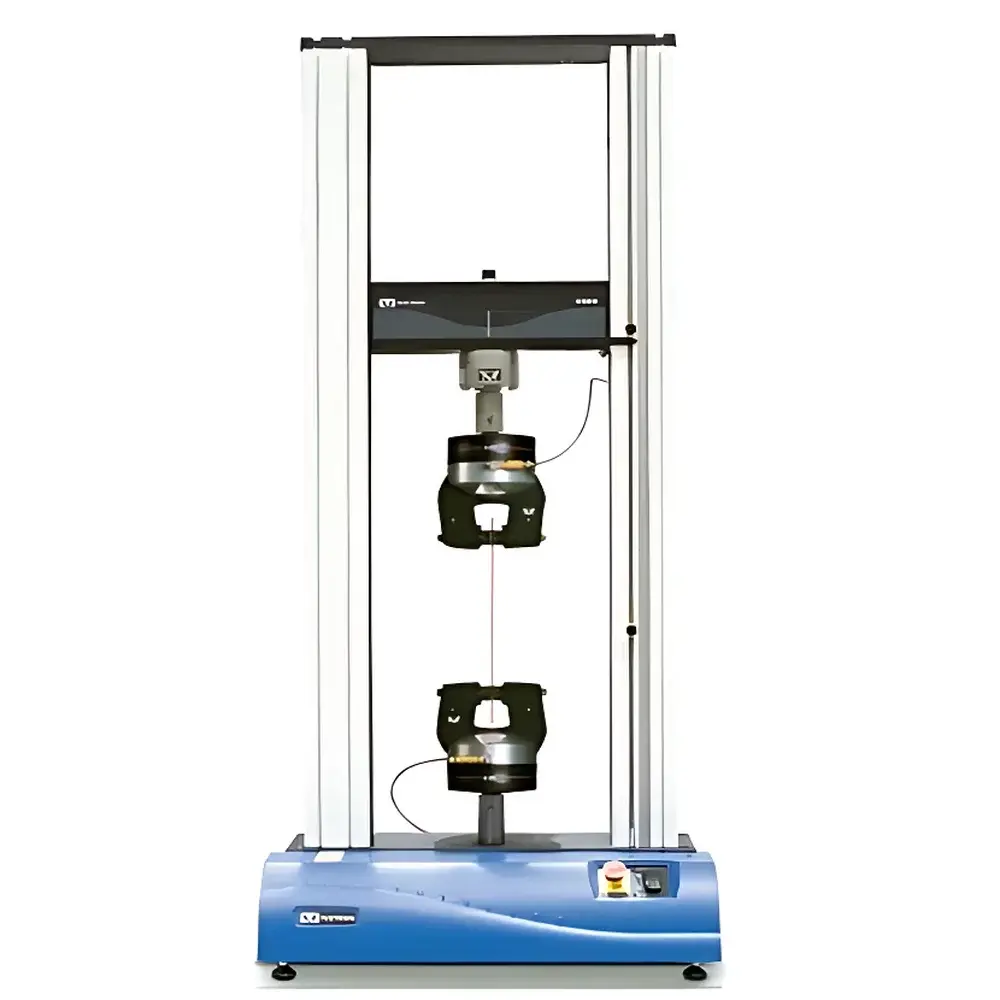
Instron 3360 Dual-Column Universal Testing System
| Brand | Instron |
|---|---|
| Origin | USA |
| Manufacturer Type | Authorized Distributor |
| Origin Category | Imported |
| Model | 3360 |
| Instrument Type | Electromechanical Universal Testing Machine |
| Load Capacity Options | 5 kN / 10 kN / 30 kN / 50 kN |
| Maximum Crosshead Speed | 500–1000 mm/min |
| Vertical Test Space | 1193 mm |
| Load Accuracy | ±0.5% of indicated load |
| Force Resolution | 100:1 force range (down to 1.0% of sensor capacity without loss of accuracy) |
| Data Acquisition Rate | 500 Hz (Bluehill® 3), 100 Hz (Bluehill & Bluehill LE) |
| Compliance | CE-certified |
| Warranty | 12-month comprehensive service coverage (parts and labor) |
Overview
The Instron 3360 Dual-Column Universal Testing System is an electromechanical materials testing platform engineered for precision, repeatability, and long-term reliability in quality control, R&D, and regulatory-compliant environments. Based on a robust dual-column frame architecture with preloaded ball screws, precision-ground linear guide columns, and a symmetrical drive system, the 3360 delivers exceptional frame stiffness (>150 kN/mm typical) and axial alignment—critical for minimizing parasitic bending moments and ensuring ASTM E4-compliant force measurement integrity. Its modular design supports standardized test methods across ISO 6892-1 (tensile metals), ASTM D638 (plastics), ISO 527 (polymer tensile), ASTM D3039 (composites), ISO 179 (impact-modified plastics), and USP (pharmaceutical mechanical testing). The system operates under closed-loop displacement, load, or strain control, with real-time feedback from factory-calibrated, auto-recognized load cells and extensometers—eliminating manual calibration entry errors and supporting GLP/GMP audit trails.
Key Features
- 100:1 usable force range: Full accuracy maintained down to 1.0% of load cell capacity—enabling single-sensor testing of both low-force elastomers and high-strength metallic specimens without hardware switching.
- High-fidelity data acquisition: 500 Hz sampling rate with Bluehill® 3 software ensures capture of transient events such as yield point onset, brittle fracture initiation, and cyclic hysteresis loops.
- Auto-sensor recognition: Integrated digital communication between load cells, extensometers, and controller enables plug-and-play transducer configuration with traceable calibration metadata embedded in every test file.
- Dual-column structural integrity: Pre-tensioned ball screws and hardened linear guides minimize deflection under load, achieving <0.01 mm/m alignment tolerance per ISO 7500-1 Class 0.5 verification requirements.
- Comprehensive environmental integration: Optional environmental chambers (−70 °C to +300 °C), humidity control units, and liquid submersion fixtures allow testing per ASTM D5229, ISO 11359, and MIL-STD-810G protocols.
- Self-diagnostic firmware: Real-time monitoring of motor current, thermal load, encoder feedback, and power supply stability enables predictive maintenance alerts and rapid fault isolation—reducing mean time to repair (MTTR) by up to 40% versus legacy systems.
Sample Compatibility & Compliance
The 3360 accommodates specimens ranging from micro-scale polymer films (0.01 mm thick) to structural composite laminates (up to 300 mm wide), using over 1,200 certified grips, fixtures, and adapters—including pneumatic wedge grips, hydraulic tension/compression platens, peel test fixtures, and biomedical suture clamps. All configurations comply with ISO/IEC 17025 documentation standards for accredited laboratories. System validation includes full IQ/OQ documentation packages aligned with FDA 21 CFR Part 11 electronic records requirements, including user access controls, audit trail logging, and electronic signature support. CE marking confirms conformity with EU Machinery Directive 2006/42/EC and Electromagnetic Compatibility Directive 2014/30/EU.
Software & Data Management
Bluehill® 3 software provides intuitive test method creation via drag-and-drop sequence builder, real-time pass/fail evaluation against multi-parameter limits (e.g., modulus deviation >±3%, elongation at break <15%), and automated report generation in PDF, Excel, or XML formats compliant with LIMS interfaces. Raw data files (.ibw) retain full 500 Hz waveform fidelity with embedded metadata: operator ID, calibration certificate IDs, environmental chamber logs, and transducer serial numbers. Version-controlled method libraries support cross-site harmonization for multinational manufacturing networks. Optional Bluehill Connect enables secure remote monitoring, cloud-based data backup (AWS S3 encrypted), and API-driven integration with MES and SAP QM modules.
Applications
The 3360 serves as a primary test platform across regulated and industrial sectors: tensile and compression testing of aerospace aluminum alloys (per AMS 2355), peel adhesion of medical device packaging (ASTM F88), flexural modulus of carbon fiber prepregs (ISO 14125), creep rupture of high-performance thermoplastics (ISO 899-1), and cyclic fatigue of orthopedic implant components (ISO 14801). Its adaptability extends to automotive NVH component characterization, textile tear strength (ASTM D5034), rubber hardness correlation (ASTM D2240), and additive manufacturing lattice structure validation per ASTM F3122.
FAQ
Does the 3360 support ASTM E8/E21 high-temperature tensile testing?
Yes—when integrated with Instron’s 3119-604 environmental chamber and high-temperature extensometer, the system meets ASTM E21 requirements up to 1000 °C.
Can Bluehill® 3 generate 21 CFR Part 11-compliant audit trails?
Yes—audit trail settings record all user actions, parameter changes, and report exports with timestamps, operator credentials, and IP addresses; archived logs are write-once/read-many (WORM) enabled.
Is factory installation and operational qualification included?
Standard delivery includes onsite mechanical leveling, electrical safety verification, and OQ execution per ISO 7500-1 using NIST-traceable reference standards.
What is the maximum specimen height for compression testing with standard platens?
With 1193 mm vertical clearance and optional 300 mm-diameter platens, maximum unsupported specimen height is 950 mm—sufficient for concrete cylinders (ASTM C39) and large composite panels.
Are third-party transducers supported?
Only Instron-certified transducers with embedded EEPROM calibration data are recognized; non-Instron sensors require custom firmware integration and void warranty coverage.



