
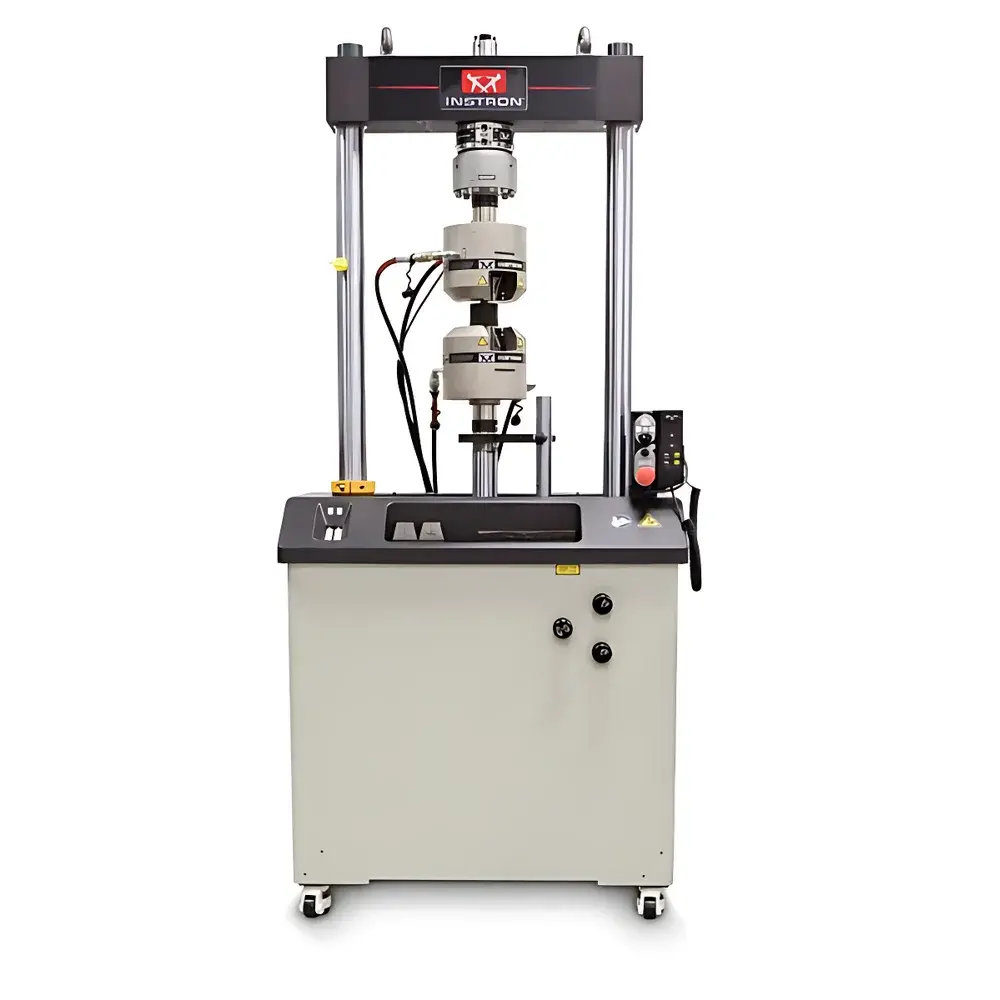
Instron 8801 Electro-Hydraulic Servo Fatigue Testing System
| Brand | Instron |
|---|---|
| Origin | United Kingdom |
| Manufacturer | Instron (UK) Ltd. |
| Type | Electro-hydraulic servo fatigue testing machine |
| Maximum Test Load | ±100 kN |
| Frame Weight | 625 kg |
| Actuator Stroke | ±150 mm |
| Footprint | < 0.5 m² |
| Controller | 8800MT Digital Controller with 19-bit resolution |
Overview
The Instron 8801 Electro-Hydraulic Servo Fatigue Testing System is a high-performance, compact-frame materials testing platform engineered for precision-controlled static, cyclic, and fatigue loading applications. Built upon a dual-column, high-stiffness load frame with bottom-mounted electro-hydraulic servo actuation, the system operates on the principle of closed-loop force and displacement control using proportional servo valves and high-bandwidth hydraulic actuation. Its architecture supports both high-cycle fatigue (HCF) and low-cycle fatigue (LCF) regimes, as well as fracture mechanics testing—including crack growth rate (da/dN), J-integral, and KIc measurements—under controlled loading waveforms (sine, trapezoidal, block, or user-defined). The system’s mechanical design minimizes parasitic bending moments through precision alignment and rigid column geometry, ensuring traceable load application per ISO 7500-1 Class 0.5 requirements.
Key Features
- Bottom-mounted, bidirectional electro-hydraulic servo actuator delivering ±100 kN (±22,500 lbf) peak dynamic force with ±150 mm (±6 in) stroke
- High-stiffness dual-column frame with integrated hydraulic power unit interface; total footprint under 0.5 m² (5.4 ft²), eliminating structural floor reinforcement requirements
- Dynacell™ patented high-frequency load cell technology offering reduced inertial error, extended bandwidth, and improved signal fidelity during transient loading
- Hydrostatic bearing actuator option available for applications demanding exceptional lateral load tolerance—critical for LCF tests on notched specimens or thermomechanical fatigue (TMF) setups
- Hydraulically actuated, motorized crosshead with position-locking mechanism enabling rapid, repeatable gauge length adjustment without manual jacking
- Modular integration capability with environmental chambers (−100 °C to +1000 °C), video extensometers (e.g., ATLAS™), wedge-action or pneumatic grips, and safety enclosures compliant with ISO 13857
Sample Compatibility & Compliance
The 8801 accommodates standardized test specimens per ASTM E8/E8M (tension), ASTM E606 (fatigue), ASTM E399 (fracture toughness), and ISO 12106 (fatigue of metallic materials), including smooth, notched, pre-cracked (SENB, CT), and miniature geometries. Its load frame geometry supports long-load-train configurations via optional tall-frame kits, enabling testing of full-scale components such as turbine blades or orthopedic implants. All hardware and firmware comply with ISO/IEC 17025 calibration traceability requirements. System-level validation includes documented performance verification per ASTM E4 and ISO 7500-1, with controller firmware qualified for GLP/GMP environments under FDA 21 CFR Part 11 when paired with Bluehill® LIMS-integrated audit trail modules.
Software & Data Management
Controlled by the Instron 8800MT digital controller, the system delivers 19-bit analog-to-digital resolution across its full sensor range and employs adaptive PID tuning based on specimen stiffness—a patented feature that reduces setup time and improves repeatability across material families. WaveMatrix™ software provides advanced waveform synthesis, real-time FFT analysis, cycle counting (Rainflow), and automated pass/fail logic for fatigue life prediction. Bluehill® Universal serves as the primary interface for static tensile, compression, and bend testing, supporting multi-step protocols, customizable reporting (PDF/Excel/XML), and direct export to statistical process control (SPC) platforms. Optional add-ons include Low-Cycle Fatigue (LCF) and Fracture Mechanics software suites, each embedding standardized calculation engines aligned with ASTM E606 Annex A3 and ASTM E1820 methodologies.
Applications
The Instron 8801 is routinely deployed in aerospace OEM laboratories for titanium alloy HCF screening, in nuclear materials R&D for irradiated steel LCF characterization, and in biomedical device testing for ISO 14801-compliant fatigue evaluation of dental implants. It supports thermomechanical fatigue (TMF) when coupled with split-furnace environmental systems, and enables strain-controlled push-pull cycling at frequencies up to 100 Hz (dependent on hydraulic configuration and specimen mass). Additional use cases include rubber compound durability testing per ISO 6942, composite delamination resistance assessment via mode-I/II interlaminar fatigue, and additive manufacturing qualification per ASTM F3049—where high-resolution load/displacement synchronization is essential for defect-correlation studies.
FAQ
What hydraulic power unit is required for the 8801 system?
The 8801 is designed for seamless integration with Instron’s 3520-series hydraulic power units (HPUs), with selection based on required flow rate, pressure rating, and noise constraints (e.g., 3522 for standard lab use, 3525 for high-flow applications).
Can the 8801 perform crack propagation testing per ASTM E647?
Yes—when equipped with a calibrated crack-mouth-opening-displacement (CMOD) clip gauge or digital image correlation (DIC) system and operated with WaveMatrix™ Fracture Mechanics software, it fully supports ΔK-controlled da/dN testing.
Is the 8800MT controller compatible with third-party sensors or data acquisition systems?
The controller features analog I/O (±10 V, 16-bit) and digital TTL interfaces for external trigger synchronization, though full closed-loop control remains limited to Instron-certified transducers to maintain metrological integrity.
Does the system support remote operation and monitoring?
Via Bluehill® Connect and Instron’s RESTful API, users can initiate tests, retrieve real-time channel data, and access historical test records from secure enterprise networks—subject to IT-administered firewall and authentication policies.
What maintenance intervals are recommended for the servo actuator and hydraulic circuit?
Per Instron’s Preventive Maintenance Schedule, hydraulic oil analysis is performed every 1,000 operating hours, filter replacement every 2,000 hours, and full actuator inspection—including seal integrity and bearing preload—every 5,000 hours or biannually, whichever occurs first.



