
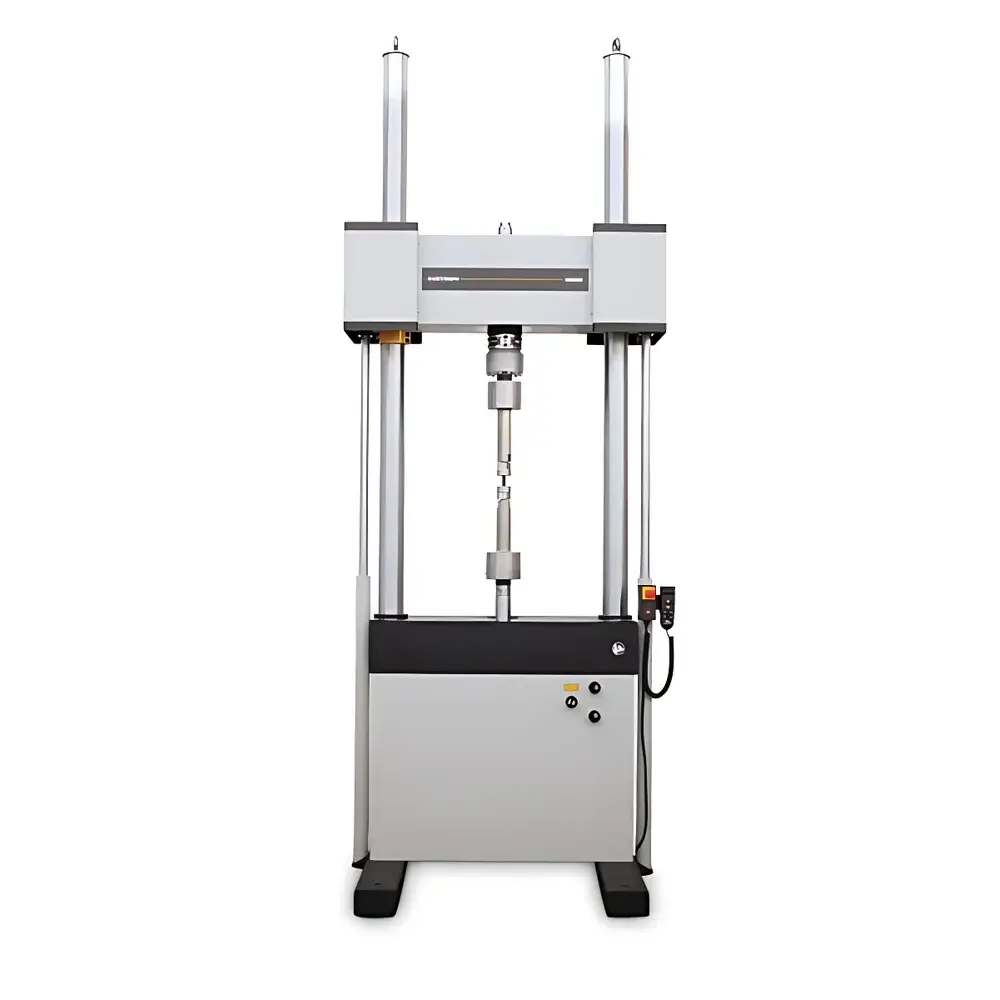
Instron 8803 Electro-Hydraulic Servo Fatigue Testing System
| Brand | Instron |
|---|---|
| Origin | United Kingdom |
| Manufacturer | Instron Corporation |
| Type | Electro-Hydraulic Servo Fatigue Testing Machine |
| Maximum Test Load | ±500 kN |
| Frame Weight | 2450 kg |
| Actuator Stroke | 250 mm |
| Footprint | < 1.6 m² |
| Controller | Instron 8800MT Digital Controller |
| Compatible Power Unit | 3520 Series Hydraulic Power Supply |
| Load Cell Technology | Patented Dynacell™ |
| Frame Configuration | Dual-Column, Floor-Mounted, High-Stiffness Precision-Aligned |
| Bearing Type | Hydrostatic Bearing Actuator |
| Crosshead Adjustment | Hydraulic Elevating and Locking System |
| Software Platform | WaveMatrix (dynamic), Bluehill® (static), LCF/Fracture Mechanics Add-ons |
| Compliance | ASTM E4, E8, E606, E647, E1820 |
Overview
The Instron 8803 Electro-Hydraulic Servo Fatigue Testing System is a high-performance, floor-mounted materials testing platform engineered for precision-controlled static, cyclic, and fatigue loading of metallic, polymeric, composite, and ceramic specimens and structural components. Built upon Instron’s proven dual-column, high-stiffness frame architecture with hydrostatic bearing actuators, the system operates on closed-loop electro-hydraulic servo control to deliver exceptional force linearity, low hysteresis, and minimal side-load sensitivity—critical for high-fidelity fatigue and fracture mechanics characterization. Its ±500 kN load capacity, 250 mm stroke, and sub-1.6 m² footprint make it suitable for both university research laboratories and industrial R&D facilities requiring rigorous mechanical property validation under ISO/ASTM-compliant conditions.
Key Features
- Patented Dynacell™ integrated load cell technology delivering high-frequency response, minimized inertial error, and improved signal-to-noise ratio across full load range
- Hydrostatic bearing actuator enabling superior lateral load resistance, extended service life, and consistent alignment throughout test duration
- Dual-column, precision-aligned frame with T-slot base and adjustable crosshead—hydraulically elevated and locked for rapid setup of variable gauge lengths
- Instron 8800MT digital controller featuring adaptive PID tuning based on specimen stiffness, real-time amplitude control, automatic safety limits, and 19-bit analog-to-digital resolution
- Modular hydraulic power integration via 3520-series units, supporting customizable flow/pressure profiles for high-cycle (HCF) or low-cycle (LCF) regimes
- Full compatibility with environmental chambers (−70 °C to +350 °C), video extensometry systems, wedge-action and hydraulic grips, and impact-rated safety enclosures
Sample Compatibility & Compliance
The 8803 accommodates standardized tensile, compression, bend, torsion, and push-pull configurations per ASTM E8/E9/E292/E606/E647 and ISO 6892-1/12106/12135. Its rigid frame and dynamic fidelity support crack growth rate (da/dN) measurements in accordance with ASTM E647 and fracture toughness (KIc, J-integral) protocols per ASTM E1820. All controller firmware and software modules comply with GLP/GMP documentation requirements, including electronic signatures, change control logs, and 21 CFR Part 11–ready audit trails when deployed with validated Bluehill® or WaveMatrix installations.
Software & Data Management
Control and analysis are executed through Instron’s integrated software ecosystem: Bluehill® 3 for static and quasi-static tests (tensile, compression, flexure), WaveMatrix 3 for advanced dynamic waveform generation (sine, block, random, spectrum-based loading), and optional add-on modules for low-cycle fatigue life prediction, R-curve analysis, and compliance-based crack length tracking. Data acquisition supports up to 10 kHz sampling, synchronized multi-channel input (load, displacement, strain, temperature, acoustic emission), and export to ASTM E1432-compliant .udf or universal .csv formats. All raw datasets retain full metadata traceability—including operator ID, calibration status, environmental conditions, and hardware configuration—for regulatory review.
Applications
The 8803 serves as a core instrumentation platform for aerospace component qualification (e.g., turbine disk, landing gear fatigue life), biomedical implant durability assessment (ISO 14801, ASTM F2129), automotive powertrain material validation, nuclear cladding cyclic testing, and additive manufacturing process development. Its high-force stability and long-stroke capability also enable full-scale subcomponent testing—such as suspension arms, composite wing spars, or pressure vessel weld joints—under representative service spectra. The system is routinely deployed in accredited testing laboratories pursuing ISO/IEC 17025 certification.
FAQ
What standards does the 8803 support for fatigue testing?
ASTM E606 (strain-controlled LCF), E647 (crack growth), E1012 (alignment verification), ISO 12106 (metallic materials), and ISO 12135 (fracture toughness).
Can the system perform thermomechanical fatigue (TMF) tests?
Yes—when integrated with compatible environmental chambers and thermal controllers, the 8800MT controller synchronizes mechanical loading with programmed temperature cycles.
Is the 8803 compliant with FDA 21 CFR Part 11 for regulated industries?
Fully compliant when configured with Bluehill® 3 or WaveMatrix 3 in validated mode, including electronic signatures, audit trail logging, and role-based access control.
What is the typical lead time for factory acceptance testing (FAT)?
Standard FAT requires 10–12 weeks post-order confirmation, inclusive of mechanical verification, controller calibration, and software validation against NIST-traceable reference standards.
Does Instron provide application engineering support for custom fixture design?
Yes—Instron’s Global Applications Lab offers fixture feasibility studies, FEA-based load path analysis, and turnkey tooling packages aligned with ISO 14726 and ASTM D5766 specifications.



