
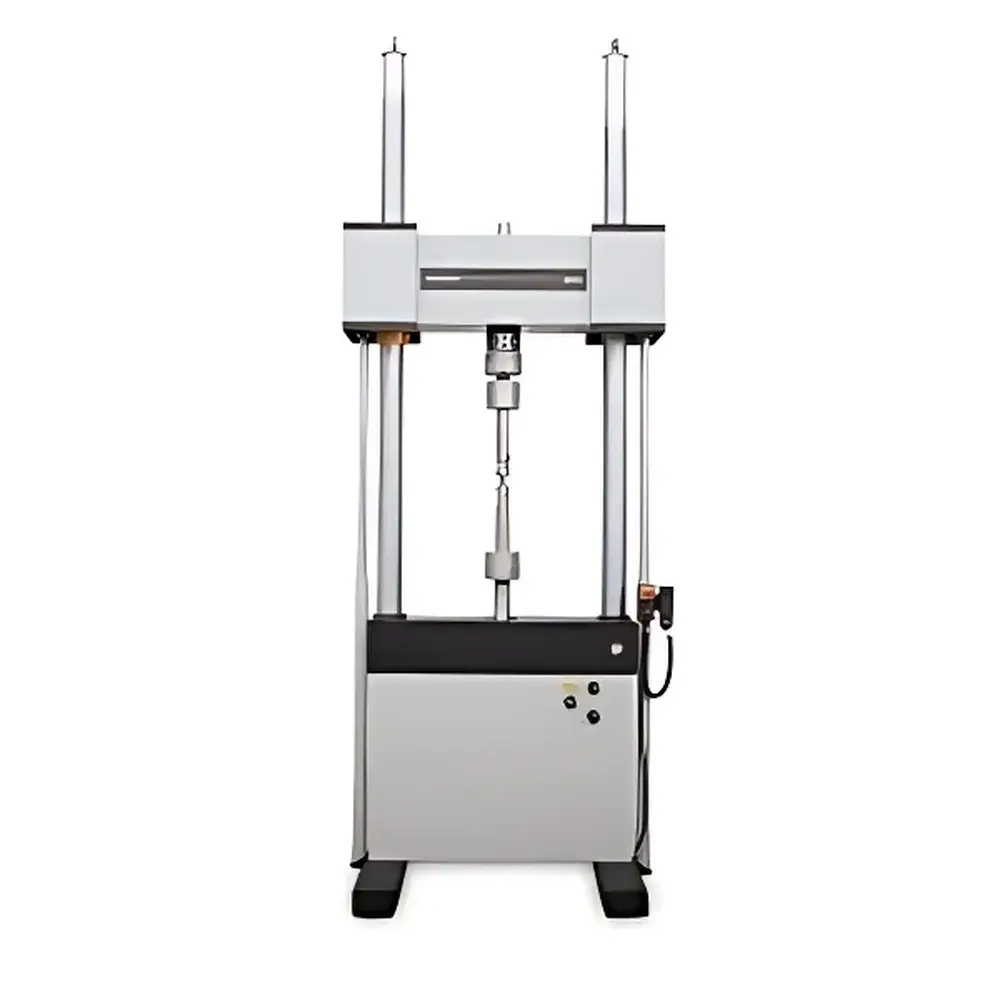
Instron 8803 Electromechanical-Hydraulic Servo Fatigue Testing System
| Brand | Instron |
|---|---|
| Origin | USA |
| Model | 8803 |
| Test Type | Electro-Hydraulic Servo Fatigue Testing Machine |
| Maximum Test Load | ±500 kN |
| Frequency Range | 0–50 Hz |
| Machine Footprint | <1.6 m² |
| Effective Stroke | 250 mm |
| Frame Weight | 2450 kg |
| Actuator Configuration | Double-Acting Hydraulic Servo Cylinder with Hydrostatic Bearings |
| Load Cell Technology | Dynacell™ |
| Controller | Instron 8800MT Digital Controller (19-bit resolution) |
| Compatible Software | WaveMatrix™, Bluehill® 3, Low-Cycle Fatigue & Fracture Mechanics Add-ons |
Overview
The Instron 8803 Electromechanical-Hydraulic Servo Fatigue Testing System is a high-performance, dual-purpose testing platform engineered for precision-controlled dynamic and quasi-static mechanical characterization of structural materials, aerospace components, biomedical implants, and advanced composites. Built upon Instron’s proven electro-hydraulic servo architecture, the system operates on the principle of closed-loop force and displacement control using high-bandwidth servo-valve hydraulics coupled with real-time digital feedback from integrated load cells and extensometers. Its ±500 kN capacity and 0–50 Hz operational frequency range enable rigorous simulation of service-level cyclic loading conditions—including high-cycle fatigue (HCF), low-cycle fatigue (LCF), crack growth rate (da/dN), and R-curve analysis—under ISO 1099, ASTM E466, ASTM E606, and ASTM E399 compliant test protocols.
Key Features
- Double-acting hydraulic servo actuator with hydrostatic bearing technology—delivering exceptional lateral stiffness and minimal parasitic bending moments, critical for accurate LCF and fracture mechanics testing.
- Rigid, precision-aligned dual-column frame with T-slot base configuration—enabling rapid reconfiguration for multi-axis fixtures, environmental chambers (e.g., −70°C to +350°C), or custom load-train assemblies.
- Hydraulically powered adjustable crosshead with automatic locking mechanism—supporting sample heights up to 250 mm stroke while maintaining axial alignment within ±0.02 mm/m over full travel.
- Dynacell™ integrated load cell—patented monolithic design eliminating mounting interface errors and reducing inertial lag; enables high-fidelity force measurement with <0.5% linearity error across full range.
- Compact footprint (<1.6 m²) without compromising rigidity—optimized for integration into regulated laboratory environments where space, vibration isolation, and floor loading constraints are critical.
- Full compatibility with Instron 3520-series hydraulic power units—scalable flow and pressure delivery (up to 28 MPa) ensures consistent dynamic response across wide amplitude/frequency spectra.
Sample Compatibility & Compliance
The 8803 accommodates specimens ranging from miniature notched coupons (ASTM E647) to full-scale structural subassemblies (e.g., turbine blade root sections or welded joints). Standard configurations support tensile, compression, torsion-combined, and push-pull fatigue modes per ISO 12107 and ASTM E466. When paired with environmental enclosures and video-based extensometry (e.g., Instron Advanced Video Extensometer), it meets GLP and GMP documentation requirements under FDA 21 CFR Part 11 when configured with audit-trail-enabled software. All hardware interfaces comply with CE Machinery Directive 2006/42/EC and IEC 61000-6-2/6-4 electromagnetic compatibility standards.
Software & Data Management
Control and data acquisition are managed via the Instron 8800MT digital controller—a deterministic real-time system featuring 19-bit analog-to-digital resolution, adaptive control algorithms, and built-in safety interlocks (e.g., force/displacement limit enforcement, emergency stop propagation). WaveMatrix™ software provides dedicated modules for spectrum loading, block cycling, dwell control, and crack propagation tracking—including compliance calibration routines aligned with ASTM E647 Annex A3. Bluehill® 3 supports static and monotonic tests with full ISO 17025 traceability reporting. Optional fracture mechanics packages integrate J-integral and CTOD calculations directly from raw load-displacement-crack mouth opening displacement (CMOD) streams. All test data are stored in vendor-neutral XML-based formats compliant with ASTM E1434 and suitable for third-party analysis tools.
Applications
- Aerospace: Fatigue life prediction of aluminum-lithium alloys, titanium fan blades, and composite wing skins under variable-amplitude loading spectra.
- Automotive: Durability validation of suspension components, powertrain mounts, and battery enclosure structures under road-load-simulated waveforms.
- Biomedical: Cyclic loading of orthopedic implants (e.g., hip stems, spinal cages) per ISO 14801 and ASTM F2193.
- Energy: Crack growth monitoring in pipeline steels and weldments subjected to pressure cycling per API RP 579.
- Academic Research: Fundamental studies of dislocation dynamics, ratcheting behavior, and microstructure-sensitive fatigue thresholds using synchronized in situ imaging.
FAQ
What is the maximum achievable test frequency at full ±500 kN load?
At rated capacity, the system maintains sinusoidal waveform fidelity up to 25 Hz; frequencies up to 50 Hz are supported at reduced load amplitudes (≤±250 kN), subject to hydraulic power unit specification and specimen mass.
Can the 8803 be upgraded for thermomechanical fatigue (TMF) testing?
Yes—when integrated with Instron’s 3119-600 series environmental chambers and high-temperature extensometers, the system supports out-of-phase thermal-mechanical cycling per ASTM E2368, with temperature ranges from −70°C to +1100°C.
Is the Dynacell™ load cell calibrated to NIST-traceable standards?
All factory-installed Dynacell™ sensors include NIST-traceable calibration certificates valid for 12 months; recalibration intervals may be extended per ISO/IEC 17025-accredited internal procedures.
Does the 8800MT controller support third-party sensor integration?
Yes—the controller provides eight configurable analog input channels (±10 V, 24-bit resolution) and two digital I/O ports for external strain gages, accelerometers, or acoustic emission sensors, with time-synchronized sampling up to 10 kHz.
How is system compliance compensated during high-strain-rate testing?
WaveMatrix™ includes real-time compliance correction algorithms based on machine-specific stiffness matrices, automatically adjusting for frame, actuator, and grip deformation contributions during transient loading events.
Related Products



