
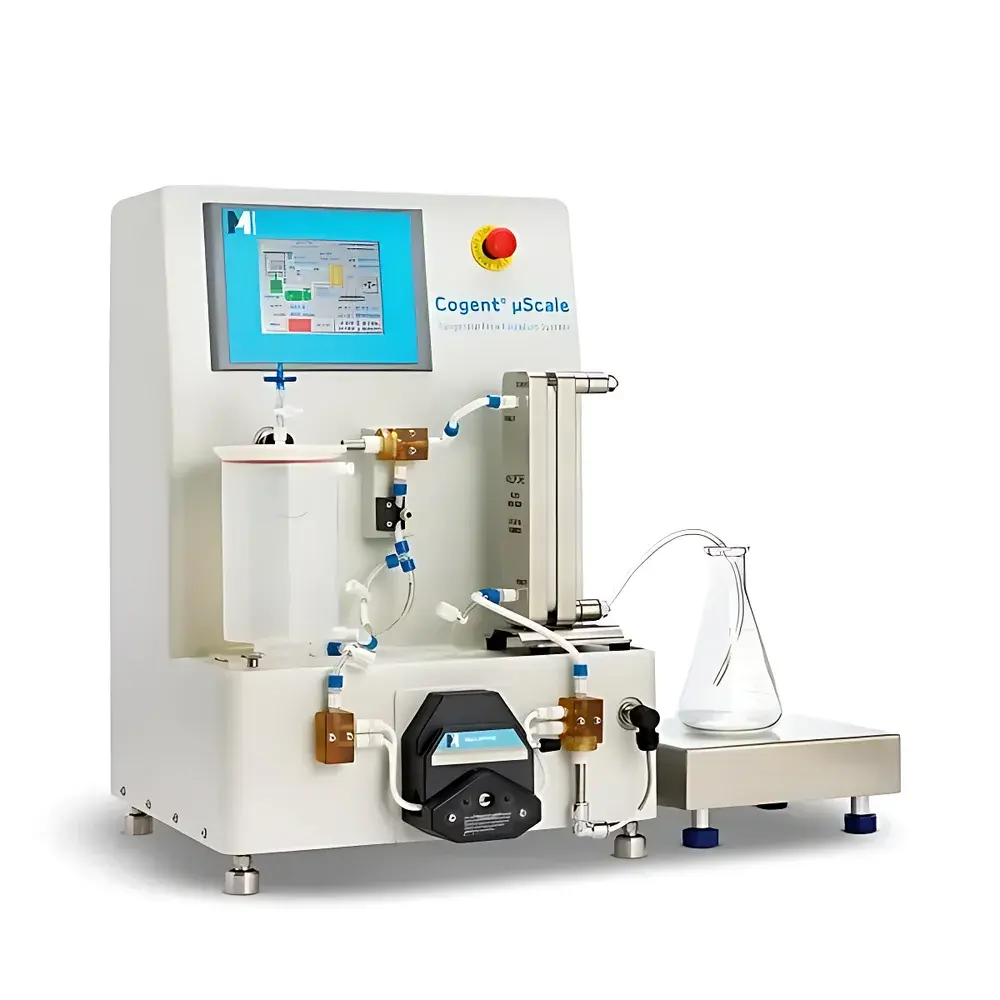
Merck Cogent® µScale Semi-Automatic Ultrafiltration System
| Brand | Millipore |
|---|---|
| Origin | USA |
| Manufacturer Type | Authorized Distributor |
| Origin Category | Imported |
| Model | Cogent® µScale |
| Pricing | Available Upon Request |
Overview
The Merck Cogent® µScale Semi-Automatic Ultrafiltration System is an engineered benchtop platform designed for precise, reproducible ultrafiltration (UF) and diafiltration (DF) operations in early-stage bioprocess development. Built upon tangential flow filtration (TFF) principles, the system utilizes controlled crossflow across flat-sheet membrane surfaces to minimize concentration polarization and fouling—enabling high recovery yields of labile biomolecules including monoclonal antibodies (mAbs), recombinant proteins, viral vectors, plasmid DNA, vaccines, and plasma-derived therapeutics. Its semi-automated architecture balances operator control with process consistency, supporting both exploratory experimentation and scalable parameter mapping under GMP-aligned workflows.
Key Features
- Dual-head peristaltic pump delivering smooth, low-pulsation flow (17–330 mL/min) with pressure stability (<3 psi fluctuation) up to 80 psi (5.5 bar) feed pressure—optimized for high-differential-pressure TFF protocols and transmembrane pressure (TMP)-driven process optimization.
- Low-volume fluid path design: minimum working volume of 16 mL and minimal hold-up volume ensures maximal product recovery—critical for precious clinical-grade or preclinical material handling.
- Modular membrane cassette compatibility: accommodates one to three Pellicon® 3 cassettes (88 cm² each, up to 264 cm² total) or three Pellicon® XL 50 cassettes (50 cm² each, up to 150 cm² total), enabling direct scale-down correlation from pilot or manufacturing-scale TFF systems.
- Vacuum-assisted feed replenishment supports isovolumetric diafiltration and continuous feed addition without manual intervention—enhancing repeatability in buffer exchange studies.
- 7-language touchscreen interface (including English, German, French, Spanish, Italian, Japanese, and Chinese) with intuitive navigation, real-time parameter visualization, and user-defined alarm thresholds for pressure, volume, time, and temperature.
- CIP-compatible wetted path constructed from USP Class VI-certified polypropylene (1 L reservoir), fully drainable flow paths, and chemical resistance to standard industrial cleaning agents (e.g., NaOH, citric acid, detergents).
- Robust mechanical architecture with minimal moving parts, reducing maintenance frequency and extending operational lifetime in regulated laboratory environments.
Sample Compatibility & Compliance
The Cogent® µScale is validated for use with a broad range of biopharmaceutical feedstreams—including clarified mammalian cell culture harvests, bacterial lysates, viral supernatants, and plasma fractions. Its low-shear peristaltic pumping and gentle crossflow dynamics preserve structural integrity of sensitive macromolecules and particulates. The system supports compliance with industry-standard quality frameworks: all data logging meets ALCOA+ principles; audit trails, electronic signatures, and configurable user access levels align with FDA 21 CFR Part 11 readiness when integrated with validated LIMS or ELN platforms. Membrane cassettes comply with ISO 9001-manufactured quality controls and are supplied with full CoA documentation traceable to batch-specific performance testing.
Software & Data Management
The embedded control software records time-stamped process parameters—including feed pressure, retentate pressure, permeate flux, cumulative permeate volume, and pump speed—at user-selectable intervals (1–60 sec). All datasets are automatically saved in CSV format to internal memory or external USB storage, supporting seamless import into statistical analysis tools (e.g., JMP, MATLAB, Python pandas). Alarm events trigger timestamped annotations and optional email/SMS notifications via network-enabled configurations. Data export supports IQ/OQ documentation packages and facilitates retrospective review during regulatory submissions (e.g., IND, BLA, MAA dossiers).
Applications
- Process development: rapid screening of membrane chemistries (regenerated cellulose, polyethersulfone), MWCO selection (3–500 kDa), and optimization of flux, TMP, and shear rate.
- Buffer exchange and desalting: efficient isovolumetric diafiltration for formulation development and removal of host cell proteins or residual media components.
- Concentration and clarification: scalable concentration of mAbs (≥10 mg/mL), viral vectors (≥1×10¹³ vg/mL), and exosomes while maintaining particle integrity.
- Cell harvesting: gentle pelleting of CHO or HEK293 cells via microfiltration mode using appropriate Pellicon® XL membranes.
- Technology transfer support: generation of robust, predictive scale-down models correlating directly with MilliporeSigma’s Pellicon® 2 and Xcell™ TFF systems used at pilot and commercial scales.
FAQ
What membrane cassettes are compatible with the Cogent® µScale system?
Pellicon® 3 (88 cm²) and Pellicon® XL 50 (50 cm²) cassettes—both supplied with standardized fittings and validated for use with this platform.
Can the system perform true isovolumetric diafiltration?
Yes—via vacuum-assisted feed addition synchronized with permeate withdrawal, maintaining constant retentate volume throughout the process.
Is the system suitable for GMP-regulated environments?
While the hardware is designed for GLP/GMP-aligned operation, full 21 CFR Part 11 compliance requires integration with validated third-party data management software and documented IQ/OQ/PQ protocols.
What is the maximum recommended operating pressure?
80 psi (5.5 bar) feed pressure, with stable TMP control and minimal pressure ripple—validated for extended operation across multiple cassette configurations.
How is system cleaning verified?
CIP effectiveness is confirmed by conductivity monitoring, visual inspection of flow paths, and optional ATP bioluminescence assays—consistent with ICH Q5A and EU Annex 1 guidance for biotech equipment cleaning validation.



