
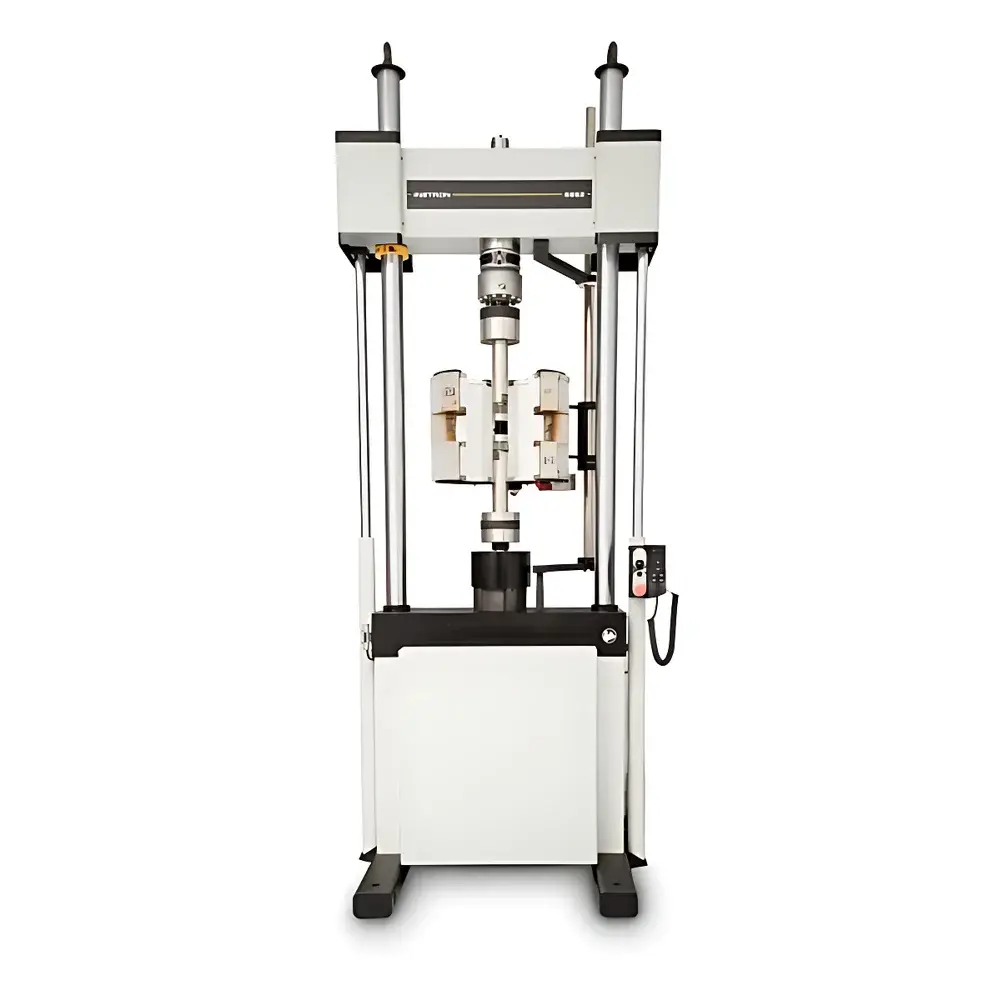
Instron 8862 Low-Cycle Fatigue Testing System
| Brand | Instron |
|---|---|
| Origin | United Kingdom |
| Manufacturer Type | Original Equipment Manufacturer (OEM) |
| Product Category | Imported Instrument |
| Model | 8862 |
| Instrument Type | Electro-Mechanical Servo Fatigue Testing System |
| Maximum Test Load | 100 kN |
| Frame Weight | 1458 kg |
Overview
The Instron 8862 Low-Cycle Fatigue (LCF) Testing System is a purpose-engineered electro-mechanical servo fatigue platform designed for high-precision, high-stiffness mechanical testing under controlled cyclic loading conditions. Unlike traditional hydraulic systems, the 8862 employs a fully electric, backlash-free actuator driven by precision ball-screw technology—eliminating dependency on hydraulic power units while delivering exceptional force resolution, positional repeatability, and thermal stability. Its architecture is optimized for low-cycle fatigue regimes characterized by relatively few cycles (typically < 10⁵), large plastic strains, and often combined with elevated temperature environments. The system supports both isothermal LCF and thermomechanical fatigue (TMF) protocols, making it suitable for evaluating advanced alloys, turbine disk materials, weldments, and coated components used in aerospace, energy, and nuclear applications. Built upon Instron’s 8800MT dynamic digital controller—the latest evolution of the 8800 series—it integrates real-time closed-loop control with adaptive tuning algorithms and deterministic response timing.
Key Features
- High-rigidity dual-column load frame engineered for exceptional axial and transverse stiffness—critical for maintaining load path integrity during high-strain reverse-stress cycling.
- Backlash-free electromechanical actuator with sub-micron positioning capability (down to 1 µm/hr), enabling ultra-slow strain rate control essential for creep-fatigue interaction studies.
- Compact footprint and near-silent operation (< 65 dB(A)), minimizing laboratory space requirements and enhancing operator ergonomics.
- Integrated uninterruptible power supply (UPS) safeguards test specimens from uncontrolled overloading during mains failure or controller reset events.
- Patented stiffness-based auto-tuning algorithm significantly reduces PID parameterization time across diverse specimen geometries and material moduli—without requiring manual gain adjustments.
- UKAS-accredited in-house sensor calibration facility ensures traceability of all load cells and extensometers to national standards (ISO/IEC 17025).
Sample Compatibility & Compliance
The 8862 accommodates standard ASTM E606, E647, and ISO 12106-compliant LCF specimens—including hourglass, notched, and miniature geometries—as well as custom-designed TMF coupons. When equipped with Instron’s high-temperature furnace systems (up to 1100 °C), the platform meets ASTM E2714, E111, and ISO 1099 requirements for elevated-temperature fatigue testing. All high-temperature configurations include AlignPro™—a software-guided alignment verification and correction suite that quantifies misalignment-induced bending moments in real time and provides step-by-step mechanical adjustment instructions. The system is compatible with third-party extensometers, clip-on gauges, and digital image correlation (DIC) hardware, supporting GLP/GMP-aligned data acquisition workflows.
Software & Data Management
Control and analysis are executed via Instron’s Bluehill® LCF/TMF software module—a dedicated application built on the Bluehill Universal platform. It includes preconfigured test methods compliant with ASTM E606 Annex A3 (strain-controlled LCF), E2714 (TMF), and USP (mechanical testing of medical device materials). The software supports multi-segment waveforms (triangle, trapezoidal, sine), hold-time insertion, thermal ramp synchronization, and real-time hysteresis loop tracking. Audit trails, electronic signatures, and 21 CFR Part 11–compliant user access controls are enabled by default. Raw data is stored in vendor-neutral .csv and .tdms formats; metadata embedding follows ASTM E1447 and ISO/IEC 17025 documentation requirements.
Applications
- Aerospace component qualification: turbine blades, disc rims, and structural fasteners subjected to cyclic thermal-mechanical loading.
- Nuclear reactor material assessment: cladding alloys and pressure vessel steels under simulated LOCA (Loss-of-Coolant Accident) conditions.
- Energy sector R&D: superalloy weld characterization, coating delamination resistance, and additive-manufactured part fatigue life prediction.
- Automotive powertrain development: exhaust manifold and turbocharger housing validation under combined thermal cycling and mechanical strain.
- Academic and standards laboratories conducting interlaboratory round-robin studies per ISO/IEC 17043 proficiency testing schemes.
FAQ
What distinguishes the 8862 from conventional hydraulic fatigue testers?
The 8862 replaces hydraulic actuation with a high-force electromechanical drive system—offering zero fluid maintenance, improved energy efficiency, and superior low-speed control fidelity without oil leakage, noise, or heat dissipation concerns.
Is the system capable of thermomechanical fatigue (TMF) testing?
Yes—when integrated with Instron’s programmable high-temperature furnaces and thermal gradient controllers, the 8862 supports out-of-phase and in-phase TMF testing per ASTM E2714, including synchronized thermal ramping and mechanical loading profiles.
How does AlignPro ensure accurate load train alignment?
AlignPro uses calibrated load cell outputs and displacement feedback to compute bending moment ratios and angular misalignment errors; it then guides users through iterative mechanical adjustments using visual prompts and quantitative pass/fail criteria.
Can the 8862 be validated for regulated environments?
Yes—the system supports IQ/OQ documentation packages, 21 CFR Part 11 compliance modules, and UKAS-traceable calibration certificates issued directly from Instron’s UK R&D center.
What is the maximum operating temperature supported?
With optional furnace integration, the system achieves stable operation up to 1100 °C; thermal uniformity across the gauge length complies with ASTM E2714 Class I specifications (±2 °C tolerance).



