
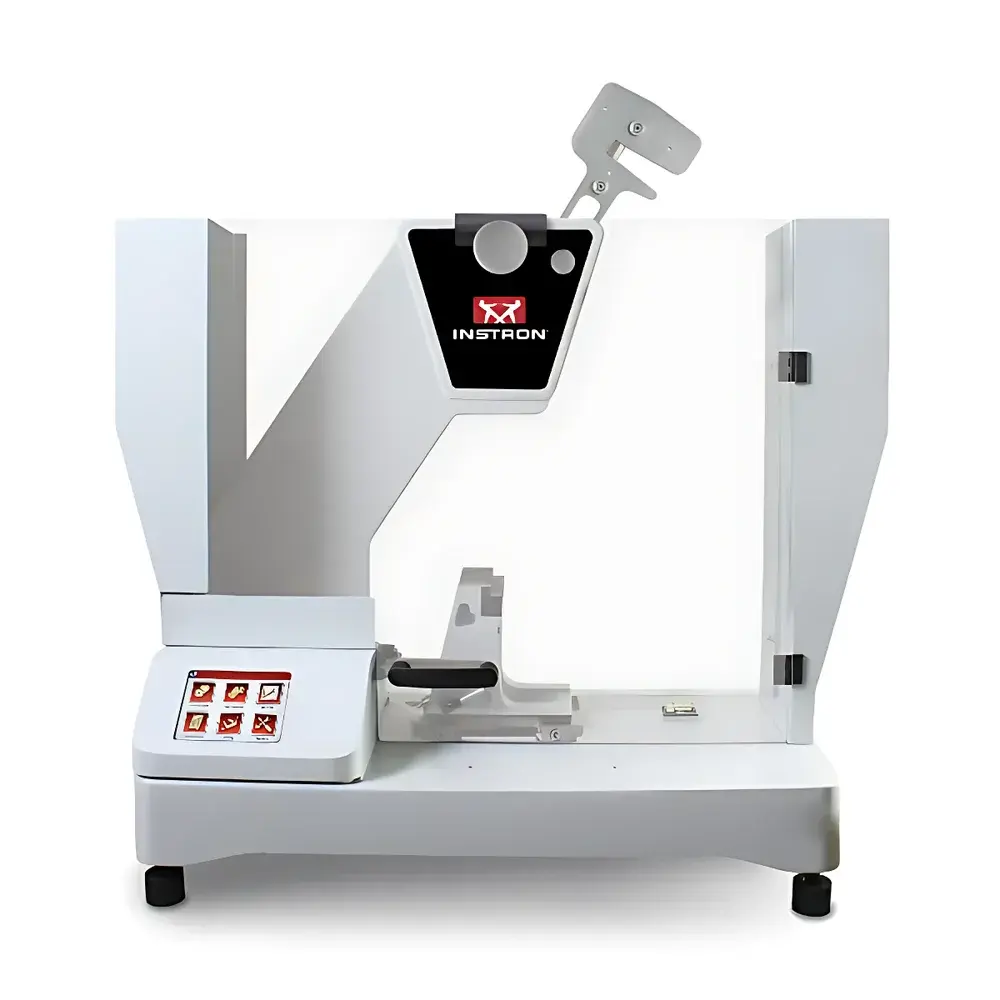
INSTRON CEAST 9050 Pendulum Impact Testing System
| Brand | INSTRON |
|---|---|
| Origin | Italy |
| Manufacturer | CEAST (a brand of INSTRON) |
| Model | CEAST 9050 |
| Instrument Type | Pendulum Impact Tester |
| Impact Energy Range | 0.5–50 J |
| Impact Velocity | 1–3.8 m/s |
| Angular Resolution | 0.05° |
| Safety Compliance | CE Marked |
| Control Interface | Integrated 6.5″ Touchscreen PC |
| Data Acquisition | Optional slip-ring and trigger for instrumented testing |
| Brake System | Dual-surface disc brake (manual or pneumatic actuation) |
| Pendulum Recognition | Automatic magnetic identification with embedded database lookup |
Overview
The INSTRON CEAST 9050 Pendulum Impact Testing System is a precision-engineered, CE-compliant pendulum impact tester designed for standardized and research-grade determination of material toughness under dynamic loading conditions. Based on the classical Charpy and Izod principles—where a gravity-driven pendulum strikes a notched or unnotched specimen—the CEAST 9050 delivers high reproducibility in energy absorption measurement across a broad range of thermoplastics, thermosets, composites, elastomers, and metallic specimens. Its modular architecture supports both non-instrumented (energy-only) and instrumented (force-time history) impact testing per ASTM D256, ISO 179-1, ISO 180, ASTM D1822, ISO 8256, and EN ISO 13802. The system’s rigid monolithic frame, combined with a low-inertia pendulum design and high-fidelity angular position sensing, ensures minimal mechanical hysteresis and exceptional test-to-test repeatability.
Key Features
- Integrated 6.5-inch high-resolution touchscreen PC running CEAST proprietary firmware—enabling full test configuration, real-time monitoring, and on-device result review without external hardware.
- Automatic pendulum identification via magnetic encoder: detects installed hammer type, retrieves nominal energy, calibrated impact velocity, and applicable standards from an internal database—eliminating manual parameter entry errors.
- Non-contact magnetic angular encoder with 0.05° resolution provides traceable, frictionless position feedback critical for accurate potential-to-kinetic energy conversion calculations.
- Dual-surface disc brake system delivers consistent, high-torque deceleration across the full 0.5–50 J energy range; manually actuated on standard models, pneumatically actuated on motorized variants.
- Tool-free pendulum and fixture exchange mechanism using a patented wedge-locking system—ensures repeatable alignment and mechanical stability while reducing setup time by >60% versus threaded-mount alternatives.
- Full perimeter safety enclosure compliant with EU Machinery Directive 2006/42/EC and EN ISO 13857, featuring interlocked access doors and dual-hand activation for manual release (optional pneumatic release available).
Sample Compatibility & Compliance
The CEAST 9050 accommodates standardized specimen geometries per major international protocols: Charpy (3 × 10 × 55 mm), Izod (6.35 × 12.7 × 63.5 mm), Dynstat (10 × 10 × 80 mm), tensile impact bars (ISO 8256), and pipe section coupons (ISO 148-1). Fixture adaptability extends to notched (A, B, C types), unnotched, and micro-notched configurations. All mechanical components—including anvils, supports, and striker edges—are manufactured to ISO 148-2 and ASTM E23 dimensional tolerances. The system meets CE marking requirements for electromagnetic compatibility (2014/30/EU) and low-voltage safety (2014/35/EU), and its firmware architecture supports audit-ready operation under GLP and GMP environments when paired with optional 21 CFR Part 11–compliant software modules.
Software & Data Management
The embedded Windows-based operating system supports local data storage (SSD), USB export (CSV, PDF, XML), and network integration via Ethernet (TCP/IP). Raw angular displacement and optional force/time signals (when equipped with instrumented hammer and slip-ring assembly) are sampled at ≥10 kHz and timestamped with microsecond precision. Data files include full metadata: operator ID, environmental conditions (optional sensor input), calibration certificate IDs, and traceable pendulum identification codes. Exported datasets comply with ASTM E1447 and ISO/IEC 17025 reporting conventions. Remote diagnostics and firmware updates are supported through INSTRON’s secure Connect platform.
Applications
This system is routinely deployed in polymer R&D labs for comparative notch sensitivity analysis, quality control of injection-molded parts, failure mode evaluation of fiber-reinforced composites, and regulatory submission testing for medical device housings (ISO 10993-12). It is also used in academic materials science programs to correlate impact strength with crystallinity (DSC), molecular weight distribution (GPC), and morphology (SEM). In automotive supply chains, the CEAST 9050 validates dash panel resiliency per SAE J2334 and under-hood component performance at sub-zero temperatures (ASTM D746). Its robustness and standardization make it suitable for third-party certification laboratories accredited to ISO/IEC 17025.
FAQ
What standards does the CEAST 9050 support out-of-the-box?
ASTM D256, ISO 179-1, ISO 180, ASTM D1822, ISO 8256, EN ISO 13802, ISO 148-1, and ISO 8256—configurable via firmware menu without additional licensing.
Can the system be upgraded from manual to instrumented testing post-purchase?
Yes—slip-ring assemblies, piezoelectric load cells, and trigger modules are field-installable with firmware update and recalibration.
Is the angular encoder calibrated traceably to national standards?
Yes—each encoder is supplied with a UKAS-accredited calibration certificate (NIST-traceable reference), valid for 12 months.
What is the maximum specimen thickness accommodated in Izod configuration?
12.7 mm per ASTM D256; custom fixtures support up to 25 mm for specialized applications.
Does the system support multi-user access with role-based permissions?
Yes—firmware v3.2+ enables administrator, operator, and viewer profiles with password protection and activity logging.



