
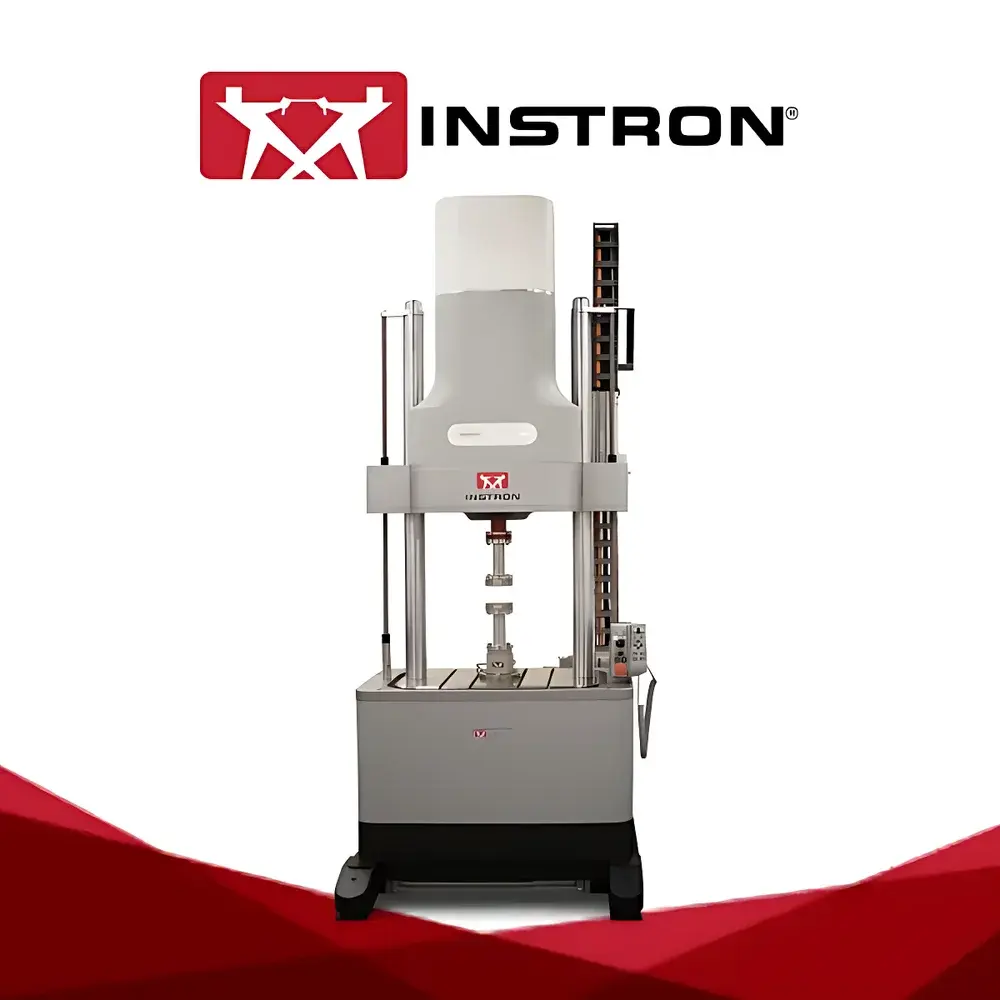
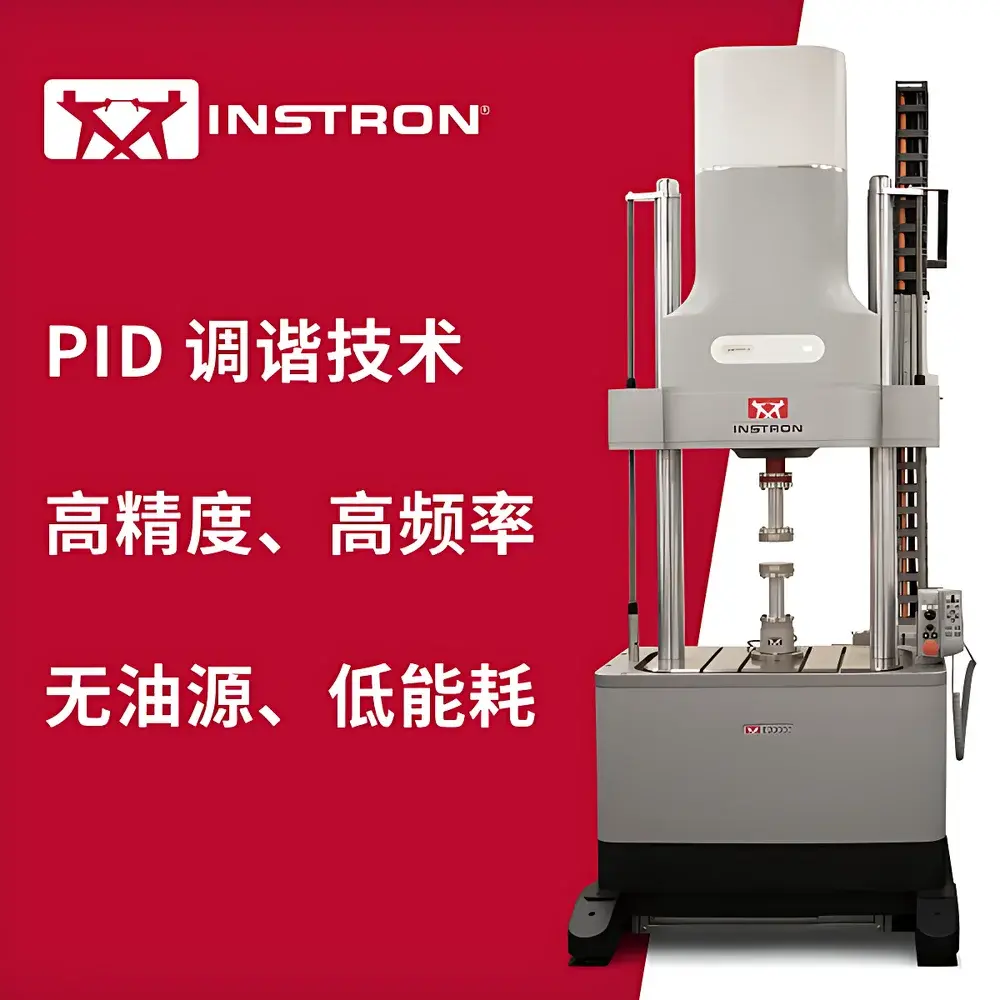
Instron E20000 Electromagnetic Biaxial Tension-Torsion Dynamic and Static Fatigue Testing System
| Brand | Instron |
|---|---|
| Origin | United Kingdom |
| Manufacturer Type | Original Equipment Manufacturer (OEM) |
| Product Category | Imported Instrument |
| Model | E20000 Biaxial Tension-Torsion |
| Maximum Dynamic Load | 20 kN |
| Maximum Dynamic Torque | 130 N·m |
| Frequency Range | Up to 100 Hz |
| Stroke | 75 mm |
| Displacement/Angle Resolution | 5 nm (optical encoder) |
| System Footprint | < 1.2 m² |
| Mass | 1288 kg |
| Actuation Type | Electromagnetic (Oil-Free) |
Overview
The Instron E20000 Electromagnetic Biaxial Tension-Torsion Dynamic and Static Fatigue Testing System represents the latest evolution of the ElectroPuls platform, engineered for high-fidelity mechanical characterization of advanced materials under complex multiaxial loading conditions. Unlike conventional hydraulic or servo-hydraulic fatigue systems, the E20000 employs a fully electromagnetic actuation architecture—eliminating hydraulic fluid, reducing thermal drift, and enabling precise, low-noise operation in standard laboratory environments. Its dual-axis capability permits simultaneous application of axial tensile/compressive forces (up to ±20 kN) and torsional moments (up to ±130 N·m), replicating real-world service loads encountered in aerospace structural components, biomedical implants, composite laminates, and automotive drivetrain elements. The system operates on a closed-loop digital control architecture built upon Instron’s proprietary controller platform, integrating real-time feedback from a Dynacell™ biaxial load cell and high-resolution optical encoders (5 nm displacement resolution; 0.001° angular resolution). With a maximum test frequency of 100 Hz and a total stroke of 75 mm, the E20000 supports both high-cycle fatigue (HCF) and low-cycle fatigue (LCF) regimes while maintaining strict waveform fidelity across sine, trapezoidal, random, and user-defined profiles.
Key Features
- Electromagnetic biaxial actuation—oil-free, quiet, and energy-efficient, with integrated regenerative braking to minimize heat dissipation and reduce laboratory HVAC load.
- Dual-channel digital control with adaptive stiffness-based tuning algorithm—automatically optimizes servo gains based on specimen compliance, ensuring stable response across diverse material types (e.g., metals, polymers, ceramics, soft tissues).
- Patented motorized crosshead locking mechanism—enables rapid, repeatable adjustment of test space without manual intervention or torque wrenching.
- High-precision optical encoders for synchronized measurement of axial displacement and rotational angle—traceable to NIST standards, with sub-nanometer interpolation capability.
- Modular software integration—native compatibility with WaveMatrix™ 3 (for dynamic fatigue, spectrum loading, and crack growth analysis), Bluehill® Fracture (ASTM E399/E1820-compliant fracture mechanics), and Bluehill Universal (static tensile, compression, flexure per ISO 6892-1, ASTM D638, EN 10002-1).
- Compact footprint (<1.2 m²) and vertical load frame design—optimized for space-constrained R&D labs and QA facilities requiring Class 1000 cleanroom compatibility.
Sample Compatibility & Compliance
The E20000 accommodates specimens ranging from miniature metallic coupons (ASTM E606, ISO 1099) to full-scale orthopedic implant constructs (ISO 7206-4, ASTM F2117), including notched, pre-cracked, and bonded joint configurations. Its modular grip and fixture interface supports standardized adapters for wedge, hydraulic, pneumatic, and custom-designed holders—including torsional collets compliant with ISO 148-1 for Charpy impact correlation studies. All hardware and firmware are designed and validated in accordance with ISO/IEC 17025:2017 requirements for testing laboratories. Software modules comply with FDA 21 CFR Part 11 for electronic records and signatures, supporting audit trails, role-based access control, and data integrity protocols required under GLP and GMP frameworks. Calibration procedures follow ISO 376 and ASTM E4 standards, with traceability to UKAS-accredited reference laboratories.
Software & Data Management
WaveMatrix™ 3 provides comprehensive test sequencing, spectral loading definition (e.g., power spectral density inputs), and real-time S–N curve generation with statistical confidence bands. Bluehill Universal delivers automated test method execution—including preload ramping, hold steps, and cyclic parameter sweeps—with export options for CSV, HDF5, and MATLAB-compatible .mat files. All software modules enforce ALCOA+ principles (Attributable, Legible, Contemporaneous, Original, Accurate, Complete, Consistent, Enduring, Available) for raw and processed data. Integrated metadata tagging enables automatic association of environmental conditions (temperature, humidity), operator ID, calibration status, and instrument configuration. Data archives are stored in encrypted SQLite databases with SHA-256 hashing and optional network backup to NAS or cloud repositories meeting ISO 27001 security benchmarks.
Applications
- Aerospace: Multiaxial fatigue life prediction of turbine disk alloys under combined thermo-mechanical loading.
- Biomedical: Cyclic torsion-tension testing of spinal fusion devices per ISO 12189 and ASTM F2193.
- Automotive: Driveshaft and CV joint durability assessment under road-simulated load spectra.
- Energy: Crack propagation behavior in welded offshore wind tower joints subjected to out-of-phase loading.
- Academic Research: Viscoelastic hysteresis quantification in shape-memory polymers using phase-resolved dynamic mechanical analysis (DMA).
FAQ
What standards does the E20000 support for fatigue testing?
The system natively executes test methods aligned with ASTM E466, ISO 1099, and BS EN 6072, with customizable waveform libraries for block-loading, variable-amplitude, and multi-axial proportional/non-proportional protocols.
Is the system suitable for high-temperature testing?
Yes—when integrated with Instron’s environmental chambers (−70 °C to +1000 °C), the E20000 maintains full biaxial control fidelity; chamber interfaces include feedthrough-rated load cell cabling and thermocouple synchronization via EtherCAT.
How is calibration maintained across dynamic and static modes?
Dual-mode calibration is performed independently per axis using traceable deadweight and torque calibration rigs; software enforces mode-specific gain tables and auto-recalls appropriate compensation coefficients during test initiation.
Can third-party sensors be integrated?
Yes—the system features 8-channel analog input (±10 V, 24-bit ADC) and EtherCAT expansion ports for synchronized acquisition from extensometers, strain gauges, acoustic emission transducers, and digital image correlation (DIC) controllers.
What maintenance is required for electromagnetic actuation?
No routine fluid changes or seal replacements; annual verification includes bearing preload check, encoder alignment validation, and controller firmware integrity audit—all documented in the integrated maintenance log module.



