
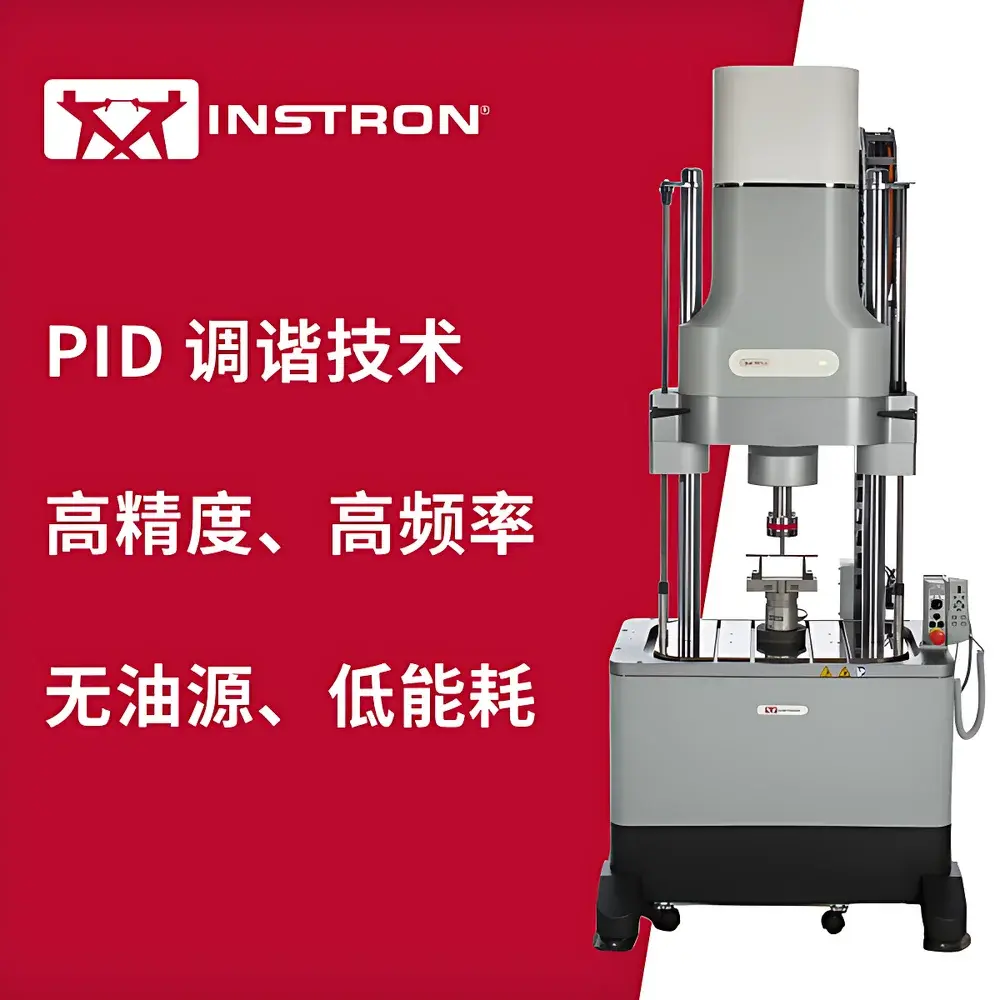
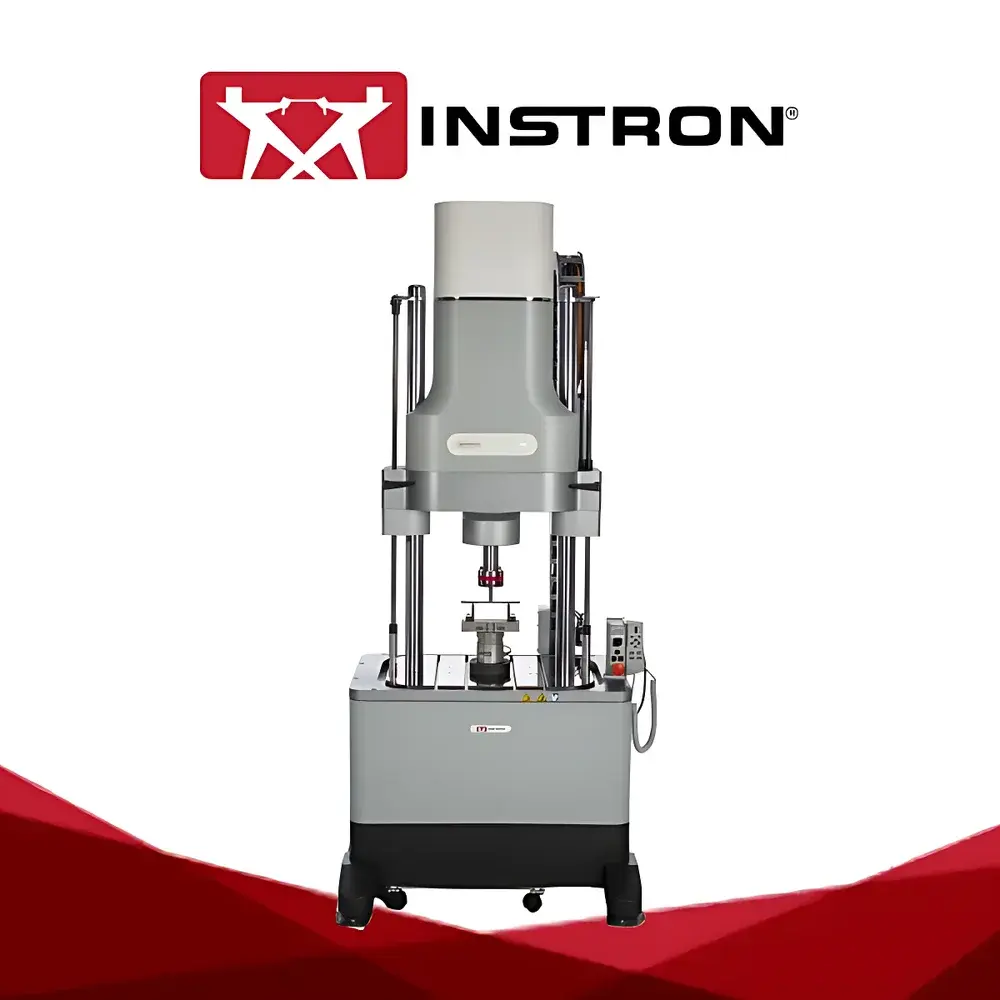
Instron ElectroPuls® E10000 Axial-Torsional Electromechanical Dynamic Fatigue Testing System
| Brand | Instron |
|---|---|
| Origin | United Kingdom |
| Manufacturer Type | Original Equipment Manufacturer (OEM) |
| Import Status | Imported |
| Model | E10000 Axial-Torsional |
| Test Force Capacity | ±10 kN (axial), ±100 N·m (torsional) |
| Frequency Range | up to 100 Hz |
| Frame Weight | 994 kg |
| Power Supply | Single-phase AC |
| Cooling | Temperature-controlled air cooling |
| Frame Footprint | < 0.8 m² (8.6 ft²) |
| Stroke | ±60 mm |
| Torsion Range | ±135° / ±16 revolutions |
| Control System | Instron Dynacell™ dynamic load cell + digital controller with stiffness-based tuning |
| Software Platform | Console™, compatible with WaveMatrix 3™ (dynamic), Bluehill® Universal™ (static), and application-specific modules |
Overview
The Instron ElectroPuls® E10000 Axial-Torsional Electromechanical Dynamic Fatigue Testing System is a high-precision, fully electric test platform engineered for combined axial-torsional loading under static, quasi-static, and high-frequency dynamic conditions. Unlike hydraulic or servo-pneumatic systems, the E10000 employs dual synchronous brushless servo motors—one for axial actuation and one for torsional actuation—enabling true biaxial coupling without cross-talk or mechanical interference. Its measurement architecture integrates Instron’s patented Dynacell™ dynamic load cell technology, which delivers real-time force and torque feedback with minimized inertial error and exceptional signal fidelity across the full 0.001–100 Hz frequency bandwidth. Designed for materials science laboratories, R&D centers, and quality assurance departments in aerospace, biomedical, and automotive sectors, the system complies with fundamental mechanical testing principles defined in ASTM E4, E8, E21, E606, and ISO 1099 for fatigue characterization. The absence of hydraulic fluid or compressed air eliminates contamination risks, supports cleanroom-compatible operation, and reduces total cost of ownership through simplified infrastructure requirements.
Key Features
- Electromechanical biaxial actuation: Independent yet synchronized axial (±10 kN) and torsional (±100 N·m) channels with closed-loop control via high-resolution optical encoders (axial displacement resolution ≤ 0.1 µm; angular resolution ≤ 0.01°)
- Stiffness-based tuning algorithm: Automatically compensates for system compliance in both axial and torsional axes, ensuring accurate load application even under varying specimen stiffness or fixture configurations
- Modular T-slot base and dual-column diagonal frame: Enables rapid reconfiguration for irregular geometries, multi-specimen fixtures, or integration with environmental chambers, video extensometers, or acoustic emission sensors
- Console™ control interface: Intuitive, role-based software environment supporting test method scripting, real-time parameter monitoring, hardware status visualization (standby, active, emergency stop, fault), and integrated safety interlock management
- Single-phase power operation (230 VAC, 50/60 Hz): Eliminates need for auxiliary hydraulics, chillers, or compressed air—reducing facility footprint and enabling deployment in standard laboratory spaces
- Thermally stabilized air-cooling system: Maintains motor and amplifier temperature within operational limits during extended high-cycle fatigue runs (e.g., >10⁶ cycles at 50 Hz)
Sample Compatibility & Compliance
The E10000 accommodates specimens ranging from miniature biomaterial coupons (e.g., orthopedic implant prototypes, stent segments) to structural metallic components (e.g., turbine blade roots, fastener assemblies). Its ±60 mm stroke and ±135° torsion range support standardized geometry specimens per ASTM E2207 (multiaxial fatigue) and ISO 148-1 (notched bar impact simulation). Fixture compatibility includes wedge-action, hydraulic, and pneumatic grips; torsional chucks; and custom-machined adapters—all mounted via ISO-standard T-slots (M8/M10). The system meets electromagnetic compatibility (EMC) requirements per EN 61326-1 and safety standards per EN 61000-6-2/6-4. When configured with audit-trail-enabled software options (e.g., Bluehill Universal with 21 CFR Part 11 compliance package), it supports GLP/GMP-regulated environments requiring electronic records, user authentication, and change control.
Software & Data Management
Control and data acquisition are managed through Instron’s Console™ operating environment—a deterministic, real-time platform built on a Linux RT kernel. Console supports seamless integration with WaveMatrix 3™ for spectrum-driven multiaxial fatigue, harmonic superposition, and block-cycle testing, as well as Bluehill® Universal™ for static tensile/compression/torsion protocols. All test data—including force, torque, displacement, angle, strain (when paired with external extensometers), and thermal feedback—are time-synchronized at ≥10 kHz sampling rate and stored in vendor-neutral HDF5 format. Raw data exports include metadata compliant with ASTM E1434 and ISO/IEC 17025 traceability requirements. Optional add-ons provide automated report generation (PDF/HTML), database archiving (SQL Server/PostgreSQL), and REST API connectivity for LIMS or MES integration.
Applications
- High-cycle multiaxial fatigue of nickel-based superalloys under combined tension-torsion loading (e.g., jet engine shafts)
- Cyclic torsional stability assessment of polymer-based cardiovascular stents per ISO 25539-2
- Low-cycle fatigue behavior of additively manufactured Ti-6Al-4V lattice structures under non-proportional loading paths
- Dynamic shear modulus and damping characterization of viscoelastic elastomers using controlled-strain torsional oscillation
- Reliability validation of micro-electromechanical systems (MEMS) packaging under thermomechanical cycling simulations
- Calibration and verification of constitutive models (e.g., Chaboche, Ohno-Wang) using experimental hysteresis loop data
FAQ
What is the maximum achievable phase shift between axial and torsional waveforms?
The system supports programmable phase offsets from –180° to +180° in 0.1° increments, enabling non-proportional loading paths essential for critical plane analysis.
Can the E10000 be integrated with an environmental chamber?
Yes—its modular base and vertical clearance (≥1.2 m above T-slot surface) accommodate commercially available thermal chambers (–70°C to +300°C) and corrosive atmosphere enclosures with feedthrough-rated cabling.
Is third-party sensor integration supported?
Absolutely—the system provides analog I/O (±10 V, 16-bit) and digital TTL triggers for synchronization with high-speed cameras, digital image correlation (DIC) systems, infrared thermography, or piezoelectric force washers.
Does the system meet FDA 21 CFR Part 11 requirements out of the box?
No—compliance requires optional Bluehill Universal 3.x with Part 11 configuration package, including electronic signatures, audit trail logging, and role-based access control.
What maintenance intervals are recommended for long-term reliability?
Routine inspection every 500 operational hours; Dynacell calibration annually or after 10,000 cycles at peak load; motor bearing lubrication every 20,000 hours per manufacturer service bulletin SB-E10000-REV7.



