
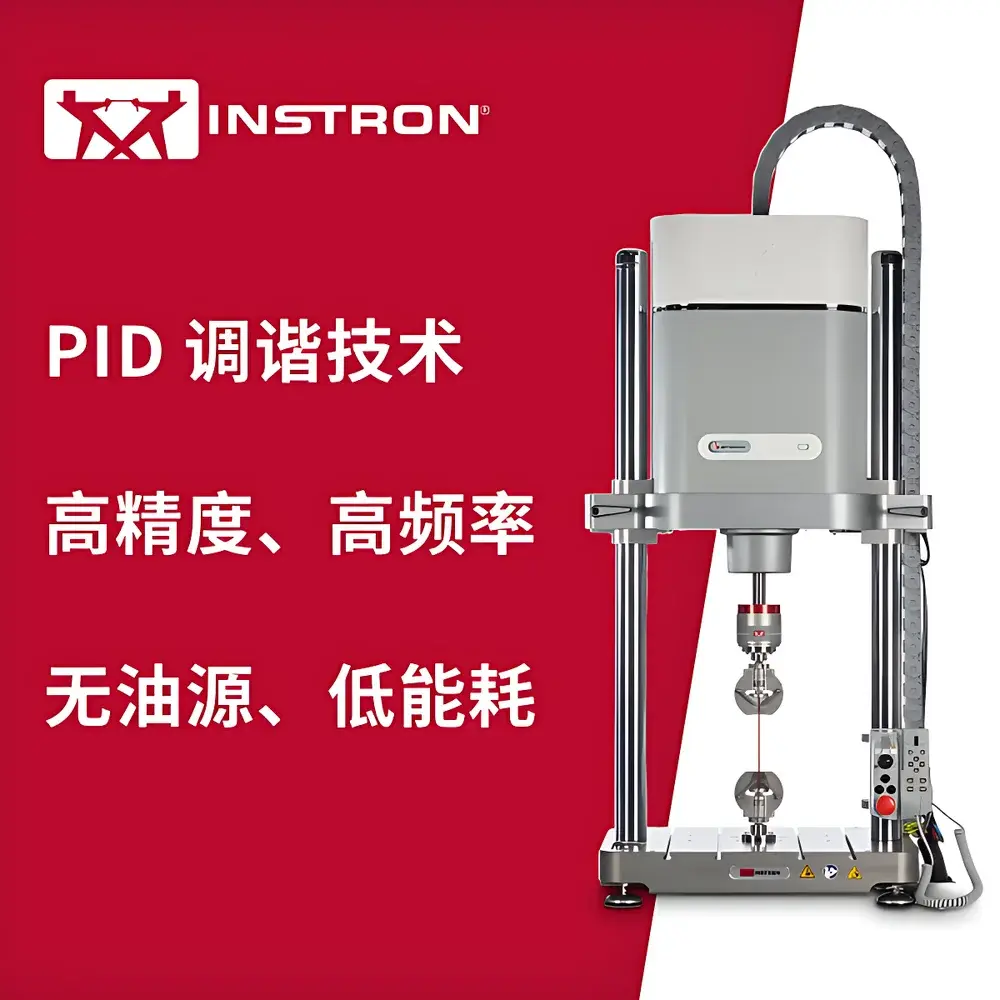
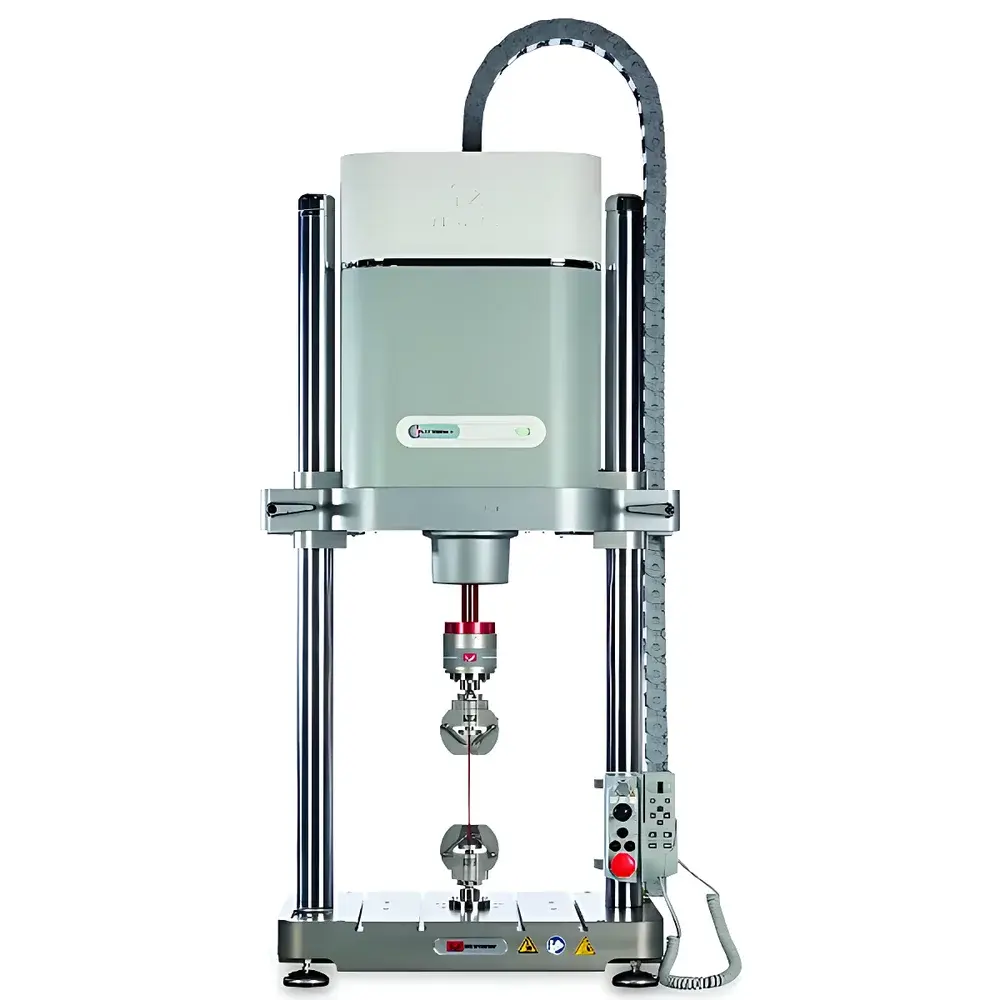
Instron ElectroPuls® E3000 Biaxial Tension-Torsion Electromechanical Dynamic Fatigue Testing System
| Brand | Instron |
|---|---|
| Origin | United Kingdom |
| Manufacturer | Instron (UK) Ltd. |
| Type | Imported |
| Model | E3000 Biaxial Tension-Torsion |
| Frequency Range | 0–100 Hz |
| Frame Weight | 250 kg |
| Power Supply | Single-phase AC |
| Max Dynamic Axial Load | ±3000 N |
| Max Dynamic Torque | ±25 N·m |
| Stroke | ±60 mm |
| Torsional Range | ±135° / ±16 revolutions |
| Cooling | Temperature-controlled air cooling |
| Frame Stiffness | High-rigidity dual-column architecture with optical encoder-based position feedback |
| Control System | Digital controller with stiffness-based tuning algorithm for axial and torsional channels |
| Software Compatibility | WaveMatrix 2 (dynamic), Bluehill Universal (quasi-static), ASTM/ISO-compliant test method libraries |
Overview
The Instron ElectroPuls® E3000 Biaxial Tension-Torsion Electromechanical Dynamic Fatigue Testing System is a high-precision, fully electric materials testing platform engineered for combined axial-torsional fatigue, creep, hysteresis, and cyclic loading characterization under controlled dynamic conditions. Unlike hydraulic or servo-pneumatic systems, the E3000 employs synchronized brushless servo motors for independent yet coordinated control of axial force and torsional moment—enabling true biaxial stress state simulation without fluid media, external cooling circuits, or compressed air infrastructure. Its measurement principle relies on closed-loop digital control of motor current, position (via high-resolution optical encoders), and load (via integrated Dynacell™ dynamic load cells), delivering traceable, low-inertia force and torque actuation with minimal phase lag across its full 0–100 Hz operational bandwidth. Designed for laboratory environments where footprint, cleanliness, and regulatory compliance are critical—including ISO 17025-accredited testing labs and medical device R&D facilities—the system meets foundational requirements for GLP/GMP-aligned fatigue validation per ASTM E466, ISO 1099, and USP .
Key Features
- Electromechanical biaxial actuation: Independent axial (±3000 N) and torsional (±25 N·m) drives eliminate hydraulic oil contamination risks and reduce maintenance overhead.
- Stiffness-based tuning technology: Patented real-time compensation algorithm dynamically adjusts control gains based on specimen and fixture stiffness—ensuring consistent response across diverse material classes (metals, polymers, composites, biomaterials).
- High-rigidity dual-column frame: Precision-machined aluminum structure with optical encoder feedback on both axial and rotational axes supports sub-micron displacement resolution and angular repeatability better than ±0.1°.
- Compact footprint: Occupies less than 0.3 m² (3.2 ft²) of bench space—optimized for integration into shared instrumentation suites or cleanroom-adjacent laboratories.
- Integrated thermal management: Closed-loop temperature-regulated air cooling maintains motor and electronics within specified operating ranges during extended high-frequency cycling (e.g., 10⁶-cycle endurance tests at 50–100 Hz).
- Electric crosshead adjustment: Motorized vertical positioning with mechanical lock enables rapid setup changes between test configurations while preserving alignment integrity.
- System status visualization: LED indicator array provides unambiguous real-time feedback on operational mode (standby, active test, emergency stop, fault condition), supporting audit-ready operational logging.
Sample Compatibility & Compliance
The E3000 accommodates specimens ranging from miniature orthopedic implants (e.g., bone screws, spinal rods) to structural composite coupons and elastomeric bushings. Its modular T-slot base and vertically oriented actuator allow flexible mounting of custom fixtures, environmental chambers (−70 °C to +300 °C), immersion baths, and video extensometry systems. All hardware and firmware comply with CE marking directives (EMC 2014/30/EU, Machinery Directive 2006/42/EC) and support 21 CFR Part 11-compliant electronic records when used with validated Bluehill Universal or WaveMatrix 2 software configurations. Test methods adhere to ASTM E606 (strain-controlled fatigue), ASTM D3479 (tension-torsion fatigue of metals), ISO 12106 (metallic materials—fatigue testing—axial strain control method), and ISO 14641-1 (polymeric vascular stent fatigue). Calibration traceability follows ISO/IEC 17025 requirements through Instron’s accredited calibration services.
Software & Data Management
Control and analysis are executed via Instron’s Console software interface—a deterministic, real-time operating environment built on deterministic Linux kernel extensions. Console supports synchronized acquisition of up to 16 analog channels (load, torque, displacement, angle, thermocouple inputs) at 10 kHz sampling rate with hardware timestamping. WaveMatrix 2 provides advanced dynamic test sequencing, including variable amplitude block loading, spectrum-driven fatigue, and hysteresis loop analysis with automatic energy dissipation calculation. Bluehill Universal delivers ISO/ASTM-compliant static and quasi-static test templates with customizable reporting (PDF, CSV, XML) and configurable audit trails. All data files include embedded metadata: operator ID, calibration certificate IDs, environmental conditions, and firmware revision—enabling full chain-of-custody documentation for regulatory submissions.
Applications
- Mechanical characterization of cardiovascular devices: Cyclic fatigue of nitinol stents, polymer heart valves, and suture anchors under physiological torsion-axial coupling.
- Aerospace component validation: High-cycle fatigue testing of turbine blade root attachments and composite fasteners subjected to multiaxial stress states.
- Automotive NVH research: Dynamic stiffness and damping measurements of elastomeric mounts under combined tension-torsion excitation.
- Advanced material development: Strain-life and crack growth behavior of additively manufactured alloys under non-proportional loading paths.
- Academic biomechanics: In vitro simulation of joint kinematics using anatomically constrained specimen holders and real-time feedback control.
FAQ
Does the E3000 require hydraulic fluid or compressed air?
No. It operates exclusively on single-phase AC power and uses air-cooled electromechanical actuators—eliminating fluid disposal, leakage risk, and pneumatic infrastructure.
Can the system perform out-of-phase axial-torsional loading?
Yes. The digital controller supports independent waveform generation for axial and torsional channels, enabling non-proportional loading paths such as Lissajous patterns or phase-shifted sine waves.
Is the system compatible with third-party environmental chambers?
Yes. Standardized mounting interfaces and analog/digital I/O ports enable seamless integration with commercially available thermal, humidity, and corrosion chambers.
What level of traceability does the system provide for regulatory audits?
Full traceability is supported via 21 CFR Part 11-compliant user authentication, electronic signatures, immutable audit logs, and calibration certificate linkage within Bluehill Universal and WaveMatrix 2.
How is alignment maintained during off-axis loading?
The patented bearing system in the biaxial actuator accommodates minor specimen misalignment and lateral forces without compromising load path fidelity or introducing parasitic bending moments.



