
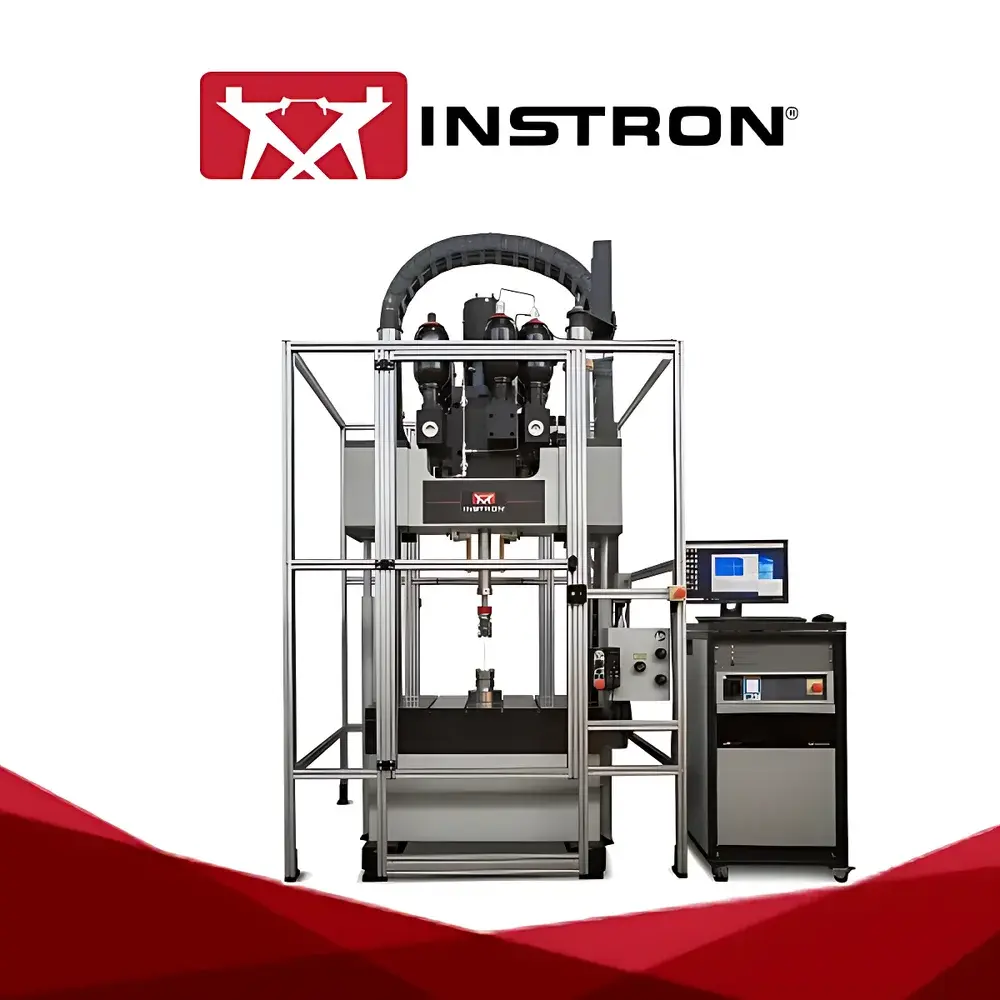
Instron VHS High Strain Rate / High-Speed Tensile Testing System
| Brand | Instron |
|---|---|
| Origin | United Kingdom |
| Manufacturer Type | Original Equipment Manufacturer (OEM) |
| Origin Category | Imported |
| Model | VHS |
| Test Machine Type | Electro-Hydraulic Servo Fatigue Testing System |
| Maximum Test Force | ±35 kN, ±40 kN, ±65 kN, ±160 kN |
| Velocity Range | Up to 20 m/s (VHS 65/80 optional at 25 m/s) |
| Machine Weight | 2500 kg, 2900 kg, or 5300 kg depending on configuration |
Overview
The Instron VHS High Strain Rate / High-Speed Tensile Testing System is an electro-hydraulic servo-controlled dynamic testing platform engineered for precise mechanical characterization of materials under strain rates ranging from quasi-static (≤0.001 s⁻¹) to ultra-high rates exceeding 1000 s⁻¹. It operates on the principle of controlled high-velocity actuator displacement, enabling direct measurement of force, displacement, and time-resolved response during transient loading events. Unlike conventional hydraulic or servo-motor systems limited by bandwidth and inertia, the VHS architecture integrates high-flow servo valves, optimized accumulator banks, and low-mass actuators to deliver repeatable, high-fidelity data acquisition at velocities up to 25 m/s—critical for capturing true material behavior during impact, crash, or ballistic loading conditions. The system is purpose-built for laboratories engaged in structural integrity validation, finite element model (FEM) calibration, and regulatory compliance testing where dynamic mechanical response directly informs safety-critical design decisions.
Key Features
- Seamless transition between closed-loop (velocity ≤1 m/s) and open-loop (velocity >1 m/s) control modes, ensuring stability across the full operational range
- Rigid, high-stiffness frame architecture minimizes parasitic vibrations and ensures rapid load application—reducing time-to-steady-state by up to 40% compared to legacy high-speed frames
- Standard 300 mm actuator stroke accommodates typical metallic and composite specimen geometries; optional 600 mm stroke variant supports large-strain polymer testing
- Modular hydraulic power unit with dual accumulator banks and high-capacity servo valves maintains consistent flow delivery, limiting velocity drop to <2% during peak-load transients
- Lightweight actuator assembly reduces inertial lag, shortening required acceleration distance and improving signal fidelity at initiation
- Interlocked safety enclosure with dual-redundant hydraulic circuit monitoring complies with EU Machinery Directive 2006/42/EC and carries full CE certification
- Native integration with Digital Image Correlation (DIC) systems—including hardware-triggered synchronization and post-test resampling aligned to machine timestamps
- Thermal compatibility with environmental chambers (–70°C to +250°C) and induction heating systems (up to 1000°C) for temperature-dependent dynamic testing
Sample Compatibility & Compliance
The VHS system supports standardized test specimens per ISO 26203-2 (tensile testing at high strain rates), ISO 18872 (dynamic tensile properties of plastics), SAE J2749 (automotive component crash simulation), ASTM D3763 (instrumented impact puncture), ISO 6603-2 (puncture resistance of plastics), and ISO 11343 (splitting tensile strength under impact). Specimen geometries include dog-bone, notched, and custom-profile configurations for metals, fiber-reinforced composites, thermoplastics, elastomers, and foams. Fixture options include sleeve-type grips, rapid-action jaw clamps, ISO/ASTM-compliant puncture tooling, and lateral-force-compensated compression platens—all calibrated to NIST-traceable standards. All configurations support GLP/GMP-aligned audit trails when used with Bluehill® VHS Analysis software under FDA 21 CFR Part 11-compliant settings.
Software & Data Management
The VHS 8800MT controller runs Instron’s dedicated high-speed testing software suite, delivering synchronized acquisition at up to 60 MHz sampling rate and real-time analog bandwidth of 200 kHz for strain gauge signals. Built-in polynomial curve fitting tools enable direct export of stress–strain derivatives for constitutive modeling (e.g., Johnson–Cook, Zerilli–Armstrong). Batch analysis modules automate statistical comparison across multiple test files—including mean, standard deviation, coefficient of variation, and outlier detection per ASTM E2282. DIC data integration supports pixel-level strain mapping with temporal alignment to force–displacement records. All raw and processed datasets are stored in vendor-neutral HDF5 format, supporting third-party post-processing in MATLAB®, Python (NumPy/Pandas), or commercial FEA platforms. Audit logs record user actions, parameter changes, calibration events, and system health metrics—fully compliant with ISO/IEC 17025 and internal quality management requirements.
Applications
The VHS system serves as a foundational tool in aerospace (landing gear impact absorption, turbine blade containment), automotive (crashworthiness validation, bumper energy absorption), defense (ballistic fabric performance, armor layer interaction), biomedical (suture tensile failure, implant fixation under dynamic loading), and advanced manufacturing (additive manufacturing part qualification under shock loading). It enables quantitative evaluation of strain-rate sensitivity, ductile-to-brittle transition, adiabatic shear band formation, and viscoelastic relaxation kinetics. Researchers use it to validate constitutive models against experimental benchmarks, while R&D engineers apply results to topology-optimized lightweighting strategies—reducing prototype iterations and accelerating time-to-certification.
FAQ
What strain rate ranges does the VHS system support?
The system covers strain rates from quasi-static (0.001 s⁻¹) up to 1000 s⁻¹, dependent on specimen geometry, material modulus, and selected actuator velocity (20 m/s standard; 25 m/s optional on VHS 65/80).
Can the VHS system perform compression or shear tests?
Yes—via interchangeable fixtures including lateral-force-compensated compression platens and ISO 11343-compliant splitting tensile tooling; shear testing requires custom fixture design validated per ASTM D7078.
Is DIC integration mandatory for accurate strain measurement?
No—contact-based extensometers and high-bandwidth strain gauges remain valid for many applications; however, DIC is essential for non-contact measurement on brittle materials, elevated temperatures, or geometrically complex specimens.
How is traceability maintained for calibration and testing?
All load cells are calibrated per ISO 376 using NIST-traceable deadweight standards; displacement sensors are verified via laser interferometry; software audit trails comply with ISO/IEC 17025 clause 7.7 and FDA 21 CFR Part 11.
Does the system support automated test sequences across varying strain rates?
Yes—the Bluehill® VHS Analysis software allows scripting of multi-step velocity profiles, automatic fixture recognition, and conditional pass/fail logic based on real-time parameter thresholds.
Related Products



