
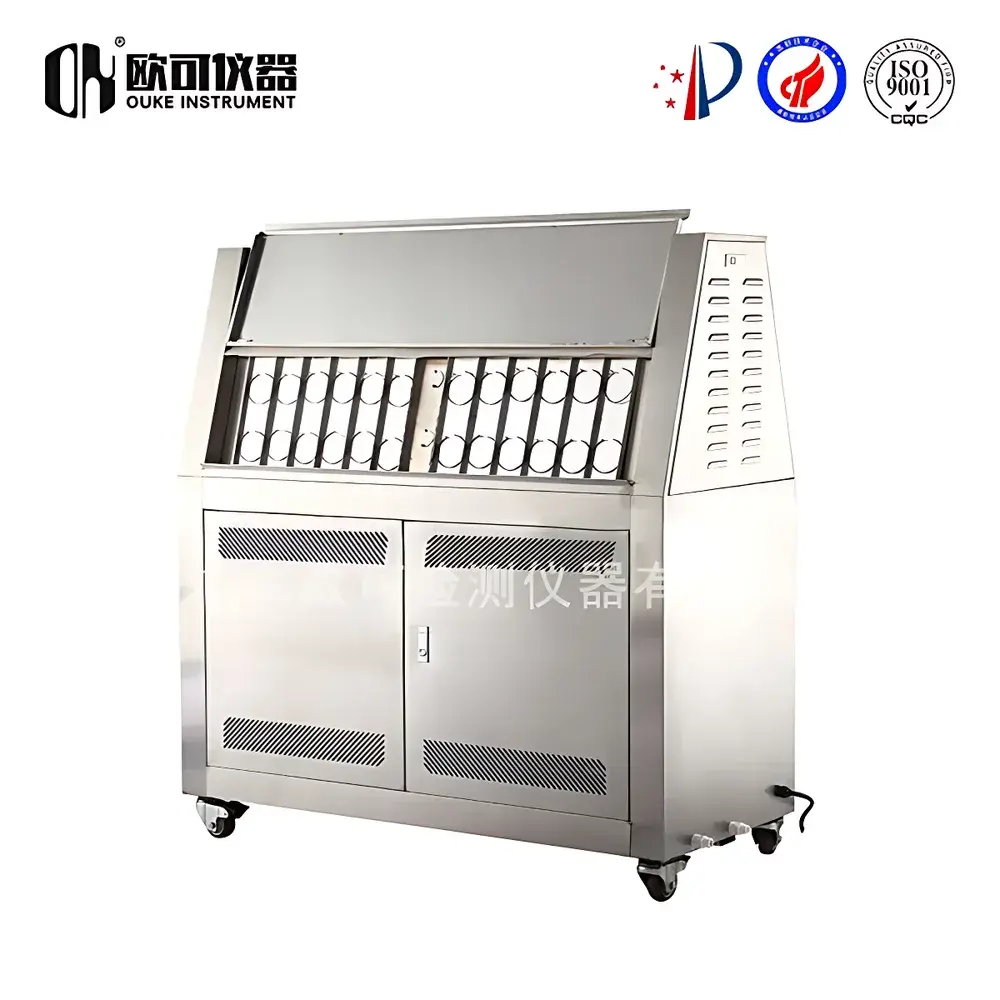
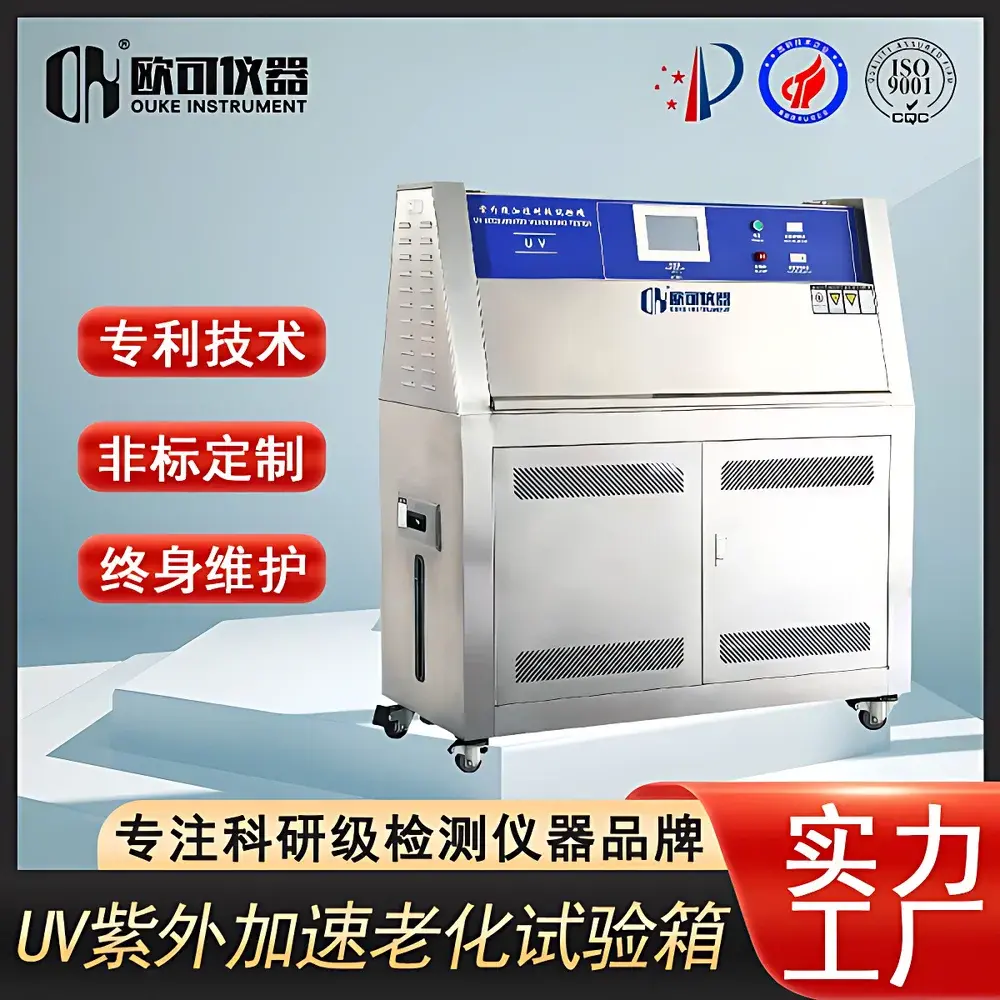
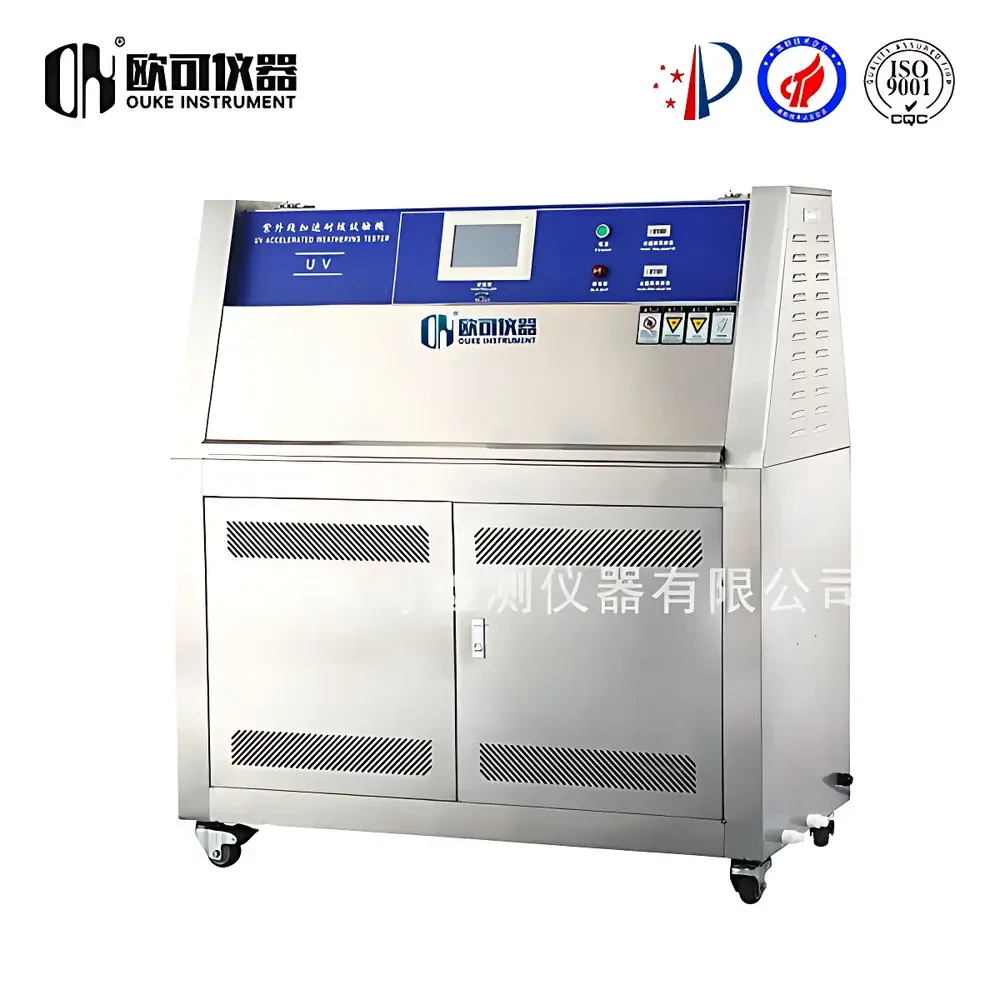
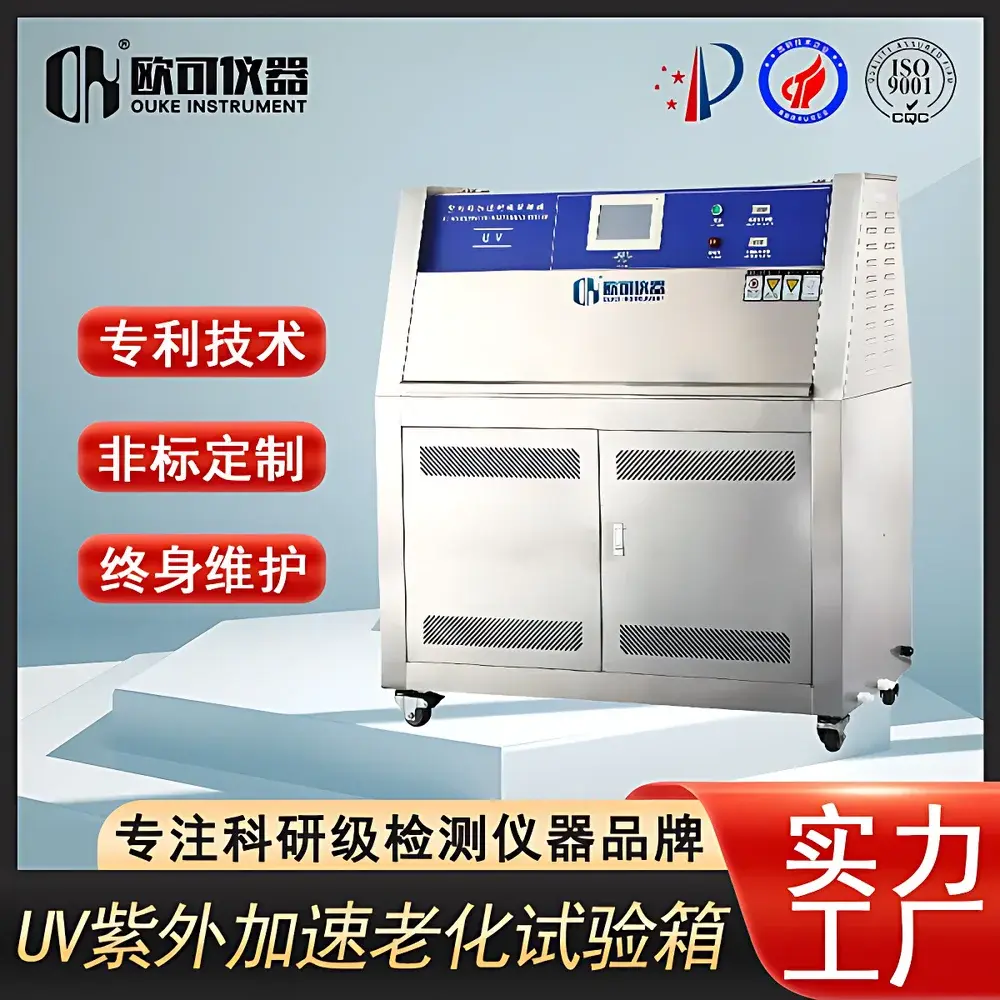
OK Instruments OK-UV-290.00..1 UV Aging Test Chamber for Leather
| Brand | OK Instruments |
|---|---|
| Origin | Guangdong, China |
| Manufacturer Type | Direct Manufacturer |
| Model | OK-UV-290.00..1 |
| Humidity Range | ≥95% RH (in-chamber actual value) |
| Lamp Power | 40 W per tube |
| Irradiance Range | 0.72 W/m² |
| Exposure Time | 1–9999 h (adjustable) |
| Black Panel Temperature Range | RT to 70 °C |
| UV Wavelength Range | 280–400 nm |
| Chamber Dimensions (L×W×H) | 1170 × 400 × 400 mm |
Overview
The OK Instruments OK-UV-290.00..1 UV Aging Test Chamber is an engineered environmental simulation system designed specifically for accelerated weathering evaluation of leather materials under controlled ultraviolet irradiation, temperature, and humidity stressors. It operates on the principle of fluorescent UV lamp exposure—primarily utilizing UVA-340 spectral output (peak emission at ~340 nm, with effective range 295–365 nm) to replicate the most photochemically active portion of terrestrial solar UV radiation. Unlike broad-spectrum xenon arc or carbon arc sources, this chamber prioritizes high-fidelity UV acceleration while maintaining reproducible thermal and hygric boundary conditions. Its primary function is to quantify degradation kinetics—including color fading (ΔE), surface cracking, coating delamination, gloss loss, and tensile property deterioration—in finished leathers used in footwear, automotive interiors, upholstery, and fashion accessories. The system enables laboratories to compress years of natural outdoor or indoor window-exposed service life into days or weeks, supporting both R&D formulation screening and routine QC validation.
Key Features
- UVA-340 fluorescent lamp array (40 W per tube) delivering spectrally accurate irradiance matching natural sunlight below 365 nm, with calibrated output at 0.72 W/m² (measured at specimen plane)
- Stainless steel interior chamber (1170 × 400 × 400 mm) resistant to UV-induced corrosion and moisture accumulation
- Precise black panel temperature control from ambient to 70 °C, ensuring consistent thermal loading during irradiation cycles
- Condensation humidity generation via heated water pan, enabling realistic dew formation simulation during dark cycles (≥95% RH achievable)
- Programmable digital controller supporting multi-step exposure profiles: UV-only, UV/condensation, or UV/condensation/spray sequences per ASTM G154 Cycle 1–4
- Uniform irradiance distribution across sample rack surface, verified per ISO 4892-3 Annex B requirements
- Compliance-ready architecture: audit trail-capable logging (time, temperature, irradiance), password-protected parameter locking, and calibration traceability documentation support
Sample Compatibility & Compliance
The OK-UV-290.00..1 accommodates standard leather test specimens (e.g., 75 × 150 mm strips or circular 50 mm discs) mounted on non-reflective, thermally stable aluminum racks. It supports full-grain, corrected-grain, nubuck, suede, and coated leathers—including chrome-tanned, vegetable-tanned, and synthetic-blend substrates. The chamber meets the operational prerequisites of key international standards including ASTM G154 (Standard Practice for Operating Fluorescent Ultraviolet (UV) Lamp Apparatus for Exposure of Nonmetallic Materials), ISO 4892-3 (Plastics — Methods of exposure to laboratory light sources — Part 3: Fluorescent UV lamps), and GB/T 14522 (Mechanical testing — Artificial weathering of plastics and rubber using fluorescent UV lamps). While not certified to SAE J2412/J2020 out-of-the-box, its irradiance stability, temperature uniformity (< ±2 °C), and programmable condensation cycle capability allow method adaptation for automotive leather qualification when validated per OEM-specific protocols.
Software & Data Management
The embedded microprocessor controller records real-time black panel temperature, chamber humidity, elapsed exposure time, and cumulative UV dose (integrated irradiance × time). Data export is supported via USB interface in CSV format for post-processing in Excel or LIMS platforms. Optional PC-based software provides extended functionality: remote monitoring, automated report generation (including pass/fail flags against user-defined thresholds), GLP-compliant electronic signatures, and 21 CFR Part 11 audit trail configuration (user access logs, parameter change history, data integrity checksums). All calibration events—including irradiance sensor verification using NIST-traceable reference meters—are logged and exportable for regulatory audits.
Applications
- Accelerated aging comparison of tanning agents, fatliquors, and topcoats during leather formulation development
- Batch-to-batch consistency verification in production QA workflows
- Supplier qualification testing for automotive OEM Tier-1 suppliers (aligned with J2412 pre-screening requirements)
- Correlation studies between accelerated UV exposure and real-world field performance of furniture and footwear leathers
- Failure analysis of premature surface degradation mechanisms (e.g., UV-initiated hydrolysis of polyurethane coatings)
- Supporting ISO 105-B02 and AATCC TM186-compliant colorfastness assessments for coated leathers
FAQ
Does this chamber support UVB-313 lamps for more aggressive testing?
Yes—the lamp fixture is mechanically and electrically compatible with UVB-313 tubes; however, substitution requires recalibration of irradiance sensors and revision of exposure duration protocols per ASTM D4329 guidelines.
Is condensation cycling mandatory for leather testing?
Not universally—but it is strongly recommended for automotive and outdoor applications where diurnal moisture cycling drives hydrolytic degradation; omission may underestimate real-world failure modes.
Can I validate irradiance uniformity myself?
Yes—using a calibrated handheld UV radiometer (e.g., EIT PowerMap or Sper Scientific 840025), users can map irradiance across the sample plane per ISO 4892-3 Annex B procedures; OK Instruments provides a measurement grid template and acceptance criteria.
What maintenance intervals are required for long-term accuracy?
Lamp replacement every 1600–2000 hours of operation; quarterly verification of humidity sensor drift; annual recalibration of black panel temperature sensor and irradiance detector by an accredited metrology lab.
How does this chamber differ from xenon arc weatherometers for leather testing?
Xenon arc systems replicate full-spectrum solar radiation (including visible and IR), making them suitable for color and gloss evaluation; the OK-UV-290.00..1 focuses exclusively on UV-driven chemical degradation—offering higher throughput, lower operating cost, and superior repeatability for polymer backbone scission and chromophore breakdown mechanisms.



