
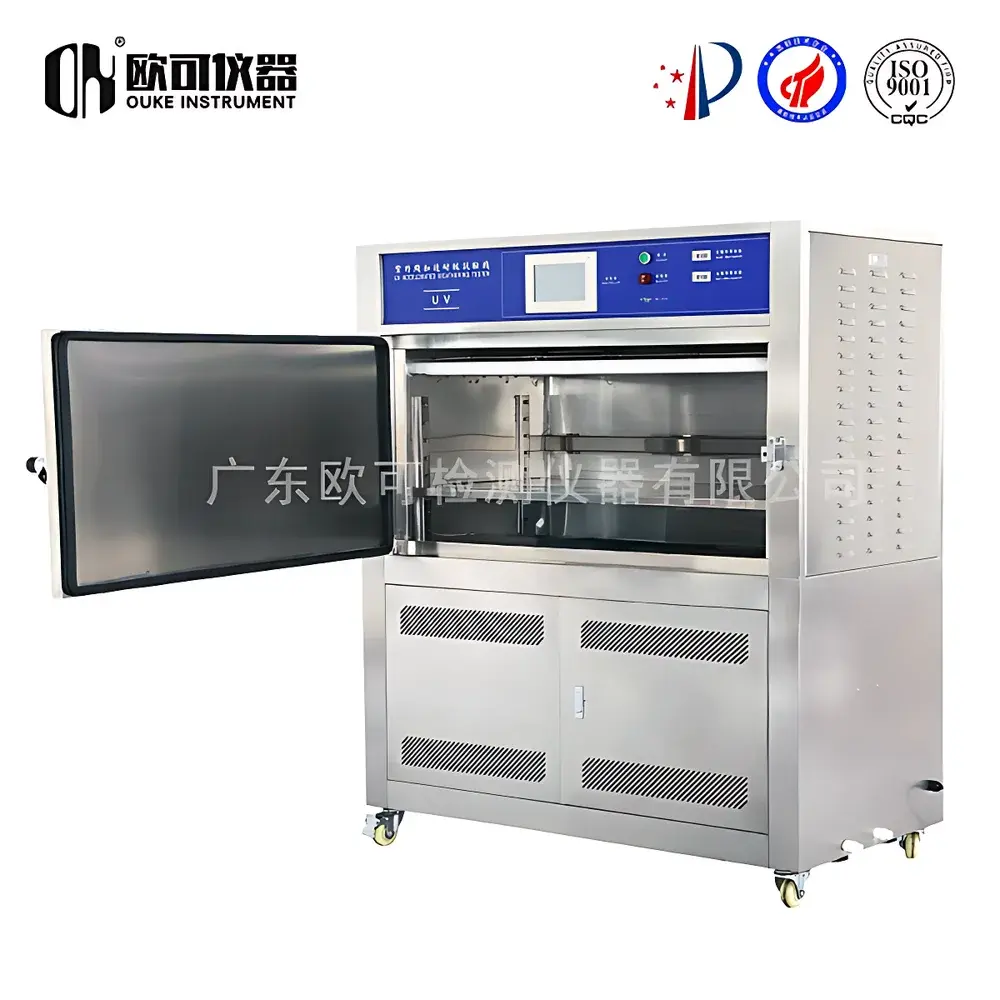
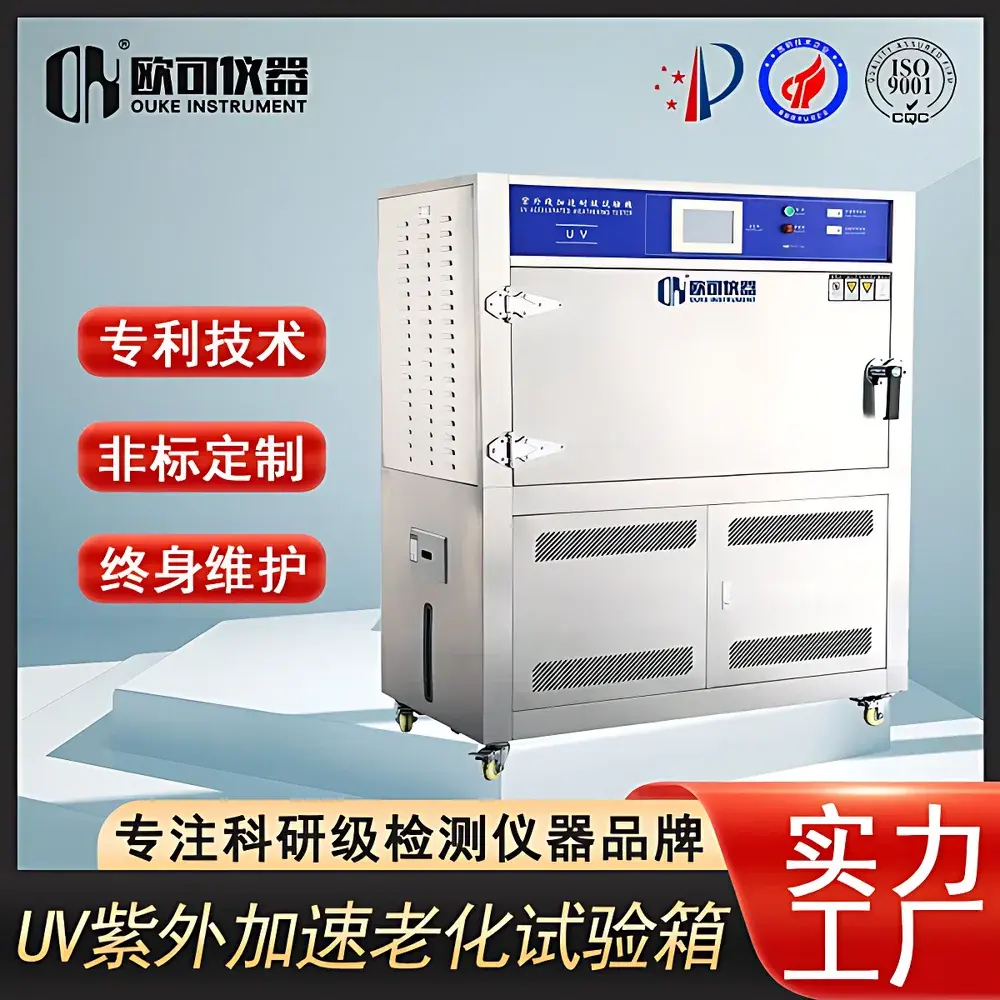
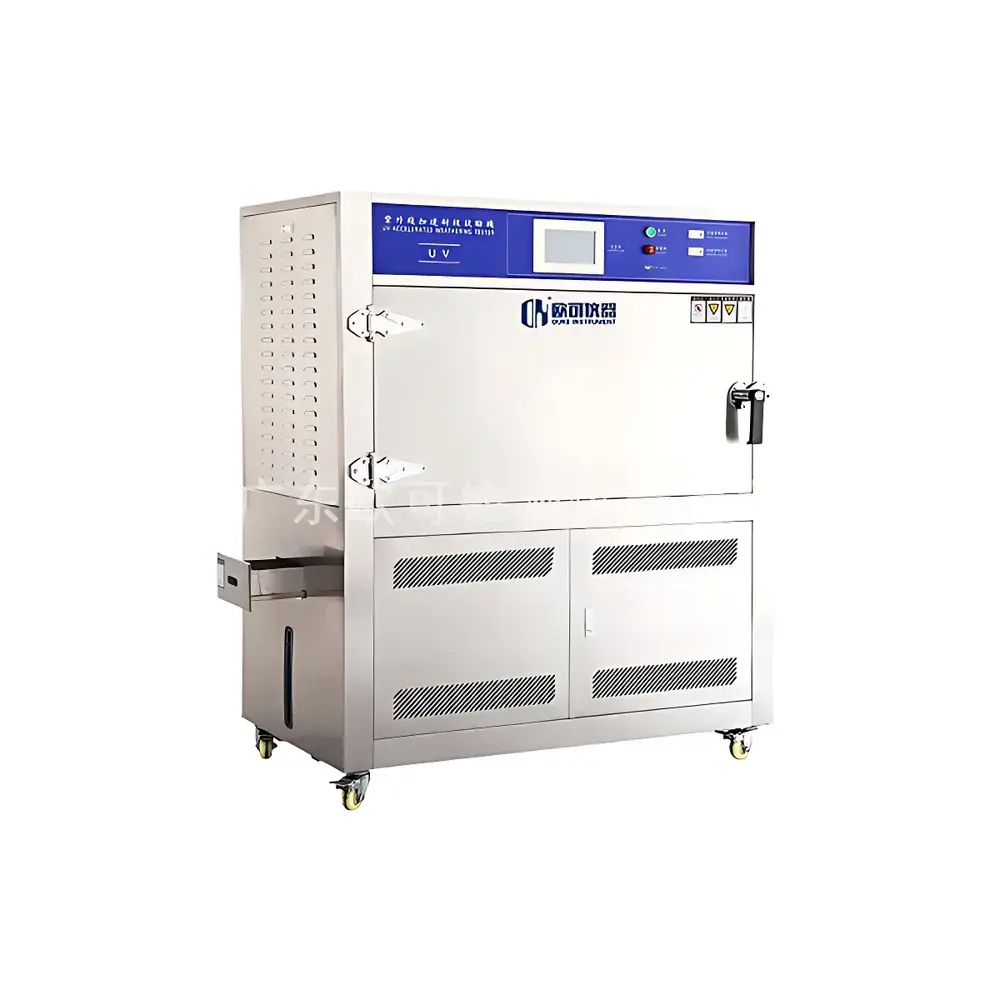
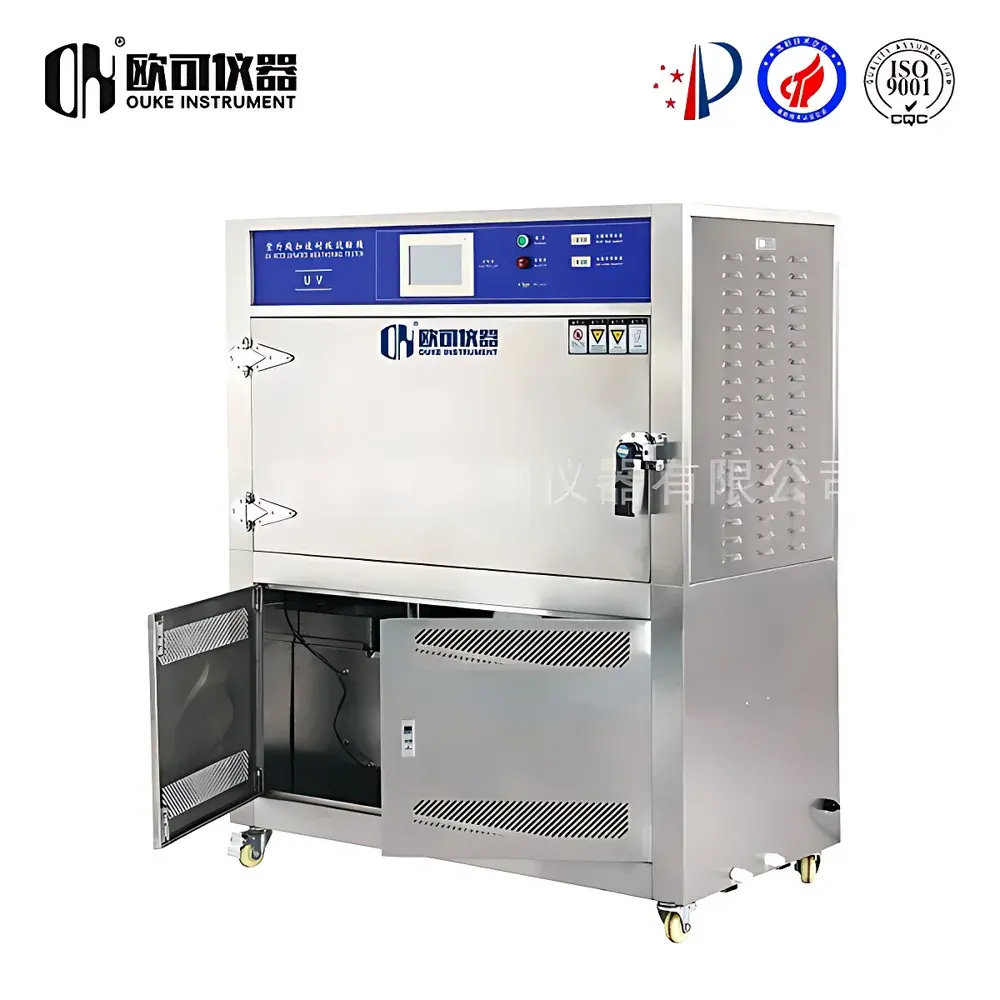
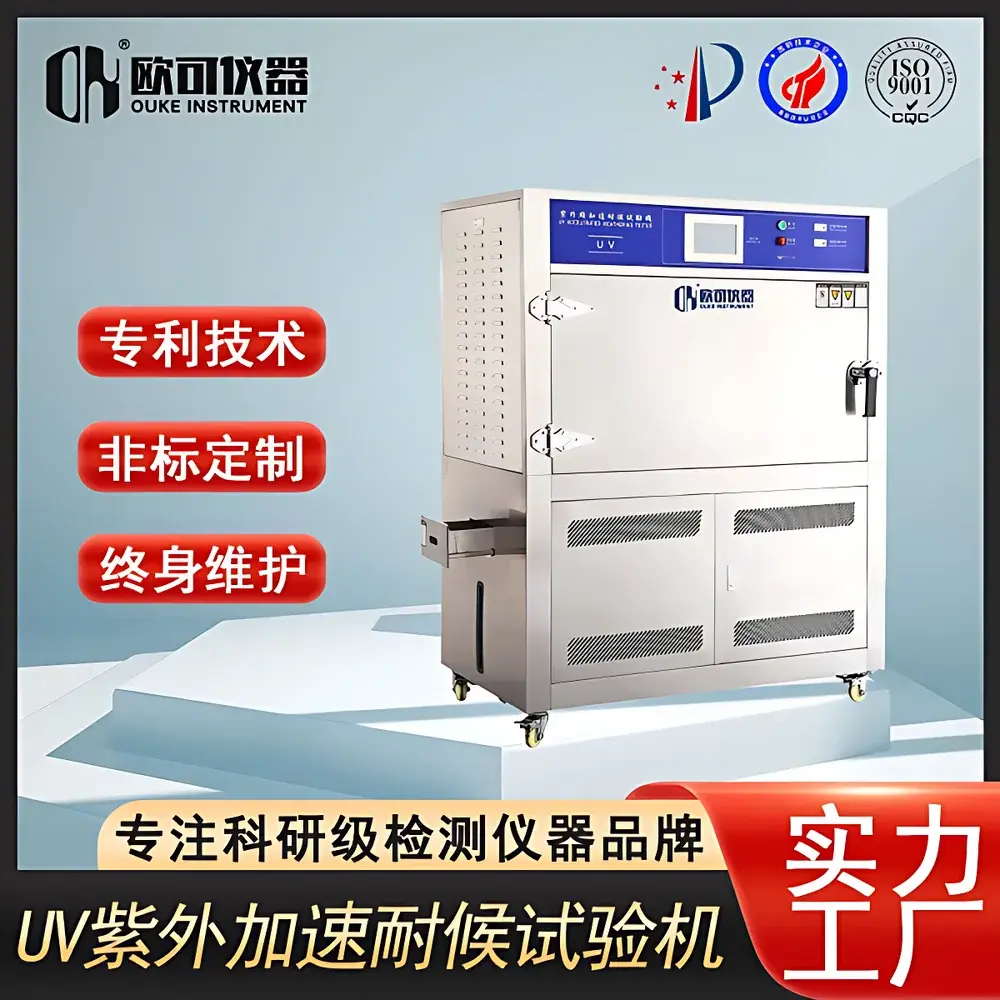
OK Instruments OK-UV-290.0100 UV Aging Test Chamber
| Brand | OK Instruments |
|---|---|
| Origin | Guangdong, China |
| Manufacturer Type | Direct Manufacturer |
| Model | OK-UV-290.0100 |
| Humidity Range | ≥95% RH (in-chamber actual value) |
| UV Lamp Power | 40 W per lamp |
| Irradiance Range | 0.72 W/m² |
| Exposure Time Setting | 1–9999 h |
| Illuminated Temperature Setpoint | 75 °C |
| UV Wavelength Peak | 300 nm |
| Internal Dimensions (W×H×D) | 114×40×40 cm |
| Temperature Range | RT to 70 °C |
| Temp. Control Accuracy | ≤±0.5 °C |
| Temp. Uniformity | ≤±2 °C or ≤±3% |
| UV Spectrum Range | 280–400 nm |
| Lamp Lifetime (avg.) | ~2000 h |
| Chamber Material | SUS#304 stainless steel (inner & outer) |
| Heating System | U-shaped titanium alloy high-speed heating elements |
| Safety Features | Interlocked door cutoff (UV power disabled upon door opening), over-temperature protection, low-water level cutoff |
| Power Supply | AC 220 ±5% V, 50 ±0.5 Hz |
Overview
The OK Instruments OK-UV-290.0100 UV Aging Test Chamber is an engineered environmental simulation system designed to accelerate material degradation under controlled ultraviolet radiation, thermal stress, and moisture condensation—mimicking key outdoor weathering factors in a reproducible laboratory setting. Based on the principles of photochemical degradation kinetics, the chamber employs fluorescent UV lamps emitting within the 280–400 nm spectral band (peak at 300 nm), corresponding to the most damaging region of solar UV-B and UV-A irradiation. Combined with programmable temperature control (RT to 70 °C) and high-humidity condensation cycles (≥95% RH), it replicates natural aging mechanisms such as polymer chain scission, pigment fading, surface chalking, and coating delamination. Unlike broad-spectrum xenon arc testers, this chamber prioritizes UV-specific photodegradation pathways relevant to long-term durability assessment of organic materials under prolonged sunlight exposure.
Key Features
- Stainless steel construction: Fully welded SUS#304 interior and exterior chambers ensure corrosion resistance, ease of cleaning, and long-term structural integrity under humid and UV-rich environments.
- UV irradiance stability: Calibrated 40 W fluorescent UV lamps deliver consistent 0.72 W/m² irradiance at specimen plane; lamp arrays are replaceable as a modular unit with average service life of ~2000 hours.
- Precise environmental control: Digital PID temperature regulation maintains setpoints within ±0.5 °C accuracy; uniformity across working volume remains ≤±2 °C or ≤±3%, verified per ASTM G154 Annex A1.
- Condensation-driven moisture cycle: Integrated cold-wall condensation system achieves ≥95% RH without external water spray—enabling realistic dew formation on test specimens during dark cycles.
- Safety-integrated operation: Door interlock circuit instantly de-energizes UV lamps upon chamber access; independent over-temperature and low-water-level safeguards prevent thermal runaway or dry-heating damage.
- Flexible exposure programming: Timer range spans 1–9999 hours with non-volatile memory retention; users may define multi-step cycles combining UV-on/heat, dark/condensation, and rest phases.
Sample Compatibility & Compliance
The OK-UV-290.0100 accommodates flat-panel specimens up to 114 cm wide × 40 cm high × 40 cm deep, suitable for coated panels, plastic sheets, textile swatches, adhesive tapes, and automotive trim components. Its operational envelope aligns with internationally recognized standards including ASTM G154 (Standard Practice for Operating Fluorescent Ultraviolet (UV) Lamp Apparatus for Exposure of Nonmetallic Materials), ISO 4892-3 (Plastics — Methods of exposure to laboratory light sources — Part 3: Fluorescent UV lamps), and GB/T 14522 (Chinese national standard for mechanical property evaluation after UV exposure). The chamber supports GLP-compliant testing workflows when paired with external data loggers meeting IEC 61000-4-30 Class A requirements for traceable environmental monitoring.
Software & Data Management
While the base model features a digital LED controller with manual parameter input, optional RS-485 interface enables integration with third-party SCADA or LIMS platforms for automated data acquisition. All temperature, irradiance (via optional calibrated sensor), and runtime parameters are logged locally with timestamped records stored in non-volatile memory. Audit trails—including operator ID, parameter changes, alarm events, and maintenance logs—can be exported via USB for regulatory review. The system architecture complies with foundational elements of FDA 21 CFR Part 11 when used with validated software extensions, supporting electronic signatures and secure user access levels in regulated QC/QA environments.
Applications
This UV aging chamber serves critical R&D and quality assurance functions across industries where UV resistance directly correlates with product lifetime and safety compliance. In coatings and inks, it evaluates gloss retention, color shift (ΔE), and adhesion loss after accelerated exposure—supporting formulation optimization against ISO 11341. Automotive suppliers use it to validate dashboard polymers, sealants, and headlamp lenses per SAE J2020. Plastics manufacturers assess embrittlement onset in PP, ABS, and PC compounds using tensile strength drop-off metrics post-exposure. Additional use cases include UV stability screening of medical device packaging (ISO 11607), cosmetic ingredient photostability (ICH Q5C), and architectural sealant performance per ASTM C719.
FAQ
What UV spectrum does the OK-UV-290.0100 emit, and how is it calibrated?
The chamber uses fluorescent UV-B/UVA lamps covering 280–400 nm, with peak output at 300 nm. Irradiance is factory-calibrated to 0.72 W/m² at specimen level using NIST-traceable radiometers.
Can the chamber perform cyclic testing with alternating UV and condensation phases?
Yes—users may program custom sequences including UV irradiation at elevated temperature (e.g., 75 °C), followed by dark condensation at high humidity (≥95% RH), simulating diurnal weathering patterns.
Is the chamber suitable for testing metallic substrates with organic coatings?
Absolutely. The stainless steel chamber and non-corrosive environment prevent interference with substrate-coating interfacial degradation analysis, including blistering, rust creep, and cathodic disbondment initiation.
How often must UV lamps be replaced, and is recalibration required after replacement?
Lamps should be replaced every ~2000 hours of operation or when irradiance drops >10% from baseline. Post-replacement verification with a calibrated sensor is recommended to maintain measurement traceability.
Does the system meet electromagnetic compatibility (EMC) requirements for laboratory deployment?
The chamber complies with EN 61326-1 (2013) for EMC in laboratory environments, including conducted/radiated emissions and electrostatic discharge immunity per IEC 61000-4-2.



