
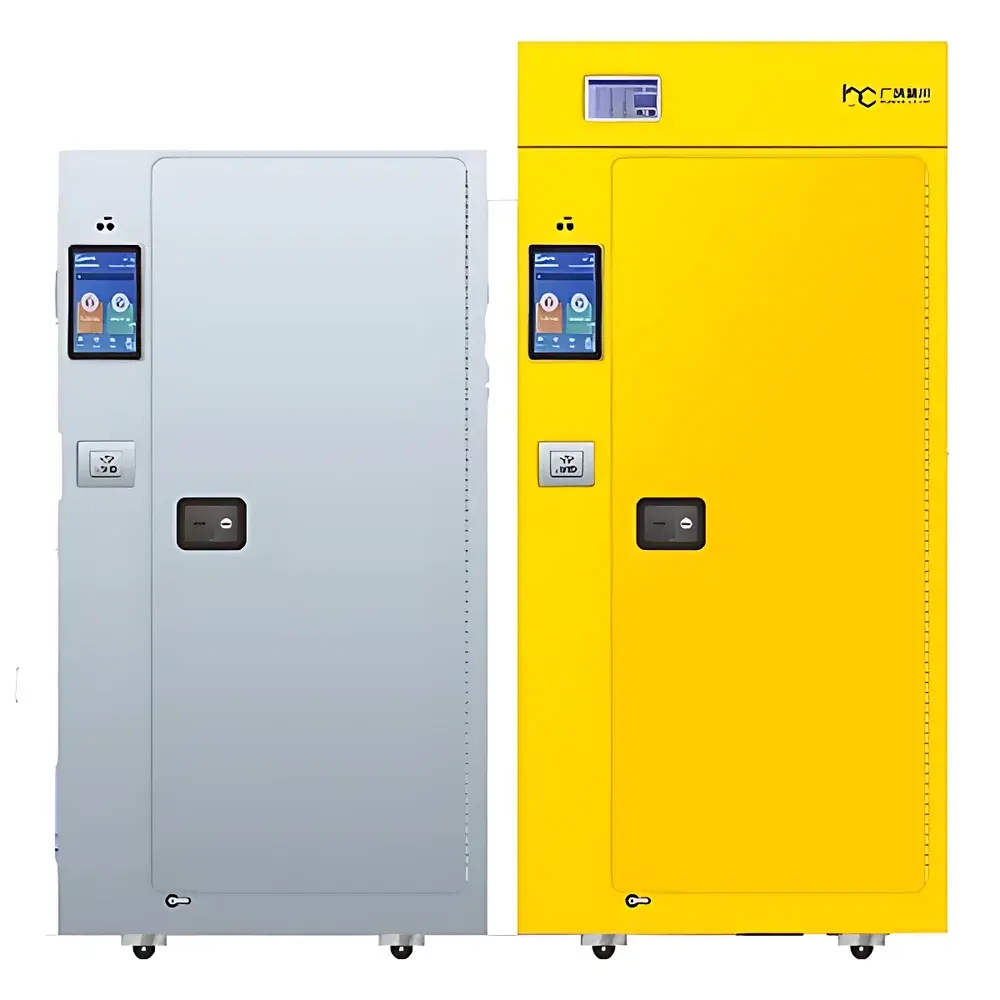
Intelligent Hazardous Chemical Storage Cabinet
| Brand | Guangna Huichuan |
|---|---|
| Origin | Guangdong, China |
| Manufacturer Type | Authorized Distributor |
| Model Series | HCE-400 / HCEF-400 / HCA-400 / HCAF-400 |
| Construction | Dual-layer cold-rolled steel with phosphate coating |
| Interior Lining | Solid white PP board with integrated spill containment sump |
| Access Control | Dual-mode authentication (facial recognition + user account) |
| Smart Locking | Configurable single-user or dual-person interlocked access |
| Inventory Tracking | RFID-based automatic material identification and usage logging |
| Environmental Monitoring | Real-time display of internal temperature, relative humidity, and hazardous gas concentration via capacitive touchscreen |
| Air Purification | Optional integrated activated-carbon + catalytic oxidation air filtration system (auto-triggered at user-defined threshold) |
| Data Storage | Local server or cloud-based deployment (TLS-encrypted transmission) |
| Compliance | Designed to meet GB/T 16758–2008 (Exhaust ventilation), GB 15603–2022 (Storage of hazardous chemicals), and ISO/IEC 27001:2022 (information security management) requirements |
Overview
The Guangna Huichuan Intelligent Hazardous Chemical Storage Cabinet is an engineered safety solution for laboratories handling flammable, corrosive, toxic, or reactive substances. Unlike conventional chemical cabinets, this system integrates industrial-grade physical containment with digital identity management, real-time environmental telemetry, and traceable material lifecycle tracking. Its core architecture follows the principle of *defensive-in-depth*: structural integrity (dual-layer cold-rolled steel with phosphate passivation), chemical resistance (solid polypropylene interior lining with integrated spill containment sump), and cyber-physical control (RFID-tagged inventory, biometric access, and encrypted audit logging). The cabinet operates as a node within a broader Laboratory Safety Management System (LSMS), enabling end-to-end visibility from procurement to disposal—supporting regulatory alignment with national standards such as GB 15603–2022 and international best practices in chemical stewardship.
Key Features
- Structural Resilience: Constructed from dual-layer cold-rolled steel plates with phosphate conversion coating, providing mechanical robustness against impact, vibration, and incidental fire exposure—meeting minimum structural performance benchmarks outlined in EN 14470-1 for safety cabinets.
- Chemical-Resistant Interior: Interior surfaces lined with solid, seamless white polypropylene (PP) board; acid- and alkali-resistant, non-porous, and impervious to common solvents including acetone, methanol, and nitric acid. Integrated 50 mm-deep spill containment sump at base prevents lateral leakage during container failure.
- Multi-Modal Access Control: Supports both facial recognition (via infrared-assisted 2D+depth imaging) and credential-based login. Authentication logs include timestamp, user ID, biometric confidence score, and cabinet door event status—enabling forensic-level accountability per GLP/GMP documentation requirements.
- Dual-Person Interlock Logic: Configurable firmware allows administrators to enforce either single-user or dual-person simultaneous unlock protocols—ensuring compliance with institutional policies governing high-hazard material access (e.g., peroxide-forming solvents or controlled precursors).
- RFID-Based Material Tracking: Integrated UHF RFID reader (860–960 MHz) automatically detects tagged containers upon insertion/removal. Each transaction captures item ID, quantity delta, operator ID, and time—synchronizing with central LSMS databases via HTTPS/REST API.
- Real-Time Environmental Telemetry: Onboard sensors continuously monitor internal temperature (±0.5 °C), relative humidity (±3% RH), and volatile organic compound (VOC) concentration (PID sensor, 0–2000 ppm isobutylene equivalent). Data rendered on 10.1″ capacitive touchscreen with configurable alert thresholds.
Sample Compatibility & Compliance
The cabinet accommodates standard laboratory containers—including glass bottles (up to 4 L), HDPE carboys (up to 20 L), and metal safety cans (up to 5 gal)—with adjustable PP-coated shelving and rear-mounted ventilation duct ports. It complies with GB/T 16758–2008 for exhaust ventilation interface design and meets flame-spread index limits under GB 15603–2022 Annex B. While not certified to UL 1275 or FM 6050, its construction aligns with functional equivalency expectations for non-certified institutional deployments where local fire codes permit engineered alternatives. All firmware and data-handling modules adhere to ISO/IEC 27001:2022 controls for information security, including AES-256 encryption of stored logs and TLS 1.2+ for network transmission.
Software & Data Management
The cabinet operates with embedded Linux-based firmware (Yocto Project build) and interfaces with the optional Guangna LSMS Cloud Platform or on-premise server deployment. Audit trails retain full metadata—including sensor history, access attempts, RFID transactions, and lock actuation events—for ≥18 months by default. Role-based permissions (administrator, supervisor, user) are enforced at both cabinet and platform levels. Export functions support CSV and PDF generation for internal audits or regulatory submissions. All remote configuration changes require two-factor authentication and generate immutable log entries compliant with FDA 21 CFR Part 11 electronic record requirements.
Applications
This system is deployed in academic research laboratories, pharmaceutical QC/QA facilities, contract development and manufacturing organizations (CDMOs), and government testing institutes where traceability, personnel accountability, and environmental monitoring are mandated by internal SOPs or external accreditation bodies (e.g., CNAS, ILAC). Typical use cases include secure storage of Class I flammables (ethanol, ether), oxidizers (hydrogen peroxide >8%), corrosives (concentrated HCl/HNO₃), and controlled substances requiring dual-custody protocols. Integration with enterprise resource planning (ERP) or electronic lab notebook (ELN) systems is supported via standardized API endpoints.
FAQ
Does the cabinet meet UL or FM certification requirements?
No—this model is designed for institutional environments governed by national standards (GB series) and internal risk assessments rather than North American third-party listing. Engineering documentation and test reports are available upon request for equivalency evaluation.
Can RFID tags be reused across different cabinets in a multi-cabinet installation?
Yes—RFID tags are encoded with globally unique EPC identifiers and synchronized across all linked cabinets via the central LSMS database, enabling cross-cabinet inventory reconciliation.
Is the air purification system mandatory or field-upgradable?
The air filtration module is optional and installed as a factory-configured add-on; it cannot be retrofitted in the field due to integrated ductwork and sensor calibration dependencies.
What happens if network connectivity is lost?
All critical operations—including access control, RFID logging, and environmental monitoring—continue locally. Data queues in encrypted onboard storage and synchronizes automatically upon network restoration, preserving chronological integrity.
How frequently are firmware updates released, and how are they deployed?
Firmware patches are issued quarterly and delivered via signed OTA packages. Updates require administrator approval and execute during scheduled maintenance windows to avoid operational interruption.



