
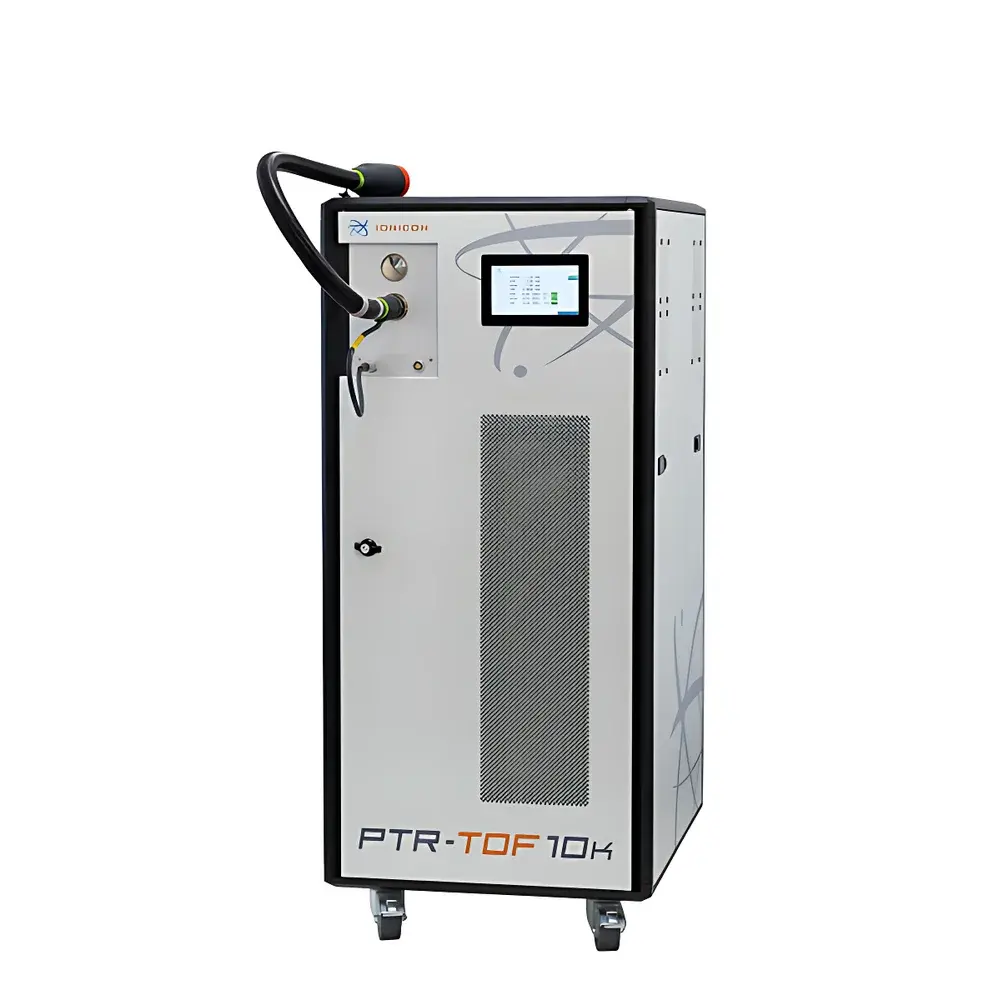
IONICON PTR-TOF 10K High-Resolution Proton-Transfer-Reaction Time-of-Flight Mass Spectrometer
| Brand | IONICON Analytik GmbH |
|---|---|
| Origin | Austria |
| Model | PTR-TOF 10K |
| Detection Principle | Proton-Transfer-Reaction (PTR) Ionization |
| Instrument Type | Online Real-Time Gas Analyzer |
| Configuration | Single-Gas-Stream VOC Analyzer |
| Detection Range | 1 pptv – 100 ppbv |
| Mass Resolution (m/Δm) | ≥10,000–15,000 |
| Accuracy | ±0.001% (relative mass accuracy) |
| Response Time | ≤100 ms |
| Detection Limit | <1 pptv |
| Sensitivity | >1000 cps/ppbv |
Overview
The IONICON PTR-TOF 10K is a high-performance, real-time trace gas analyzer engineered for unambiguous identification and quantification of volatile organic compounds (VOCs) in complex gaseous matrices. It integrates proton-transfer-reaction (PTR) soft chemical ionization with high-resolution time-of-flight mass spectrometry (TOF-MS), enabling selective, fragmentation-free ionization of VOCs at ambient pressure while preserving molecular integrity. Unlike electron-impact or laser-based ionization methods, PTR relies on controlled H3O+ reagent ion chemistry—ensuring near-unit ionization efficiency for most oxygenated, aromatic, and unsaturated VOCs without extensive fragmentation. The core innovation lies in the ioniTOF 10k mass analyzer, delivering sustained mass resolving power of 10,000–15,000 (FWHM) across the full m/z 20–500 range. This resolution permits baseline separation of isobaric species—for example, distinguishing C3H6O (acetone, propanal) from C2H6N (ethylamine) at m/z 58.042, or separating C7H8 (toluene) from C6H4O (phenol) at m/z 92.063—critical for atmospheric chemistry, emissions profiling, and biogenic VOC fingerprinting.
Key Features
- Real-time, continuous online operation with sub-second temporal resolution (≤100 ms dwell time per spectrum)
- Ultra-low detection limit of <1 pptv (parts-per-quadrillion by volume) for key VOCs such as isoprene, formaldehyde, and monoterpenes
- Quantitative accuracy supported by TRU-E/N calibration architecture—patented electrode geometry and dynamic E/N (electric field / buffer gas number density) control ensures long-term stability of ion-molecule reaction conditions (±0.05 Td)
- Ruggedized vacuum system with dual-stage differential pumping and cryo-cooled ion optics for stable high-vacuum operation (<5×10⁻⁷ mbar in TOF region)
- Integrated humidity-compensated inlet with heated sampling line (up to 180 °C) and particle filter (≤0.3 µm), compliant with ISO 16000-22 for indoor air monitoring
- Self-diagnostic firmware with automated mass calibration using internal reference ions (e.g., H3O+(H2O)n, O2+, N2+) and daily drift correction
Sample Compatibility & Compliance
The PTR-TOF 10K accepts direct, unpreconcentrated gas streams from ambient air, stack emissions, breath samples, or headspace vials—eliminating thermal desorption artifacts and adsorption losses common in GC-coupled systems. It complies with EN 14662 (ambient air quality — VOC measurement), ASTM D6196-21 (selection of sorbents, sampling, and thermal desorption), and supports GLP/GMP-aligned workflows through audit-trail-enabled data logging. All firmware and acquisition software are validated per FDA 21 CFR Part 11 requirements for electronic records and signatures when deployed in regulated environmental testing laboratories. Calibration traceability follows NIST SRM 1861 (benzene in nitrogen) and certified EPA TO-15 standards.
Software & Data Management
Control and analysis are performed via TOF-DAQ v4.x, a deterministic real-time acquisition platform supporting synchronized multi-instrument triggering (e.g., with meteorological stations or PID sensors). Raw .tdf files store full transient ion signals with 24-bit intensity resolution and timestamp precision of ±1 µs. Post-acquisition processing includes peak deconvolution using iterative least-squares fitting (ILSF), elemental composition assignment (with ppm-level mass error tolerance), and isotopic pattern matching against NIST Chemistry WebBook and SIRIUS databases. Export formats include NetCDF-4 (CF-compliant), CSV, and mzML 1.1.0 for interoperability with OpenMS and MZmine2. All processing steps are scriptable via Python API (pyTOF), enabling integration into automated QA/QC pipelines.
Applications
- Atmospheric science: Real-time speciation of biogenic and anthropogenic VOCs in field campaigns (e.g., ICOS, ACTRIS networks)
- Industrial hygiene: Fenceline monitoring of fugitive emissions from petrochemical facilities and semiconductor fabs
- Indoor air quality: Source apportionment of formaldehyde, acetaldehyde, and terpenes in office buildings and schools
- Medical research: Exhaled breath VOC profiling for non-invasive biomarker discovery (e.g., lung cancer, asthma exacerbation)
- Food & flavor science: Headspace dynamics during fermentation, roasting, or packaging degradation studies
- Plant physiology: High-temporal-resolution VOC emission kinetics under controlled stress conditions (light, herbivory, drought)
FAQ
What does “TRU-E/N” signify in IONICON’s PTR technology?
TRU-E/N refers to a patented hardware and control architecture that actively stabilizes the reduced electric field (E/N) in the PTR drift tube to within ±0.05 Townsend (Td), ensuring reproducible proton-transfer reaction kinetics and eliminating batch-to-batch calibration drift.
Can the PTR-TOF 10K quantify VOCs without external calibration standards?
Yes—absolute quantification is enabled by first-principles calculation using known reaction rate constants (k), measured residence time, and H3O+ primary ion signal. For highest accuracy in regulatory contexts, NIST-traceable standard additions are recommended.
Is the instrument suitable for unattended operation in remote field sites?
Yes—designed for 24/7 operation with industrial-grade embedded controller, redundant power supply options, and remote diagnostics via TLS-secured SSH or MQTT telemetry.
How is mass calibration maintained over extended deployments?
The system performs autonomous internal calibration every 30 minutes using hydrated hydronium clusters (H3O+(H2O)n, n = 1–4) and residual air ions, with optional external lock-mass introduction for ultra-high-stability applications.
Does the PTR-TOF 10K support isotope ratio measurements?
Yes—the 15,000 resolution enables baseline separation of 13C/12C isotopologues (e.g., m/z 59.049 vs. 60.052 for acetone), permitting natural abundance stable isotope analysis (SAIA) without chromatographic separation.







