
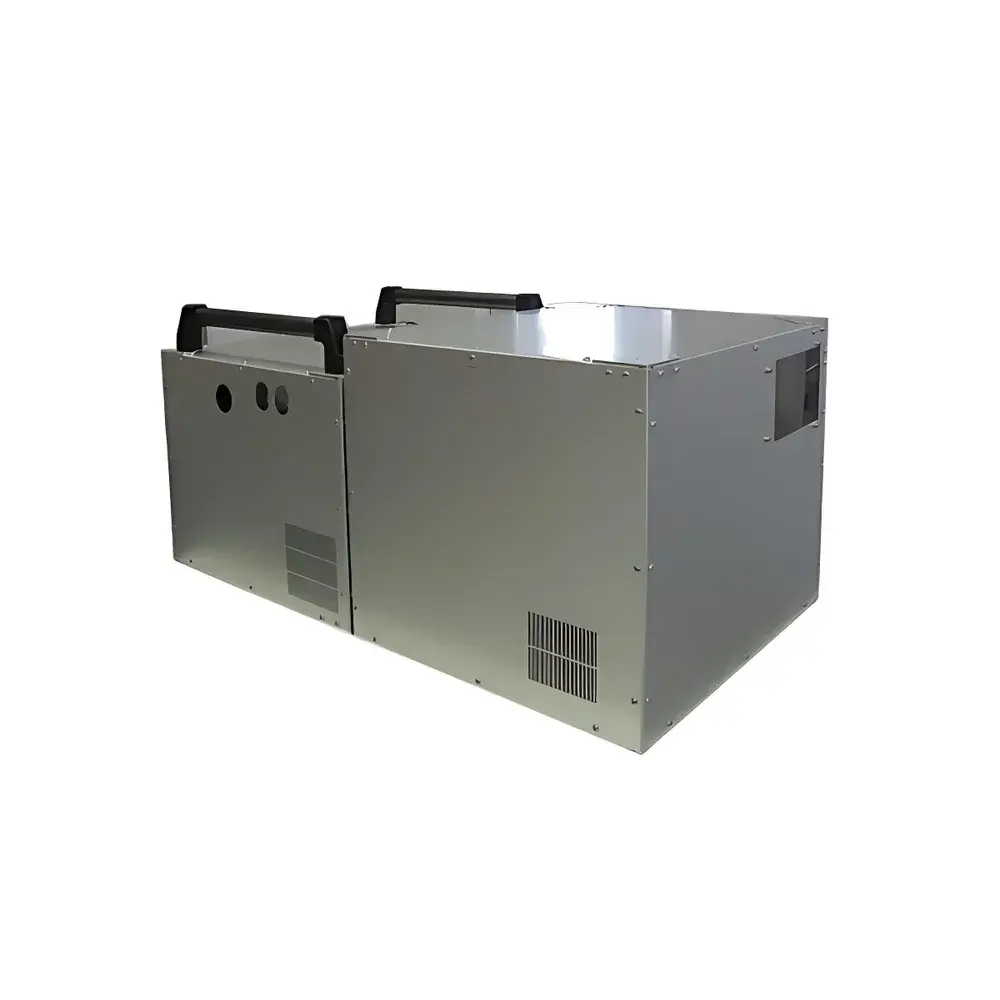
IONICON PTR-TOF QB Portable VOCs Real-Time Monitoring Mass Spectrometer
| Brand | IONICON Analytik G m.b.H. |
|---|---|
| Origin | Austria |
| Manufacturer Type | Authorized Distributor |
| Origin Category | Imported |
| Model | PTR-TOF QB |
| Detection Principle | Proton-Transfer-Reaction Time-of-Flight Mass Spectrometry (PTR-TOF MS) |
| Instrument Type | Portable |
| Typical Configuration | Multi-Analyte VOC Analyzer |
| Detection Range | C2–C12 Volatile Organic Compounds (VOCs), including aldehydes, ketones, aromatics, terpenes, oxygenates, and sulfur-containing compounds |
| Mass Resolution (m/Δm) | 4000 (FWHM at m/z 200) |
| Accuracy | ±5% relative to certified standard gas mixtures |
| Response Time | <100 ms (10–90% rise time for individual compounds) |
Overview
The IONICON PTR-TOF QB is a field-deployable, real-time volatile organic compound (VOC) monitoring mass spectrometer engineered for mobile environmental monitoring applications. It implements proton-transfer-reaction time-of-flight mass spectrometry (PTR-TOF MS), a soft ionization technique that enables quantitative, interference-free detection of trace-level VOCs in ambient air without pre-concentration or chromatographic separation. Unlike conventional GC-MS or PID-based systems, PTR-TOF MS delivers sub-second temporal resolution, full mass spectra acquisition at up to 10 Hz, and inherent sensitivity to most biogenic and anthropogenic VOCs down to low parts-per-quadrillion (ppq) volume mixing ratios. The system is purpose-built for integration into mobile laboratories—such as van-mounted atmospheric research platforms, industrial fence-line monitoring units, or emergency response vehicles—where space, weight, power efficiency, and operational robustness are critical constraints.
Key Features
- Modular 19-inch rack architecture: Composed of two independent, stackable 19″ x 19″ x 19″ (W×D×H) cubical units—each weighing under 50 kg—enabling flexible installation in confined vehicle compartments or on vibration-isolated laboratory benches.
- Low-power operation: Total system power consumption remains below 500 W during continuous operation, compatible with standard 110–240 V AC inputs or optional DC/UPS configurations for extended off-grid deployment.
- Real-time spectral acquisition: Delivers full mass spectra (m/z 10–300) with 4000 mass resolving power (FWHM), allowing baseline separation of isobaric compounds (e.g., C₃H₆O isomers) and accurate mass assignment within ±2 ppm calibration stability.
- Sub-100 ms compound-specific response: Achieves rapid dynamic measurement of transient VOC plumes—essential for vehicle-based mapping, leak detection, and boundary-layer flux studies.
- Scalable performance: Base configuration built upon the proven PTR-TOF 1000 platform; upgrade paths available to PTR-TOF 1000 ultra (enhanced sensitivity & mass accuracy) or PTR-TOF 4000 (higher mass range and resolution) upon specification review.
Sample Compatibility & Compliance
The PTR-TOF QB directly analyzes unfiltered, humid ambient air at atmospheric pressure, requiring no sample conditioning beyond particulate filtration (standard 0.2 µm PTFE filter). It quantifies over 600 VOC species simultaneously—including formaldehyde, benzene, toluene, limonene, isoprene, methanol, acetaldehyde, and hydrogen sulfide—without chemical derivatization. The instrument complies with ISO 16000-6 for indoor air VOC analysis methodology and supports data traceability requirements aligned with EPA Method TO-15 and EU Directive 2008/50/EC for ambient air quality assessment. Its firmware and data acquisition software are designed to support audit-ready workflows compliant with GLP and ISO/IEC 17025 documentation standards.
Software & Data Management
Controlled via IONICON’s proprietary TOF-DAQ software suite, the PTR-TOF QB provides real-time spectral visualization, automated peak identification using NIST/EPA mass spectral libraries, and time-resolved concentration mapping (ppbv or µg/m³). Raw .tdf files are stored in open HDF5 format for third-party processing (e.g., Python, MATLAB, R). The system supports timestamp-synchronized external sensor input (e.g., GPS, meteorological stations, CO₂ analyzers) and exports calibrated time-series data in CSV/NetCDF formats. Optional 21 CFR Part 11-compliant user access control, electronic signatures, and audit trail logging are available for regulated industrial hygiene or pharmaceutical cleanroom AMC (Airborne Molecular Contamination) monitoring applications.
Applications
- Mobile atmospheric chemistry campaigns: Emission source attribution, urban plume tracking, forest-atmosphere exchange studies.
- Industrial compliance monitoring: Fence-line VOC surveillance near petrochemical facilities, semiconductor fab AMC control, and wastewater treatment odorant profiling.
- Hazardous material response: Rapid identification and quantification of toxic VOCs (e.g., chlorinated solvents, acrylonitrile) during chemical spills or clandestine lab investigations.
- Indoor air quality (IAQ) diagnostics: Real-time assessment of building emissions, cleaning product off-gassing, and HVAC system performance validation.
- Research-grade method development: Reference instrumentation for validating low-cost sensor networks or calibrating optical remote sensing systems (e.g., DOAS, FTIR).
FAQ
What VOCs can the PTR-TOF QB detect and quantify?
It detects and quantifies most proton-affinic VOCs with molecular weights between ~30 and 300 Da—including aldehydes, ketones, aromatic hydrocarbons, terpenes, alcohols, esters, and sulfur-containing compounds—provided they possess higher proton affinity than water.
Is calibration required before each measurement campaign?
A single multi-point calibration using certified gas standards (e.g., TO-14/TO-15 mix) is sufficient for 2–4 weeks of stable operation; humidity-dependent sensitivity drift is corrected in real time using internal water cluster signal normalization.
Can the system operate continuously for extended periods (e.g., >30 days)?
Yes—the PTR-TOF QB has demonstrated uninterrupted operation for >60 days in field deployments; its solid-state ion source, passive cooling design, and redundant vacuum interlocks ensure long-term reliability without scheduled maintenance.
Does it meet regulatory reporting requirements for ambient air monitoring?
While not certified as a reference method per EU or U.S. EPA equivalency protocols, its data are widely accepted for investigative monitoring, trend analysis, and supplementary reporting when operated under documented QA/QC procedures aligned with ISO 16000-6 and EN 14662.
Related Products







