
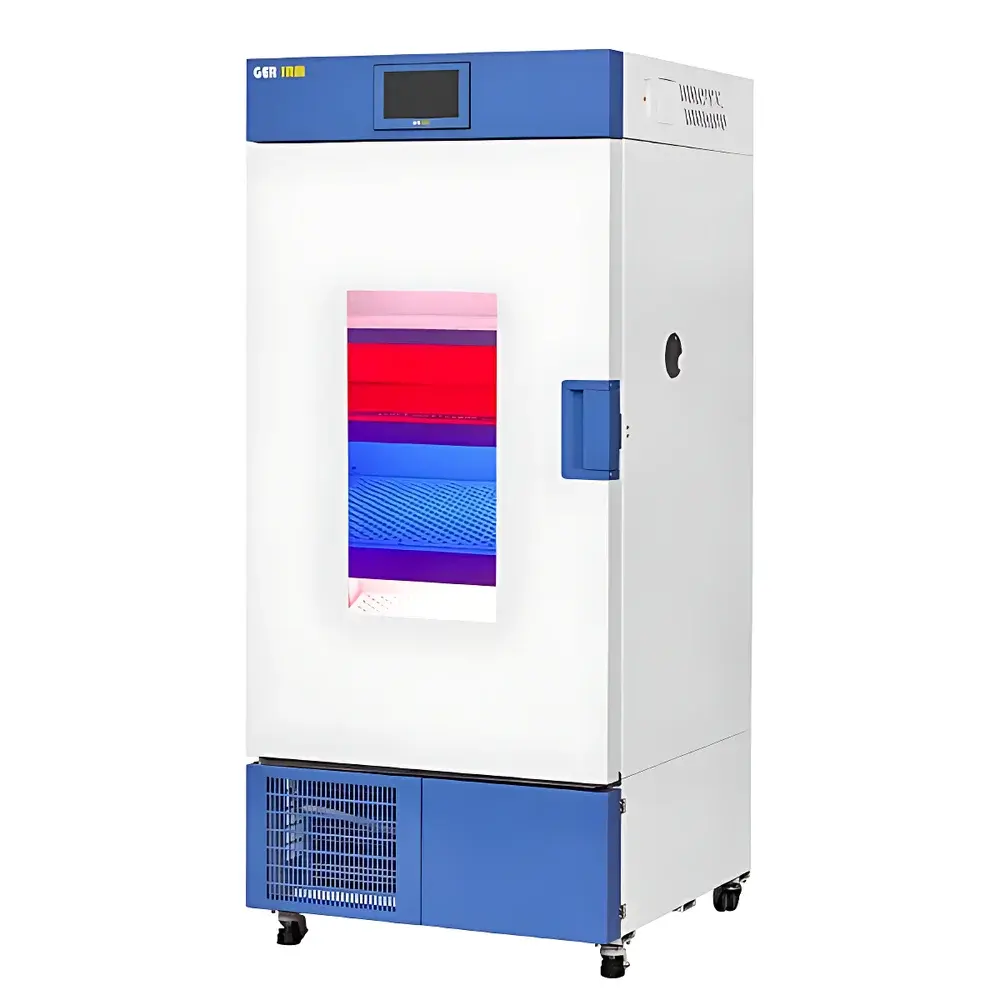
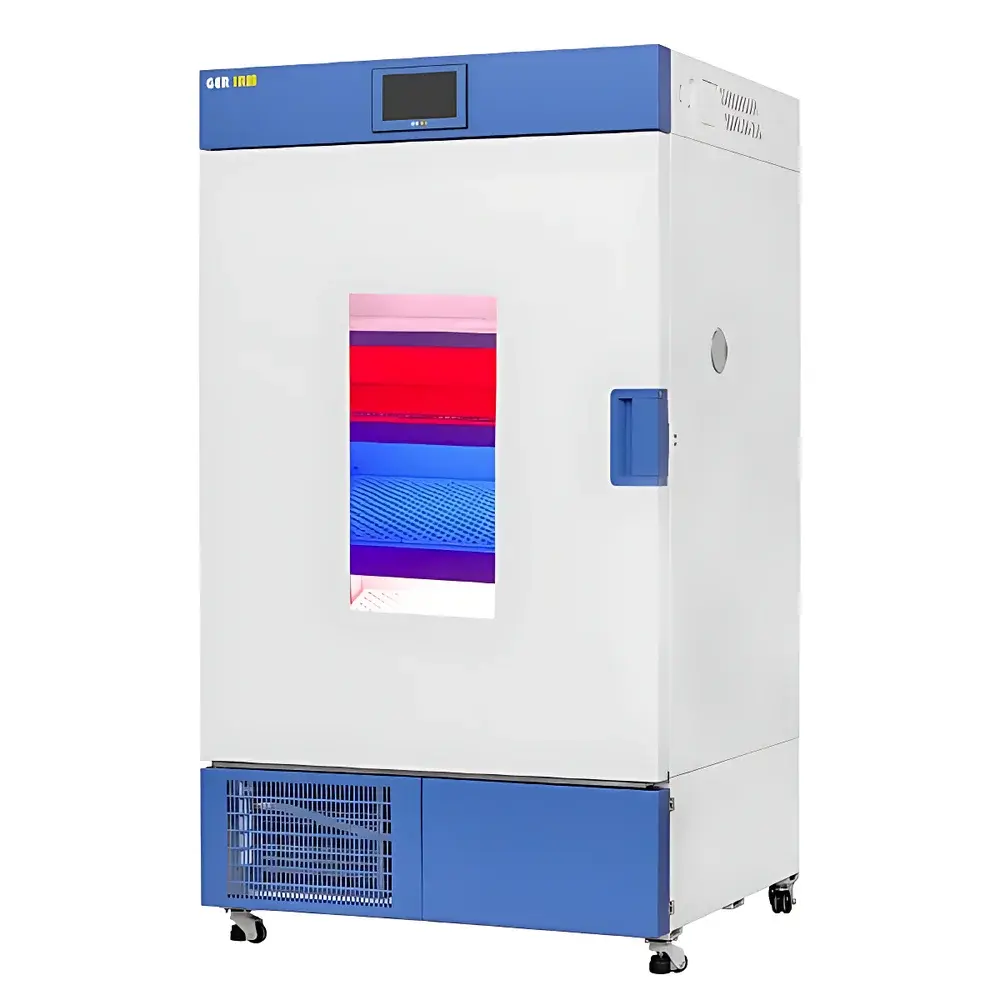
IRM IDH260 Drosophila-Specific Plant Growth Chamber
| Brand | IRM |
|---|---|
| Origin | Beijing, China |
| Manufacturer Type | Direct Manufacturer |
| Model | IDH260 |
| Illumination Method | Shelf-Integrated LED Lighting |
| Light Source | High-Efficiency White LED Array |
| Spectral Range | Visible Spectrum (400–700 nm) |
| Temperature Range | 10–65°C (with illumination), 0–65°C (without illumination) |
| Temperature Fluctuation | ±0.3°C |
| Temperature Uniformity | ±1.0°C (at 20°C, within single shelf) |
| Humidity Range | 30–95% RH |
| Photosynthetic Photon Flux Density (PPFD) | 0–500 µmol/m²/s |
| Chamber Capacity | 305 L |
| External Dimensions (W×D×H) | 780 × 790 × 1600 mm |
Overview
The IRM IDH260 Drosophila-Specific Plant Growth Chamber is an engineered environmental control system designed for reproducible, long-term maintenance of Drosophila melanogaster cultures under rigorously defined photoperiodic, thermal, and hygric conditions. Unlike generic incubators, the IDH260 integrates iHACC (intelligent High-Accuracy Climate Control) technology—a proprietary dual-loop PID architecture that synchronizes refrigeration, heating, humidification, and LED lighting subsystems to maintain stable setpoints across all operational parameters. Its design addresses core challenges in Drosophila research: condensation-induced media degradation, diurnal rhythm disruption from inconsistent light spectra, and temperature-induced developmental variability. The chamber operates via forced-air convection with adjustable fan speed to minimize desiccation stress on agar-based culture vials and plates—critical for larval viability and adult eclosion consistency. All control logic complies with GLP-aligned data integrity principles, supporting audit-ready operation in academic, pharmaceutical, and contract research settings.
Key Features
- 7-inch industrial-grade capacitive touchscreen interface with multi-level access control (Operator / Supervisor / Administrator), enabling role-based parameter modification and full event logging (including setpoint changes, alarms, door openings, and power interruptions)
- iHACC climate control system delivering ±0.3°C temperature fluctuation and ±1.0°C uniformity (measured at 20°C across a single shelf), validated per ASTM E2876-21 for environmental chamber performance verification
- Shelf-integrated white LED illumination (400–700 nm PAR spectrum) with digitally tunable PPFD output (0–500 µmol/m²/s), calibrated traceably to NIST-traceable spectroradiometric standards
- Integrated ultrasonic humidification with auto-refill function, large-capacity internal water reservoir, and wastewater recirculation loop—reducing manual intervention frequency by up to 70% compared to conventional systems
- Variable-speed centrifugal blower with low-turbulence airflow profile, minimizing evaporative loss from culture vessels while ensuring uniform environmental distribution
- Comprehensive safety architecture: independent overtemperature cutoff (dual-sensor redundancy), leak-current protection, anti-overflow and dry-run detection for humidifier, compressor overpressure monitoring, cooling fan thermal shutdown, and audible/visual door-open alert
- Optional CO₂ control module (0–5000 ppm range, ±50 ppm accuracy) and 4G LTE connectivity for remote real-time monitoring, alarm notification, and firmware updates via secure HTTPS API
Sample Compatibility & Compliance
The IDH260 accommodates standard Drosophila culture formats—including 25 × 95 mm glass vials, 35 mm and 60 mm Petri dishes, and multi-well plates—within its 305 L working volume. Internal dimensions (640 × 450 × 1060 mm) support up to four illuminated shelves with ≥200 mm vertical clearance per tier, accommodating stacked vial racks and inverted plate storage configurations. All materials in contact with the chamber interior (stainless steel shelves, food-grade ABS lining, silicone gaskets) comply with USP Class VI biocompatibility requirements. The system supports ISO/IEC 17025-compliant calibration protocols and generates timestamped, tamper-evident audit trails compliant with FDA 21 CFR Part 11 when paired with optional electronic signature modules.
Software & Data Management
Embedded firmware enables three operational modes: constant-setpoint (single-value hold), timed cycles (start/stop scheduling), and multi-segment programmable profiles (up to 30 steps per program). All runtime data—including temperature, humidity, PPFD, and CO₂ (if installed)—are logged at user-defined intervals (1 s to 60 min resolution) and stored internally for ≥30 days. Data export is supported via USB 2.0 (FAT32-formatted drives) in CSV format for downstream analysis in MATLAB, Python (Pandas), or JMP. Optional thermal printer integration provides hard-copy record generation for SOP adherence. Remote access via 4G LTE includes TLS 1.2-encrypted web dashboard with live graphing, historical trend overlays, and configurable email/SMS alerts triggered by deviation thresholds.
Applications
- Standardized rearing of Drosophila strains across genetic, neurobiological, and aging studies where circadian entrainment and developmental timing must remain invariant across cohorts
- Phenotypic screening under controlled photoperiods (e.g., 12:12 LD cycles) and temperature gradients (e.g., 18°C vs. 25°C comparisons for lifespan assays)
- Co-culture experiments involving Drosophila and symbiotic microbes or plant tissue explants requiring simultaneous regulation of humidity and CO₂
- Validation of environmental stress responses (e.g., heat shock, desiccation, light toxicity) using precisely stepped stimulus protocols
- GLP-regulated toxicology endpoints where environmental parameter traceability and instrument qualification (IQ/OQ/PQ) are mandated
FAQ
What is the minimum and maximum operating temperature with active illumination?
The chamber maintains 10–65°C when LED lighting is energized; without illumination, the lower limit extends to 0°C.
Is humidity control available on all models?
Humidification is exclusive to IDH and IDHC series variants; base ID models (e.g., ID260) lack this capability.
How is temperature uniformity verified during qualification?
Uniformity is measured per ISO 15271:2021 Annex B using nine calibrated PT100 sensors placed on a single shelf at 20°C setpoint under steady-state conditions.
Can the LED spectrum be customized beyond white light?
Yes—optional monochromatic (e.g., 450 nm blue, 660 nm red) or polychromatic LED arrays are available for spectral response studies.
Does the system support automated calibration verification?
Yes—the touchscreen interface includes guided sensor validation routines aligned with ASTM E74-22 for temperature and humidity transducers.



