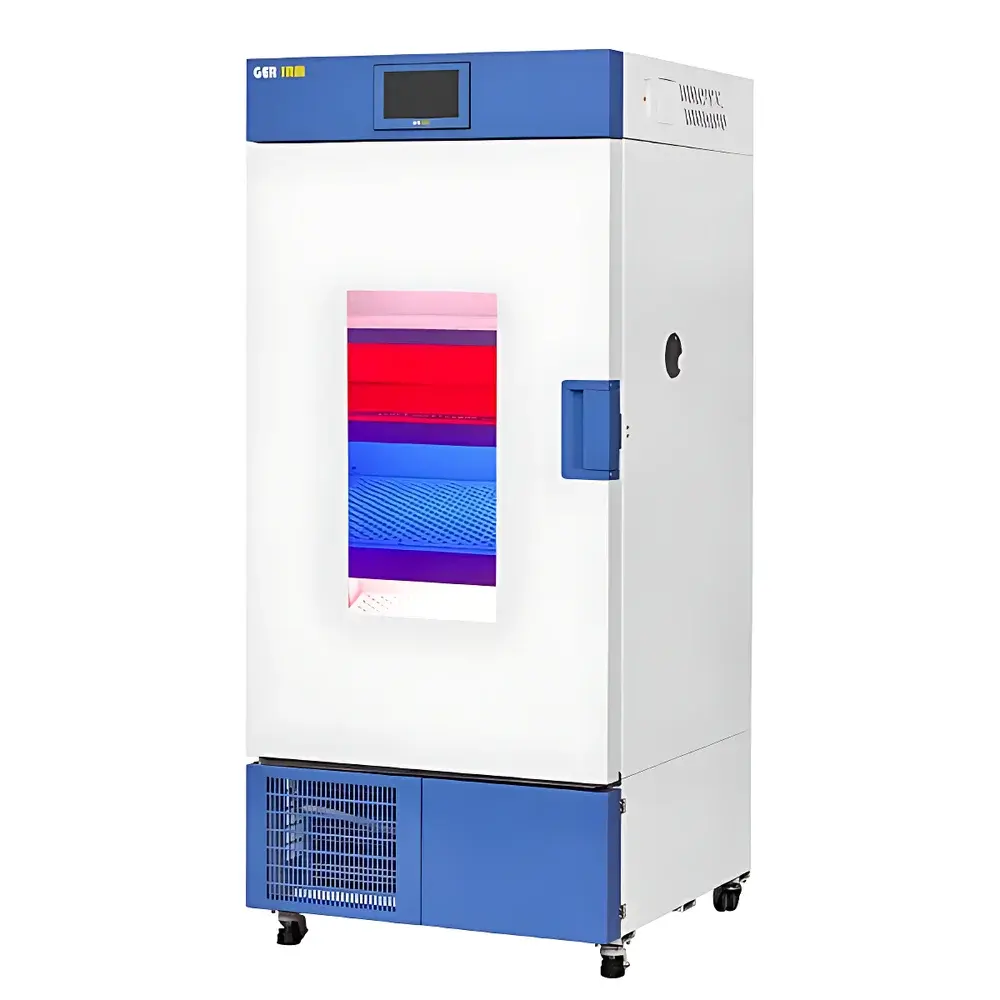
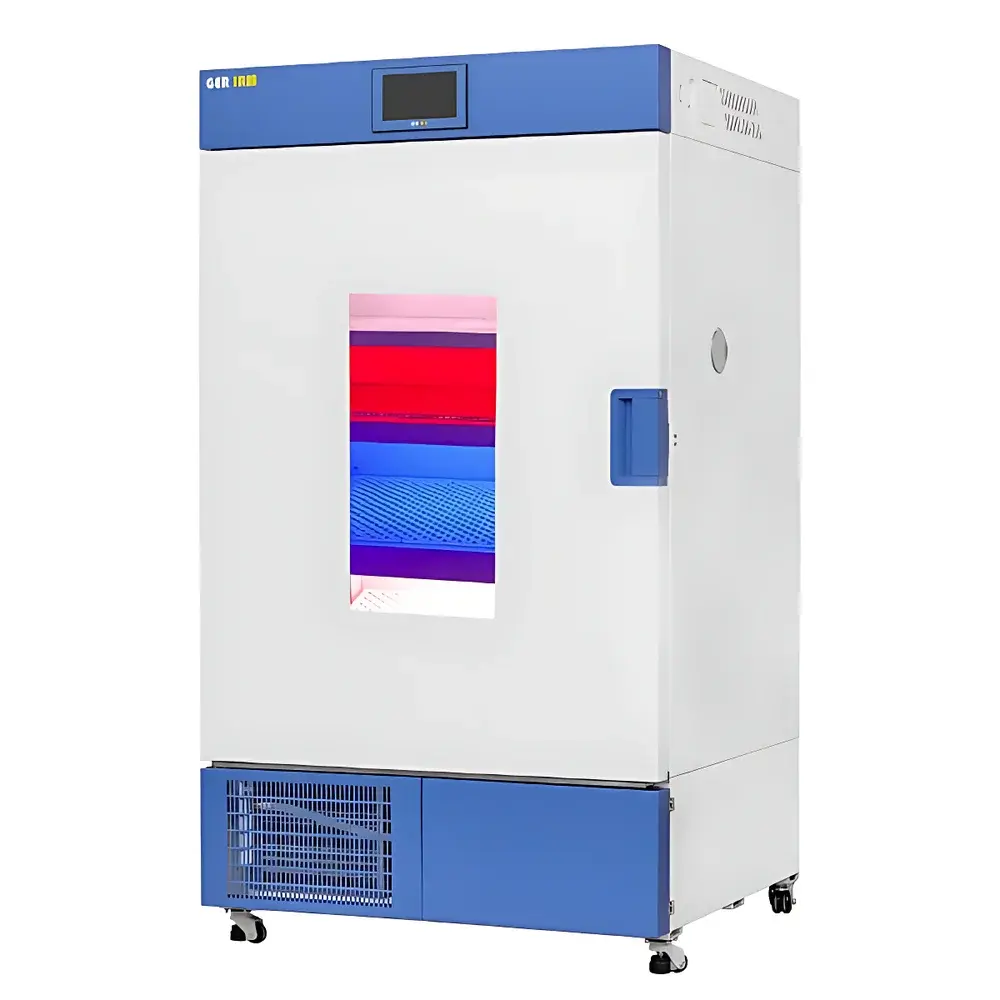
IRM IPT260 Plant Growth Chamber with LED Illumination and Precision Environmental Control
| Brand | IRM |
|---|---|
| Model | IPT260 |
| Origin | Beijing, China |
| Manufacturer Type | Direct Manufacturer |
| Category | Domestic Equipment |
| Illumination Method | Shelf-Integrated LED Lighting |
| Light Source | High-Efficiency White LED Array |
| Spectral Range | Visible Spectrum (400–700 nm) |
| Temperature Range | 10–65°C (with illumination), 0–65°C (without illumination) |
| Temperature Fluctuation | ±0.3°C |
| Temperature Uniformity | ±1.0°C (at 20°C, same shelf) |
| Photosynthetic Photon Flux Density (PPFD) | 0–500 µmol/m²/s |
| Chamber Capacity | 305 L |
| External Dimensions (W×D×H) | 780 × 790 × 1600 mm |
| Control Interface | 7-inch Capacitive Touchscreen |
| Cooling System | Inverter-Driven Hermetic Compressor |
| Humidity Control | Optional (IPTH/IPTHC variants only) |
| CO₂ Control | Optional (0–5000 ppm, IPTHC variants only) |
| Connectivity | Optional 4G IoT Module (Remote Monitoring & Control via Android/Web) |
| Safety Protections | Dual Independent Over-Temperature Cut-off, Leak Current Protection, Water-Level Monitoring (Auto-Fill & Overflow Prevention), Compressor High-Pressure & Fan Overheat Protection, Door-Open Alarm, Power-Failure Recovery, Sensor Fault Detection |
| Airflow | Adjustable-Speed Forced Convection |
| Access Ports | Two Ø50 mm Pass-Through Ports (Left & Right) |
| Mobility | Heavy-Duty Braked Casters |
| Compliance | Designed for GLP-aligned operation |
Overview
The IRM IPT260 Plant Growth Chamber is an engineered environmental simulation platform designed specifically for controlled plant tissue culture, photobiological research, and developmental physiology studies under reproducible light–temperature–(optional humidity/CO₂) conditions. It operates on the principle of active environmental regulation: precise thermoelectric and refrigeration-based temperature control is coupled with spectrally stable, intensity-tunable LED illumination to replicate diurnal cycles and growth-specific photon environments. Unlike conventional incubators, the IPT260 integrates iHACC™ (intelligent Hybrid Air Conditioning & Control) technology—a proprietary multi-sensor PID feedback architecture that dynamically balances heating, cooling, and airflow to maintain ≤±0.3°C temperature fluctuation and ≤±1.0°C spatial uniformity across its 305 L working volume—even during extended 20°C+ operation without defrost interruption. Its modular design accommodates optional humidity (30–95% RH) and CO₂ (0–5000 ppm) modules, enabling full factorial experimental control aligned with ASTM E1822 (Standard Practice for Plant Growth Chamber Performance Testing) and ISO 17025-compliant validation protocols.
Key Features
- Shelf-integrated white LED lighting system delivering uniform PPFD from 0–500 µmol/m²/s across two standard illumination layers—calibrated per IESNA LM-79 standards for spectral stability and radiant efficiency.
- Inverter-driven hermetic compressor minimizing surface temperature rise and eliminating thermal shutdown risk during continuous operation.
- 7-inch industrial-grade capacitive touchscreen interface supporting three-tier role-based access (Administrator, Operator, Viewer), full operational logging, and encrypted U盘 (USB flash drive) data export for regulatory traceability.
- Programmable environmental profiles: up to 30 segmented cycles combining temperature setpoints, light intensity ramps, timing schedules, and optional humidity/CO₂ setpoints—enabling simulation of seasonal transitions or stress acclimation protocols.
- Robust safety architecture including dual independent over-temperature cut-offs, auto-recovery after power loss, real-time sensor health monitoring, and audible/visual alarms for door-open, low-water, or compressor fault events.
- Optimized internal airflow with variable-speed centrifugal fans—adjustable to prevent desiccation of delicate explants or callus cultures while ensuring laminar distribution of conditioned air.
- Two Ø50 mm pass-through ports with silicone grommets for external sensor integration, gas line routing, or in-chamber instrumentation—fully compatible with third-party data loggers or analytical probes.
Sample Compatibility & Compliance
The IPT260 accommodates standard tissue culture vessels—including Magenta boxes, Petri dishes (up to 150 mm diameter), and multi-well plates—across four adjustable stainless-steel shelves (two illuminated by default; expandable to four). Its interior chamber (640 × 450 × 1060 mm) provides ≥200 mm vertical clearance above each shelf, supporting upright shoot development in Arabidopsis, tobacco, or orchid protocorms. All wetted components comply with USP Class VI biocompatibility requirements. The system meets CE marking directives (2014/30/EU EMC, 2014/35/EU LVD) and is engineered for alignment with FDA 21 CFR Part 11 when paired with IRM’s optional audit-trail-enabled firmware package—supporting electronic signatures, change history, and locked data export for GLP/GMP-regulated botanical product development.
Software & Data Management
The embedded control firmware records timestamped events—including parameter changes, alarm triggers, door openings, and sensor readings—at 1-second resolution. All logs are stored internally with 30-day circular buffering and exportable in CSV format via USB. Optional 4G IoT connectivity enables remote visualization of real-time chamber status (temperature, PPFD, humidity if equipped, CO₂ if equipped), push notifications for critical alarms, and secure web-based parameter adjustment using TLS 1.2 encryption. Data integrity is preserved through SHA-256 hash verification of exported files. Firmware updates are delivered via signed OTA packages, ensuring version control and rollback capability in validated environments.
Applications
- Plant tissue culture: sterile propagation of elite cultivars, somatic embryogenesis, and meristem elimination protocols requiring stable photoperiodic cues and minimal thermal drift.
- Photomorphogenesis studies: quantitative analysis of phytochrome- and cryptochrome-mediated responses across defined PPFD gradients and spectral compositions.
- Abiotic stress screening: controlled imposition of temperature oscillations, light deprivation, or combined light–temperature stress to evaluate genotype-specific resilience.
- Secondary metabolite induction: optimization of light quality/intensity to enhance anthocyanin, alkaloid, or terpenoid biosynthesis in medicinal plant cell suspensions.
- Phytosanitary quarantine support: maintaining pathogen-free stock cultures under ISO 21569-compliant environmental containment.
FAQ
Does the IPT260 support custom light spectra beyond white LED?
Yes—optional monochromatic (e.g., 450 nm blue, 660 nm red) or polychromatic LED arrays can be factory-installed to meet species-specific photosynthetic action spectrum requirements.
Is humidity control available on the base IPT260 model?
No—humidity functionality is exclusive to the IPTH260 and IPTHC260 variants. The base IPT260 is optimized for temperature–light co-regulation only.
Can the chamber operate continuously at 4°C with illumination enabled?
No—minimum operating temperature with active illumination is 10°C, as specified in the thermal management design to ensure LED driver stability and condensation prevention.
What validation documentation is provided?
Each unit ships with a Factory Acceptance Test (FAT) report including temperature uniformity mapping (per ISO 17025 Annex A), light intensity calibration certificate (traceable to NIST), and electrical safety test record.
Is the 4G module compatible with global LTE bands?
Yes—the optional module supports LTE-FDD Bands 1/3/5/7/8/20 and LTE-TDD Bands 38/40/41, enabling deployment across North America, EU, and APAC regions with carrier-specific SIM configuration.
Related Products