
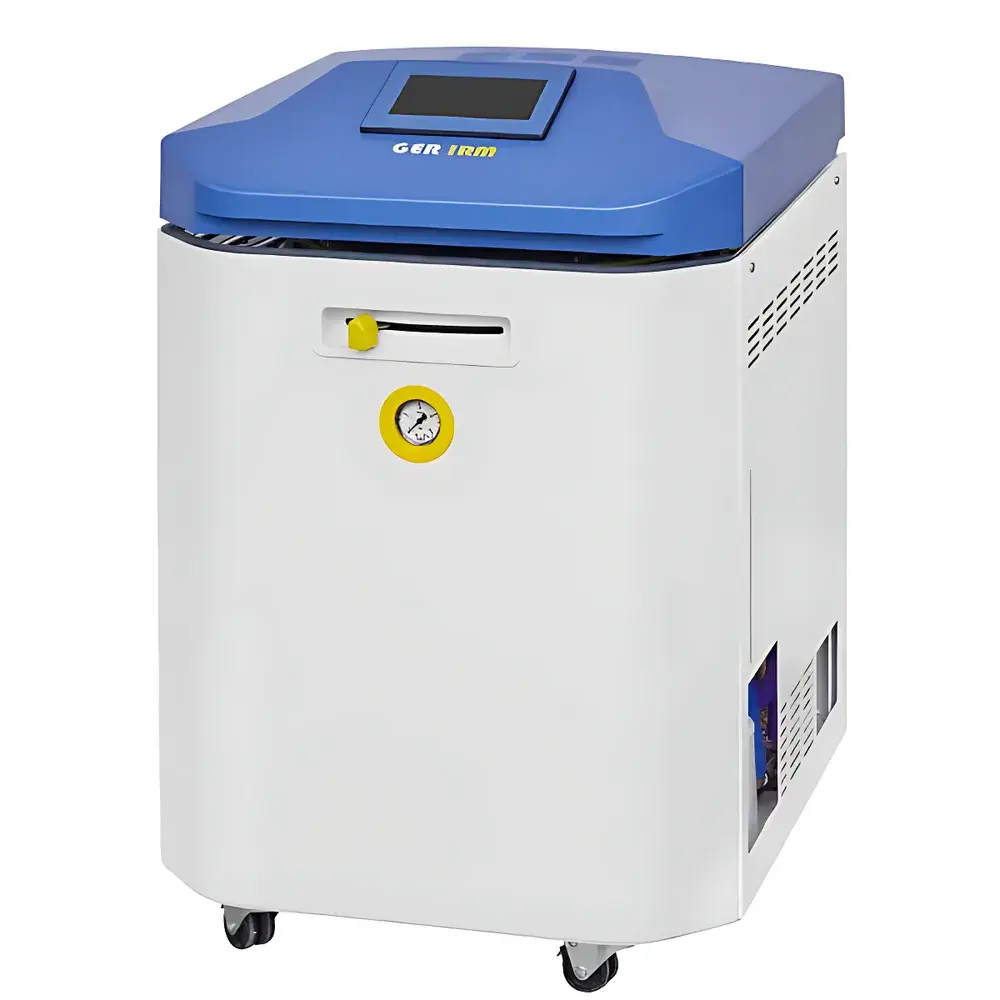
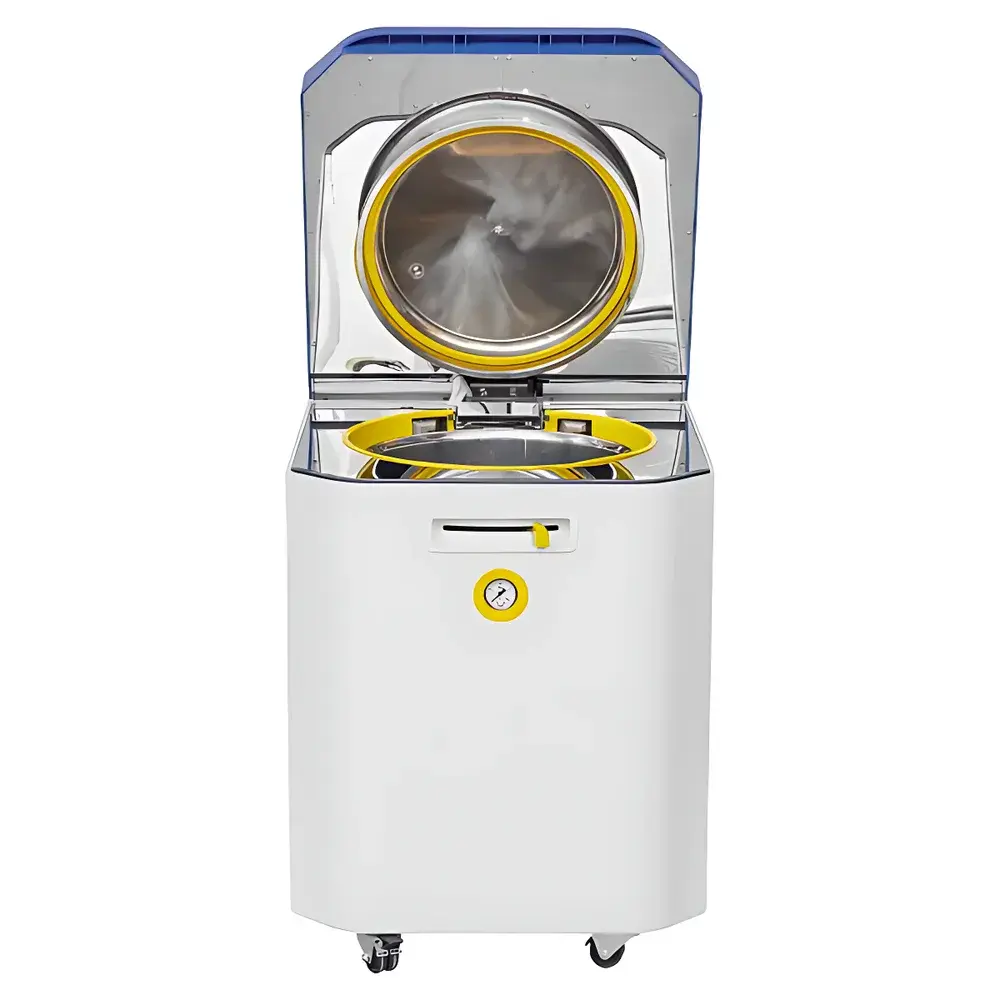

IRM L75 Vertical High-Pressure Steam Sterilizer
| Brand | IRM |
|---|---|
| Origin | Beijing, China |
| Manufacturer Type | Manufacturer |
| Product Category | Domestic |
| Model | L75 |
| Instrument Type | Vertical |
| Maximum Temperature | 141 °C |
| Maximum Pressure | 0.3 MPa |
| Chamber Dimensions | Ø400 × 583 mm |
| External Dimensions | 630 × 680 × 900 mm |
| Chamber Volume | 75 L |
Overview
The IRM L75 Vertical High-Pressure Steam Sterilizer is an engineered solution for reliable, repeatable, and compliant moist-heat sterilization in academic, clinical, pharmaceutical, and industrial laboratories. Based on the fundamental principle of saturated steam under controlled pressure and temperature—per ASTM F1486 and ISO 17665-1—the system delivers validated microbial inactivation across diverse load types, including wrapped instruments, liquid media, solid waste, and heat-labile materials requiring precise thermal management. Designed to meet core requirements of GLP, GMP, and ISO 13485 environments, the L75 integrates dual-sensor temperature monitoring (±0.1 °C resolution), real-time pressure tracking, and full-cycle data logging to support audit-ready documentation. Its vertical configuration optimizes floor space without compromising chamber volume or thermal uniformity, while the SUS304 stainless steel chamber ensures corrosion resistance and long-term structural integrity under repeated sterilization cycles.
Key Features
- Intelligent iSmart Control System: Dual-core architecture combining PID temperature regulation with PLC-based logic control, synchronized with a 7-inch color TFT touchscreen interface for intuitive program navigation and parameter adjustment.
- Triple-Layer Safety Architecture: Combines active safeguards (real-time water level detection, interlocked lid actuation, independent overtemperature/overpressure cutouts) with passive mechanical redundancy (spring-loaded safety valve, dual thermal fuses, SSR failure detection).
- iSpeed Rapid-Cooling Technology: Integrated internal steam condensation system enables chamber depressurization and safe lid opening within approximately 6 minutes post-cycle—reducing total cycle time by up to 40% versus conventional gravity-displacement units.
- Eight Predefined Sterilization Modes: Including media sterilization, instrument sterilization, solid load, liquid load, waste decontamination,保温 (hold), dissolution, and vessel preheating—each configurable with user-defined time, temperature, and exhaust profiles.
- Three Automated Exhaust Strategies: Full exhaust, pulsed exhaust, and no-exhaust modes accommodate varying load compositions and minimize liquid boil-over risks during cooling.
- Mechanically Optimized Lid Mechanism: Patented counterbalanced hinge design allows stable positioning at any angle (0–110°), eliminating manual strain during loading/unloading and preventing accidental lid drop or seal misalignment.
Sample Compatibility & Compliance
The L75 accommodates standard laboratory loads up to 75 L chamber volume, including stainless-steel baskets (Ø370 × 220 mm, 5 × 5 mesh), wrapped surgical kits, glassware, plastic containers rated for autoclaving, and aqueous solutions. Its operating range (40–141 °C) supports both standard sterilization (121 °C/15 psi for 15–20 min) and high-temperature protocols (e.g., 134 °C/205 kPa for porous load validation per EN 285). All critical sensors—including PT100 temperature probes, piezoresistive pressure transducers, and water-level electrodes—undergo factory calibration traceable to NIST standards. The unit complies with GB/T 30690–2014 (Chinese national standard for steam sterilizers), and its control architecture supports optional 21 CFR Part 11-compliant electronic signatures and audit trail generation when paired with certified external recorders or printers.
Software & Data Management
The embedded iSmart controller stores ≥100 complete sterilization cycles locally, each timestamped with start/end times, peak temperature/pressure values, dwell durations, and fault codes. Cycle data can be exported via USB to CSV format for integration into LIMS or QA databases. Optional accessories include a thermal printer (with paper roll retention and automatic timestamping) and a calibrated external probe port for simultaneous monitoring of load core temperature—critical for validating liquid sterilization per USP . All software revisions are field-upgradable via secure firmware update protocol, and system diagnostics continuously monitor SSR health, CPU status, sensor continuity, and power supply stability.
Applications
The IRM L75 serves as a primary sterilization platform in microbiology labs for preparing agar plates and broth media; in hospital central sterile supply departments (CSSD) for reprocessing surgical instruments; in biotech pilot plants for sterilizing bioreactor components and buffer solutions; and in veterinary clinics for pathogen decontamination of contaminated waste. Its programmable dissolution mode (40–115 °C) enables controlled agar melting without degradation, while the hold function maintains temperatures between 40–100 °C for extended incubation or sample conditioning. The system’s modular design permits future integration with building management systems (BMS) via optional RS485/Modbus RTU interface.
FAQ
What safety certifications does the L75 hold?
The unit conforms to GB/T 30690–2014 and incorporates design elements aligned with IEC 61010-1 for electrical safety and IEC 62304 for medical device software lifecycle management.
Can the L75 be validated for ISO 13485 compliance?
Yes—its deterministic control logic, full-cycle data logging, and sensor traceability enable IQ/OQ/PQ execution using standard validation protocols; optional IQ/OQ documentation packages are available upon request.
Is automatic water replenishment available?
Yes—models designated “LW75” integrate an internal reservoir with float-switch-controlled auto-fill, eliminating manual top-ups between cycles.
How is wastewater managed during operation?
Condensate and chamber drainage are routed through a dedicated outlet hose to either a floor drain or sealed collection vessel; no external vacuum or compressed air supply is required.
What maintenance intervals are recommended?
Daily visual inspection of door gasket integrity and water level; quarterly verification of safety valve set point and temperature sensor accuracy; annual full-system calibration and pressure vessel inspection per local regulatory requirements.



