
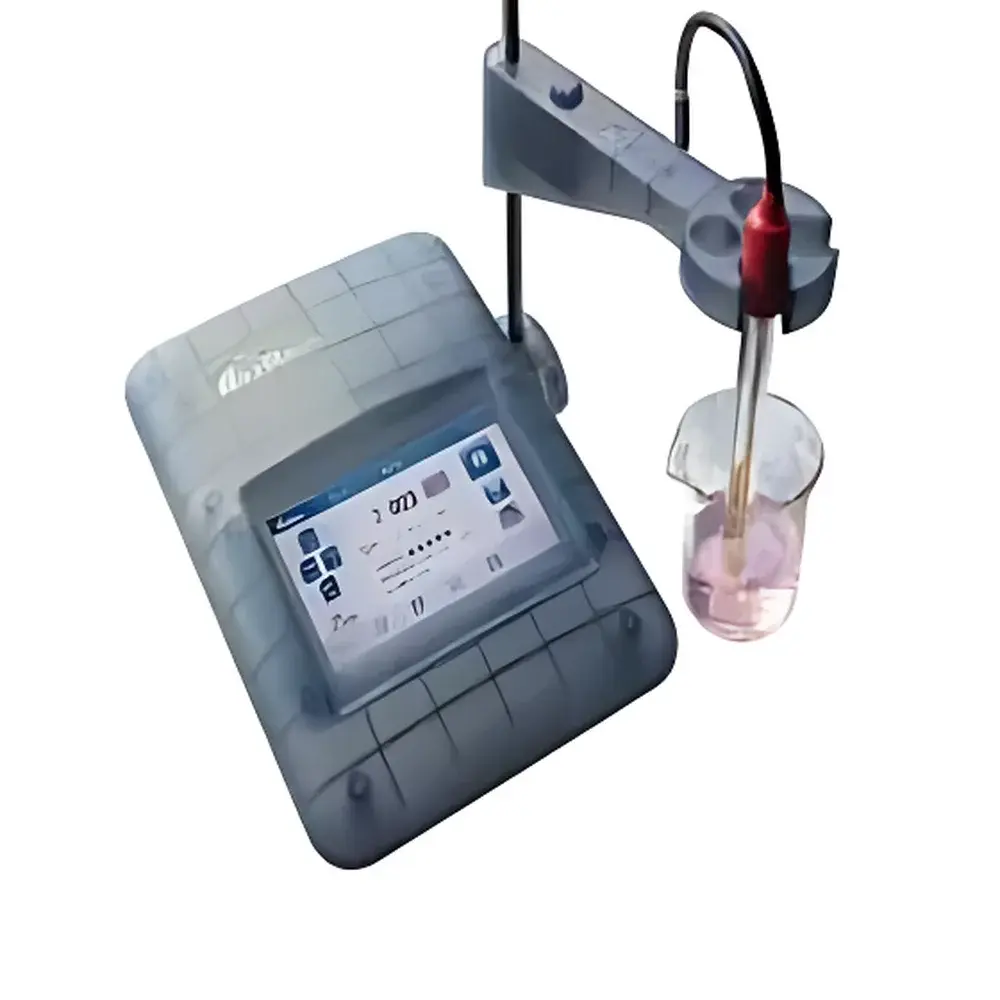
IS139 Benchtop pH Meter by Jihepu (Jinan Hepu)
| Key Features | Touchscreen interface |
|---|---|
| pH range | −2.000 to 20.000 |
| pH resolution | 0.001/0.01/0.1 selectable |
| pH accuracy | ±0.002 |
| mV range | −2000.0 to +2000.0 mV |
| mV resolution | 0.01/0.1/1 selectable |
| mV accuracy | ±0.1 mV |
| Temperature range | −30.0 to 130.0 °C (MTC), −5.0 to 130.0 °C (ATC) |
| Temp. accuracy | ±0.1 °C |
Overview
The IS139 Benchtop pH Meter is a high-precision electrochemical instrument engineered for routine and advanced pH, mV, and ORP measurements in quality control laboratories, academic research settings, and industrial process support environments. It operates on the fundamental principle of potentiometric measurement: detecting the potential difference between a pH-sensitive glass electrode and a stable reference electrode immersed in an aqueous sample. This voltage—generated in accordance with the Nernst equation—is converted into a pH value using temperature-compensated algorithms. Designed for regulatory compliance and operational rigor, the IS139 supports Good Laboratory Practice (GLP) workflows through time-stamped, user-identifiable data records, audit-ready calibration logs, and full traceability of electrode usage history.
Key Features
- Intuitive 5.0-inch color touchscreen interface with 800×480 resolution enables direct, gesture-free navigation across measurement modes, calibration menus, and data review screens—eliminating reliance on physical buttons and reducing operator error.
- Multi-mode temperature compensation: Automatic (ATC) and manual (MTC) options accommodate diverse probe configurations and ambient conditions; ATC range spans −5.0 to 130.0 °C, while MTC extends to −30.0 °C for cryogenic applications.
- Intelligent buffer recognition system identifies standard pH 4.01, 6.86, and 9.18 solutions (and six additional international buffers) during calibration, minimizing misconfiguration and ensuring adherence to ISO 3696 and ASTM E70 protocols.
- Flexible endpoint detection: Users select from automatic stabilization-based termination, timed endpoints (e.g., 10 s, 30 s), or manual confirmation—critical for viscous, low-conductivity, or unstable samples where equilibrium drifts occur.
- Electrode health dashboard displays real-time slope (%), offset (mV), and asymmetry potential alongside graphical calibration curves—enabling predictive maintenance and verification against USP and EP 2.2.3 acceptance criteria.
- Comprehensive data management architecture: Stores up to 2000 measurements with timestamps, operator IDs, electrode serial numbers, and calibration metadata; supports export via RS232 serial link or USB mass storage (4 GB drive included).
Sample Compatibility & Compliance
The IS139 accommodates a broad spectrum of aqueous and semi-aqueous matrices—including buffers, cell culture media, pharmaceutical formulations, wastewater effluents, food extracts, and electroplating baths—provided conductivity exceeds 25 µS/cm and temperature remains within specified limits. Its design conforms to IEC 61010-1 safety standards for laboratory electrical equipment. Calibration procedures align with ISO 17025 requirements for measurement uncertainty estimation, and data integrity features—including immutable timestamps, electronic signatures (via IS-LINK software), and configurable audit trails—support compliance with FDA 21 CFR Part 11 and EU Annex 11 when deployed in regulated GxP environments.
Software & Data Management
IS-LINK PC software provides real-time bidirectional communication for live graphing (pH vs. t, mV vs. t), batch calibration validation, and automated report generation in PDF or CSV format. The software enforces role-based access control, enabling lab managers to restrict calibration parameter edits while permitting technicians to perform routine measurements. All exported datasets include embedded metadata: instrument ID, firmware version, electrode model and serial number, calibration date/time, and environmental temperature at time of measurement—ensuring full analytical traceability per GLP Chapter 5 and ISO/IEC 17025:2017 Clause 7.7.
Applications
- Pharmaceutical QC testing of injectables, oral suspensions, and lyophilized reconstitution solutions per USP .
- Environmental monitoring of surface water, groundwater, and treated effluent in accordance with EPA Method 150.1 and ISO 10523.
- Food & beverage process control for fermentation pH tracking, dairy titratable acidity verification, and shelf-life stability studies.
- Academic teaching labs requiring robust, student-proof instrumentation with customizable measurement templates and multi-language UI support.
- Chemical manufacturing for acid/base titration endpoint verification and catalyst bath monitoring in electroplating lines.
FAQ
Does the IS139 support two-point or multi-point calibration with custom buffers?
Yes—the instrument allows 1–9 point calibration using any combination of its nine built-in buffer sets or user-defined pH values, with automatic slope and offset calculation per IUPAC recommendations.
Can calibration data be exported and validated externally?
Yes—calibration reports, including electrode slope (%), zero offset (mV), and residual error per point, are exportable via IS-LINK software and retain digital signatures for audit purposes.
Is the YE203 triode pH electrode compatible with non-aqueous solvents?
The YE203 is optimized for aqueous and low-alcohol (<15% v/v) solutions; for organic-rich matrices, use a double-junction electrode with solvent-resistant reference electrolyte (e.g., LiCl in ethanol).
How does the IS139 ensure data integrity under GLP/GMP conditions?
It implements mandatory user login, immutable time/date stamps, electronic record retention with version control, and configurable audit trail logging—all aligned with FDA 21 CFR Part 11 Subpart B requirements.
What power and connectivity options are available for integration into automated lab systems?
The unit accepts 9 V DC input and offers RS232 (with Modbus RTU protocol support), USB host port (for barcode scanners or flash drives), and optional Ethernet-to-RS232 converters for LIMS interfacing.




