
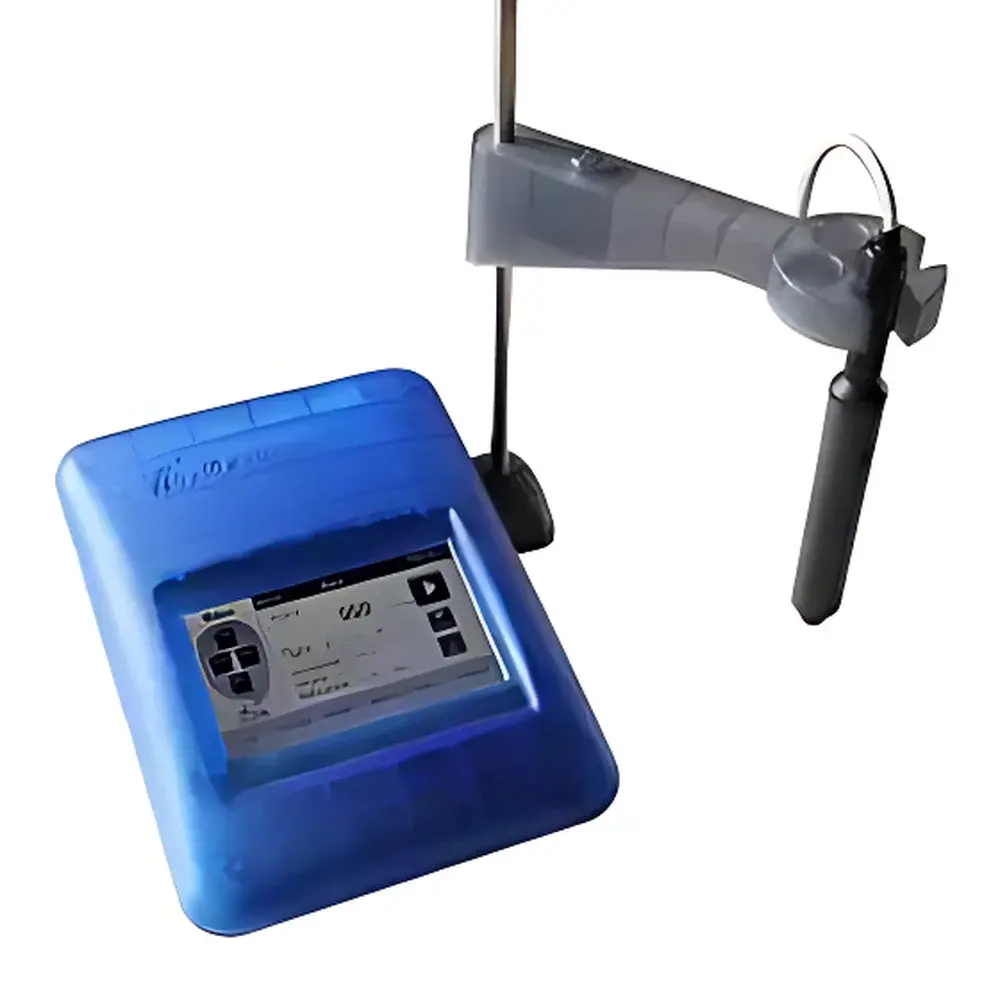
IS228-PW Pure Water Conductivity Meter by Jihepu
| Brand | Jihepu |
|---|---|
| Origin | Shandong, China |
| Model | IS228-PW |
| Measurement Parameters | Conductivity, Resistivity, TDS, Salinity, Temperature |
| Form Factor | Benchtop |
| Conductivity Range | 0.000 μS/cm to 1000 mS/cm |
| Resistivity Range | 0.00 to 100.0 MΩ·cm |
| TDS Range | 0.00 mg/L to 1000 g/L |
| Salinity Range | 0.00 to 80.00 PSU |
| Temperature Range | −30.0 to 130.0 °C (MTC), −5.0 to 130.0 °C (ATC) |
| Accuracy | ±0.5% of reading (conductivity/resistivity/TDS/salinity), ±0.1 °C (temperature) |
| Calibration | Single-point pure water calibration with built-in 10 standard solutions and user-defined option |
| Data Storage | 2000 GLP-compliant records |
| Interface | RS232, USB |
| Display | 5.0-inch color touchscreen (800 × 480) |
| Power Supply | External 9 V/1 A adapter |
| Electrode Input | Mini-DIN 8 with integrated NTC 30 kΩ temperature sensor |
| Included Electrode | YE302 ultra-low-conductivity cell (k = 0.1 cm⁻¹, range: 0.01 μS/cm to 200 mS/cm) |
Overview
The IS228-PW Pure Water Conductivity Meter is a high-precision benchtop instrument engineered for reliable, trace-level conductivity measurement in ultrapure water systems, pharmaceutical water loops (PW, WFI, PW–C), semiconductor rinse processes, and laboratory-grade deionized water validation. It operates on the principle of two-electrode AC conductance measurement, optimized for low-conductivity media via automatic range switching and temperature-compensated algorithms compliant with ASTM D1125 and ISO 7888. The meter features a dedicated pure water calibration mode that accounts for non-linear temperature behavior below 10 μS/cm—critical for accurate resistivity reporting in critical process environments where deviations >0.1 μS/cm may indicate membrane failure or resin exhaustion.
Key Features
- Ultra-low-range capability: Measures from 0.000 μS/cm with auto-ranging across seven decades (0.000 μS/cm to 1000 mS/cm), enabling seamless transition from ultrapure water (≥18.2 MΩ·cm) to concentrated brines.
- Integrated YE302 pure water electrode (cell constant k = 0.1 cm⁻¹): Designed for minimal polarization error and rapid stabilization in sub-μS/cm matrices; includes built-in NTC 30 kΩ temperature sensor for simultaneous real-time compensation.
- GLP-compliant data architecture: Stores 2000 timestamped, operator-tagged measurements with full audit trail—including calibration history, electrode ID, temperature, and compensation settings—meeting FDA 21 CFR Part 11 requirements when paired with IS-LINK software and secure PC configuration.
- Intelligent temperature compensation: Supports linear, non-linear (NaCl-based), and manual disable modes; configurable reference temperatures at 20 °C or 25 °C per USP and EP 2.2.38.
- 5.0-inch high-resolution color touchscreen (800 × 480): Graphical interface with intuitive navigation, customizable display layouts, and real-time trend visualization for conductivity, resistivity, TDS, and salinity.
- Dual communication protocols: RS232 and USB interfaces support direct connection to LIMS, SCADA, or data acquisition systems; optional thermal printer integration for hard-copy SOP compliance.
Sample Compatibility & Compliance
The IS228-PW is validated for use with Type I ultrapure water (ASTM D1193), purified water (USP ), water for injection (USP ), and process rinse waters in biopharmaceutical manufacturing. Its measurement stability under low-flow, static, or recirculating conditions meets the dynamic response requirements of ISO 14644-1 cleanroom monitoring and semiconductor fab water quality control (SEMI F63). The instrument complies with CE marking directives (EMC 2014/30/EU, RoHS 2011/65/EU) and supports GMP/GLP workflows through mandatory metadata capture (operator ID, sample ID, location tag, calibration certificate number).
Software & Data Management
IS-LINK software provides bidirectional real-time data streaming and batch export in CSV, Excel, and PDF formats. It enables remote instrument configuration, firmware updates, and automated report generation aligned with ALCOA+ principles (Attributable, Legible, Contemporaneous, Original, Accurate, Complete, Consistent, Enduring, Available). Audit trail functionality logs all user actions—including parameter changes, calibration events, and data deletions—with immutable timestamps and digital signature support. Data encryption (AES-128) and role-based access control ensure regulatory readiness for FDA inspection and MHRA audits.
Applications
- Validation and routine monitoring of reverse osmosis (RO), electrodeionization (EDI), and mixed-bed polishing systems.
- USP compliance testing for conductivity limits in purified water and water for injection.
- Leak detection in stainless-steel distribution loops via localized resistivity drop analysis.
- Quality control of cleaning-in-place (CIP) final rinse water in aseptic processing suites.
- Research applications requiring high-fidelity correlation between conductivity and ionic impurity profiles in nanofiltration studies.
- Environmental labs measuring low-salinity groundwater and rainwater chemistry.
FAQ
What is the minimum detectable conductivity level for ultrapure water measurement?
The IS228-PW achieves a resolution of 0.001 μS/cm in its lowest range (0.000–1.999 μS/cm), corresponding to a theoretical resistivity resolution of 0.001 MΩ·cm near 18.2 MΩ·cm.
Does the instrument support automatic temperature compensation for non-aqueous solvents?
No—ATC is optimized for aqueous electrolyte solutions per IEC 60746-3; non-aqueous calibration requires manual temperature offset or external correction.
Can the YE302 electrode be used for high-conductivity samples above 200 mS/cm?
The YE302 is rated up to 200 mS/cm (k = 0.1); for higher ranges, a k = 1.0 or k = 10.0 cell must be selected and manually configured in the instrument setup menu.
Is the 2000-record memory retained during power loss?
Yes—data are stored in non-volatile flash memory with battery-backed real-time clock; no data corruption occurs during unexpected shutdown.
How often does the YE302 electrode require recalibration in continuous ultrapure water service?
Per USP , daily verification is recommended; full calibration is required after electrode cleaning, replacement, or if drift exceeds ±0.02 μS/cm against a certified reference standard.




