
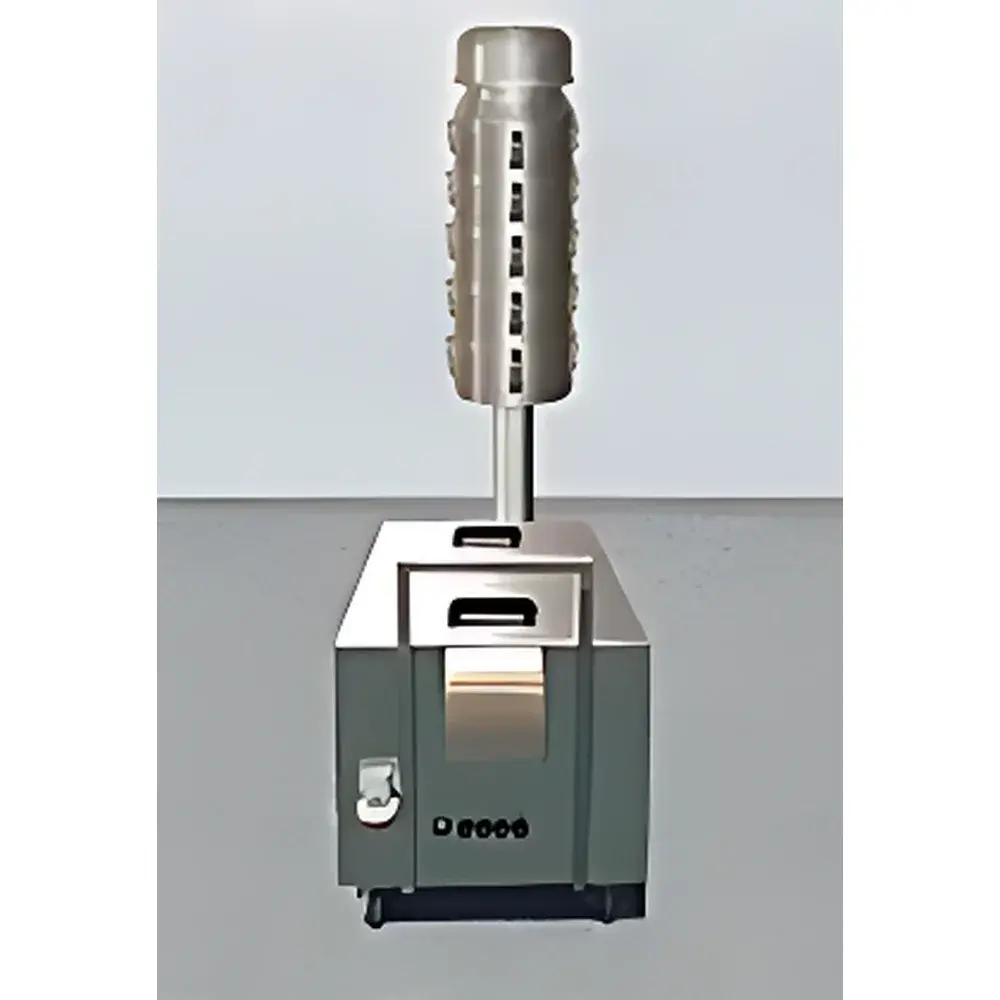
ISAP 4000e High-Volume Aerosol Sampler
| Brand | ISAP |
|---|---|
| Origin | Germany |
| Model | 4000e |
| Max. Flow Rate | 1000 m³/h (configurable: 200 / 500 / 700 / 1000 m³/h) |
| Operating Temperature Range | −30 °C to +40 °C (optional up to +50 °C) |
| Compliance | EU Directive 2008/50/EC, German 39th BImSchV, ISO 7708, ISO 8756, EN 481, TA Luft |
| Cut-Point Options | TSP, PM₁₀, PM₂.₅, UHVCI (Ultra-High-Volume Cascade Impactor) |
| Filter Compatibility | Glass microfiber, Quartz microfiber, Polyimide (Kapton®), Polycarbonate (PC), Polyester, Polypropylene (PP), PTFE (Teflon®), Polyurethane foam (PU), Polyvinyl fluoride (PVF/Tedlar®) |
| Optional Meteorological Sensors | Wind direction & speed, Relative humidity, Ambient temperature, Precipitation, Solar radiation, UV index, Total radiation, Acoustic noise, Vibration |
Overview
The ISAP 4000e is a high-volume, stationary aerosol sampling system engineered for regulatory-grade ambient air monitoring of trace-level toxic and radioactive particulate matter. It operates on the principle of inertial impaction and gravitational sedimentation—optimized for quantitative collection of airborne particles across defined aerodynamic size fractions. Designed for continuous or scheduled operation in demanding outdoor environments, the 4000e delivers volumetric flow rates up to 1000 m³/h, enabling statistically robust mass loading on filter media within practical sampling durations (e.g., 24–168 h). This capability is essential for detecting ultra-low-concentration analytes—including heavy metals (Pb, Cd, As, Ni), halogenated hydrocarbons (PCBs, dioxins/furans), radionuclides (⁷Be, ²¹⁰Pb, ¹³⁷Cs), and ultrafine particulate-bound toxins—where low-flow samplers would require impractically long integration times to achieve detection limits required by modern analytical instrumentation (e.g., ICP-MS, TXRF, PIXE, HR-GC/HR-MS).
Key Features
- Modular high-volume airflow architecture with precision-matched blower, flow control valve, and integrated thermal mass flow sensor calibrated traceably to NIST standards.
- Interchangeable inlet assemblies compliant with ISO 7708 (particle size definition) and EN 481 (worker exposure), including TSP, PM₁₀, and PM₂.₅ cyclones as well as multi-stage ultra-high-volume cascade impactors (UHVCI) for size-resolved fractionation down to 0.01 µm.
- Ruggedized aluminum enclosure rated IP55, operational from −30 °C to +40 °C (extended range option to +50 °C), with internal condensation management and anti-icing heater for winter deployment.
- Real-time flow monitoring with automatic pressure-drop compensation; flow stability maintained within ±2% over full operating range and temperature span.
- Filter holder compatible with standard 20.3 cm (8-inch) and 15 cm (6-inch) diameter substrates, supporting gravimetric, elemental, organic, and radiochemical analysis workflows.
- Integrated data logger with timestamped flow, temperature, pressure, and operational status; supports external trigger inputs and remote diagnostics via Ethernet or optional GSM module.
Sample Compatibility & Compliance
The ISAP 4000e meets the technical requirements of major European and national air quality directives, including EU Directive 2008/50/EC Annex II (reference methods for PM₁₀ and PM₂.₅), the German 39th Ordinance on Air Quality Control (39. BImSchV), and TA Luft (Technical Instructions on Air Quality Control). Its design conforms to ISO 8756 (high-volume sampler performance criteria) and ISO 7708 (aerodynamic particle size definitions). The system supports a broad spectrum of certified filter media—including quartz fiber (for thermal-optical EC/OC analysis), polycarbonate (for SEM/EDS), PTFE (low blank for ICP-MS), and PVF (Tedlar®) for volatile organic compound preservation—ensuring compatibility with downstream analytical protocols mandated under EPA Method IO-3.2, EN 14902, EN 16913, and ISO/IEC 17025-accredited laboratories.
Software & Data Management
The ISAP 4000e interfaces with ISAP ControlSuite™ v4.x—a Windows-based configuration and data acquisition platform compliant with FDA 21 CFR Part 11 (electronic records/signatures) and GLP audit requirements. Software features include automated calibration logging, flow drift correction algorithms, event-triggered sampling, and export of time-stamped datasets in CSV, NetCDF, and EEA-compliant AQ e-Reporting format. All raw sensor data are stored with cryptographic hash integrity verification; audit trails record user actions, parameter changes, and maintenance events with immutable timestamps. Remote firmware updates and diagnostic telemetry support predictive maintenance scheduling and ISO/IEC 17025 traceability documentation.
Applications
- Long-term ambient monitoring networks for compliance with EU Air Quality Directive reporting obligations.
- Source apportionment studies requiring high-mass loading for isotopic fingerprinting (e.g., Pb isotopes, Sr/Nd ratios) and organic marker analysis (e.g., PAHs, dioxins).
- Post-incident radiological surveillance near nuclear facilities or after accidental releases (e.g., ¹³¹I, ¹³⁷Cs, ²⁴¹Am).
- Health impact assessments in urban, industrial, and near-roadway environments where ultrafine and transition metal-rich particles drive oxidative stress pathways.
- Calibration and validation of lower-flow reference samplers and optical particle counters (OPCs) using co-located high-volume gravimetric reference data.
FAQ
What regulatory standards does the ISAP 4000e meet for PM₂.₅ and PM₁₀ monitoring?
It complies fully with EU Directive 2008/50/EC Annex II, German 39. BImSchV, and EN 12341:2014 for reference measurement methods.
Can the system operate unattended for extended periods in extreme cold?
Yes—rated for −30 °C operation with optional anti-icing heater and condensation-trap design; field-proven in Arctic and alpine deployments.
Is the flow rate adjustable during sampling?
Yes—programmable stepwise flow profiles (e.g., ramp-down during high wind) are supported via ControlSuite™ with real-time feedback compensation.
Which filter types are recommended for ICP-MS analysis of trace metals?
Quartz microfiber and PTFE (Teflon®) filters are preferred due to ultra-low procedural blanks and acid resistance; both are certified for use in EN 14902 and US EPA IO-3.2.
Does the system support meteorological data integration for dispersion modeling?
Yes—via optional integrated sensor suite (wind, RH, temp, radiation, noise) with synchronized timestamping and export in WMO-compliant BUFR or CF-NetCDF formats.







