
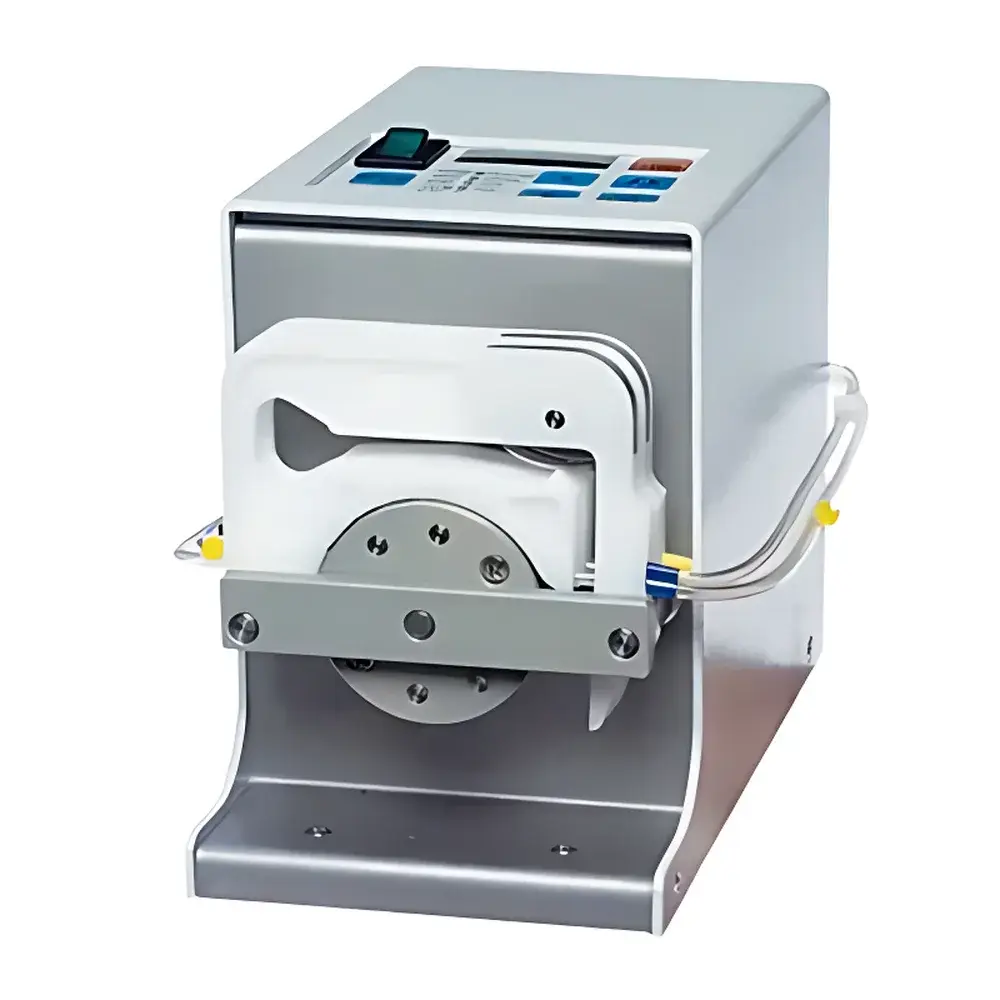
Ismatec 78016/78017 Compact Multi-Channel Peristaltic Pump
| Brand | ISMATEC |
|---|---|
| Model | 78016 / 78017 Series |
| Channel Count | 2 or 4 channels |
| Speed Range | 1.0–160 rpm |
| Flow Rate Range | 0.003–59 mL/min |
| Power Supply | 115/230 V AC |
| Analog Input Options | 0–5 V DC, 0–10 V DC, 0–20 mA, 4–20 mA |
| Control Interface | DB15 female dry-contact I/O |
| Dimensions (W×D×H) | 178 × 102 × 135 mm |
| Compliance | CE, RoHS |
Overview
The Ismatec 78016 and 78017 series are compact, precision-engineered multi-channel peristaltic pumps designed for reliable, low-pulsation fluid delivery in demanding laboratory and process environments. Based on the proven roller-compression principle of peristaltic pumping, these units provide pulse-free, contamination-free flow by isolating the fluid path entirely within flexible tubing—eliminating valves, seals, or wetted metal components. Each channel operates independently with synchronized speed control, enabling precise proportional dosing, gradient generation, or parallel sample handling across up to four discrete streams. The modular architecture supports seamless integration into automated workflows via analog and digital control interfaces, making them suitable for applications requiring traceable, repeatable flow performance under GLP, GMP, or ISO 17025-aligned protocols.
Key Features
- Independent channel control with adjustable speed resolution down to 1% increments (0–99% of max RPM), ensuring fine-tuned flow modulation without mechanical recalibration.
- Wide operational speed range: 1.0–160 rpm for 2-channel models (78016-00, 78016-10, 78017-25) and 1.0–100 rpm for 4-channel variants (78016-30, 78017-30, 78017-35), optimized for both high-throughput transfer and ultra-low-flow microdosing.
- Multiple analog input compatibility: accepts 0–5 V DC, 0–10 V DC, 0–20 mA, and 4–20 mA signals for external PLC, DAQ system, or process controller synchronization.
- DB15 female interface provides dry-contact I/O for remote start/stop and direction reversal—enabling fail-safe interlocks and hardware-level pump coordination in safety-critical setups.
- Compact footprint (178 × 102 × 135 mm) facilitates benchtop deployment in space-constrained analytical workstations, bioreactor control racks, or multi-instrument automation cabinets.
- Universal power supply (115/230 V AC, 50/60 Hz) ensures global operational readiness without voltage conversion hardware.
Sample Compatibility & Compliance
Peristaltic operation inherently supports a broad spectrum of chemically aggressive, viscous, particulate-laden, or shear-sensitive fluids—including organic solvents, cell suspensions, polymer solutions, and abrasive slurries—without risk of cross-contamination or degradation of internal components. Tubing selection (e.g., PharMed® BPT, Tygon® LFL, or Viton®) determines chemical resistance and pressure rating, with maximum backpressure capability dependent on tube ID and material compliance (up to 2 bar typical). All models conform to CE marking requirements under the EU Machinery Directive 2006/42/EC and Electromagnetic Compatibility Directive 2014/30/EU. RoHS 2011/65/EU compliance guarantees restricted substance management in line with environmental stewardship standards. While not certified for sterile processing or medical device use, the pumps meet functional prerequisites for ISO 9001-certified quality laboratories and support audit-ready documentation when paired with validated tubing change logs and calibration records.
Software & Data Management
These pumps operate as stand-alone instruments but are fully compatible with third-party SCADA, LabVIEW™, or Python-based control frameworks via analog signal mapping and TTL-level contact logic. No proprietary software is required; however, integration with data acquisition systems enables time-stamped flow logging, alarm-triggered event capture (e.g., tubing occlusion detection via motor current monitoring), and audit-trail generation. When deployed in regulated environments, users may implement 21 CFR Part 11-compliant electronic signatures and access controls at the supervisory system level—though the pump itself does not embed user authentication or electronic record storage. Firmware updates are performed via physical reset sequence only; no network connectivity or cloud dependency is present, minimizing cybersecurity exposure surfaces.
Applications
- Automated liquid handling in HPLC and UHPLC mobile phase delivery, especially for binary or quaternary gradient mixing where channel independence prevents solvent carryover.
- Continuous feeding of reagents or nutrients in microbial fermentation, mammalian cell culture, or enzymatic reaction monitoring systems.
- Parallel sampling in environmental water analysis, where multiple streams (e.g., pH, conductivity, turbidity) are drawn simultaneously from a single source manifold.
- Calibration standard delivery in metrology labs requiring gravimetrically verified flow rates traceable to NIST SRMs.
- Microfluidic chip priming and reagent loading in diagnostic assay development, leveraging low-flow precision (<0.01 mL/min) and bubble-tolerant operation.
FAQ
What tubing sizes are supported?
Standard configurations accommodate inner diameters from 0.1 mm to 3.2 mm; optimal flow ranges and pressure tolerance depend on selected tubing material and wall thickness—reference Ismatec’s Tubing Selection Guide for compatibility matrices.
Can the pump be used for vacuum applications?
No—these are positive-displacement peristaltic pumps rated for pressure delivery only; they are not designed for suction lift beyond 2–3 meters of water column and lack vacuum-rated sealing or motor torque characteristics.
Is flow rate calibration traceable to national standards?
The pump itself does not include factory calibration certificates; however, its linear speed-to-flow relationship allows end-user verification using gravimetric or volumetric methods compliant with ASTM D3417 or ISO 4787 procedures.
How is maintenance performed?
Routine maintenance consists solely of periodic tubing replacement (typically every 100–500 hours depending on speed, pressure, and fluid abrasiveness) and visual inspection of roller alignment—no lubrication or internal servicing is required.
Are replacement parts available globally?
Yes—ISMATEC-certified tubing, rotor assemblies, and DB15 interface cables are distributed through authorized partners in North America, EMEA, and APAC regions with documented lead times and lot-number traceability.



