
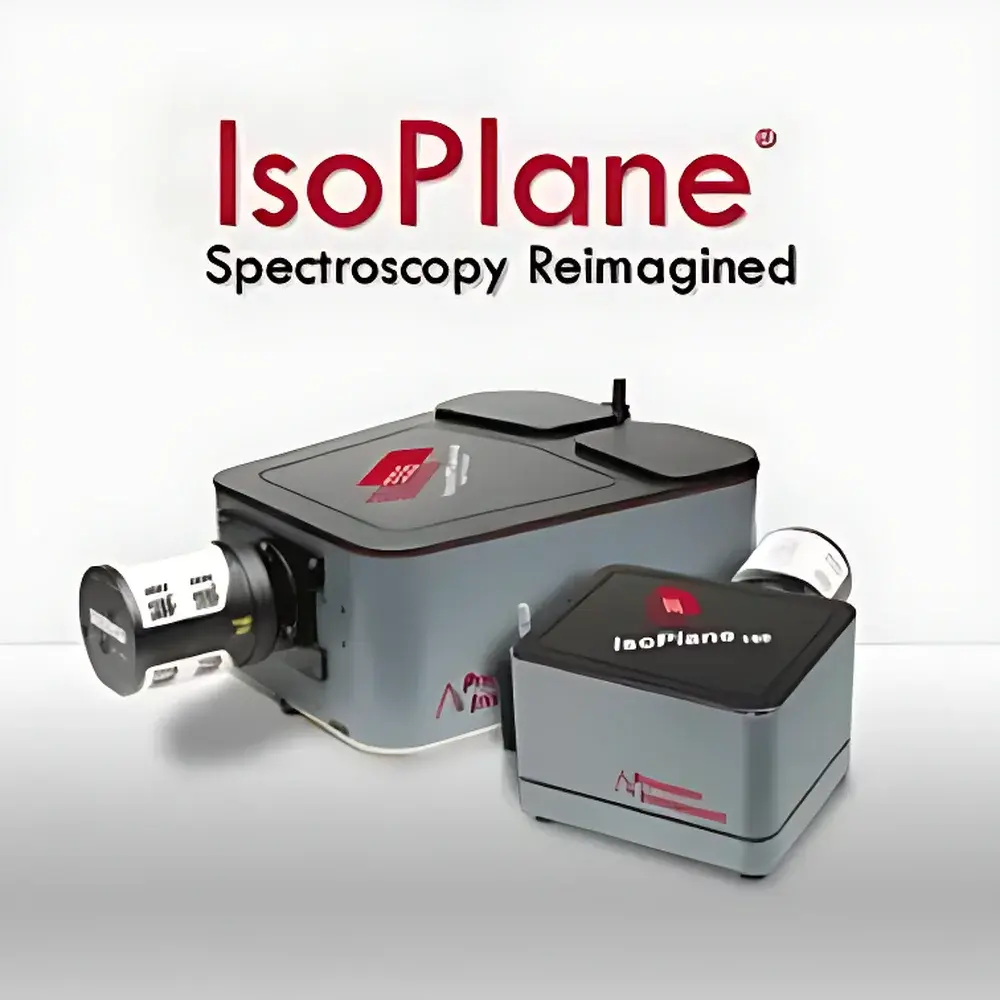
IsoPlane SCT-320 and IsoPlane 160 Imaging Spectrographs
| Brand | Princeton Instruments (Teledyne) |
|---|---|
| Origin | USA |
| Model | IsoPlane SCT-320, IsoPlane 160 |
| Focal Length | 320 mm (SCT-320), 203 mm (160) |
| Aperture Ratio | f/4.6 (SCT-320), f/3.88 (160) |
| Spectral Resolution (PMT) | 0.05 nm (SCT-320), 0.10 nm (160) |
| Spectral Resolution (CCD, 1200 gr/mm, 435 nm, 20 µm pixels, 10 µm slit) | 0.08 nm (SCT-320), 0.15 nm (160) |
| Grating Mount | Motorized triple-grating turret with auto-recognition |
| Wavelength Range | UV to mid-IR (193 nm–>5 µm, depending on grating & detector) |
| Optical Coating Options | Acton #1900 enhanced Al (193 nm–mid-IR), protected Ag (>98% avg. reflectance), Au (NIR/SWIR) |
| Detector Compatibility | PIXIS, ProEM, PI-MAX4, NIRvana series |
| Software Platform | LightField v8+ (64-bit), supports LabVIEW, MATLAB, EPICS, and FDA 21 CFR Part 11-compliant audit trail modules |
Overview
The IsoPlane SCT-320 and IsoPlane 160 are patented, zero-aberration imaging spectrographs engineered for high-fidelity spatial-spectral correlation in demanding scientific applications. Unlike conventional Czerny-Turner (C-T) or crossed-beam spectrometers, the IsoPlane platform employs a fully reflective, off-axis parabolic optical architecture that eliminates coma, astigmatism, and field curvature across the entire focal plane—achieving true diffraction-limited imaging performance at all wavelengths and positions. This intrinsic isoplanatic design enables simultaneous acquisition of multi-channel spectral data without signal crosstalk, making it uniquely suited for fiber array inputs (e.g., >100-channel spectroscopy), microspectroscopy, and time-resolved hyperspectral imaging. The SCT-320 delivers resolution comparable to a 0.5 m C-T instrument while providing double the throughput; the compact IsoPlane 160 achieves resolution equivalent to a 1/3 m C-T system within a 203 mm focal length package—ideal for integration into confocal microscopes, LIBS probes, and portable analytical platforms.
Key Features
- Zero-aberration optical design: Full-field correction across the entire CCD height (up to 22 mm) ensures uniform spectral fidelity and pixel-level spatial registration—critical for quantitative multichannel analysis and spectral line profile integrity.
- High-throughput f/4.6 (SCT-320) and f/3.88 (160) optics: Maximizes photon collection efficiency without sacrificing resolution—enabling low-light applications such as single-molecule fluorescence, TERS, and photoluminescence decay studies.
- Motorized triple-grating turret with auto-recognition: Supports up to nine gratings; software-controlled selection enables seamless switching between UV, VIS, NIR, and mid-IR configurations with calibrated wavelength positioning and repeatability <±0.005 nm.
- Optimized broadband coatings: Acton #1900 enhanced aluminum (193 nm–5 µm), protected silver (>98% average reflectance), and gold (NIR/SWIR) options ensure consistent throughput across spectral domains.
- Sub-pixel focusing adjustment: Precision micrometer-driven collimator alignment allows fine-tuning of spectral focus and spatial image sharpness—directly improving both spectral resolution and camera-limited MTF performance.
- Native compatibility with Princeton Instruments detectors: Fully synchronized operation with PIXIS CCDs, ProEM EMCCDs, PI-MAX4 ICCDs/emICCDs, and NIRvana InGaAs arrays—including hardware-triggered gating, kinetic mode, and photon-counting modes.
Sample Compatibility & Compliance
The IsoPlane platform accommodates diverse sample interfaces via standardized C-mount and SM1-threaded ports, supporting fiber bundles (e.g., 1×16, 1×64, hex-packed arrays), microscope couplers (including infinity-corrected objectives), free-space beams, and plasma/LIBS collection optics. Its rigid monolithic aluminum housing minimizes thermal drift (<0.005 nm/°C), ensuring long-term stability required for GLP/GMP-compliant environmental monitoring or pharmaceutical QC workflows. When paired with LightField software configured for 21 CFR Part 11 compliance (electronic signatures, audit trails, role-based access control), the system meets regulatory requirements for analytical instrumentation in FDA-regulated laboratories. All optical components conform to ISO 10110 surface quality standards; spectral calibration traceability is maintained via NIST-traceable IntelliCal sources (wavelength ±0.002 nm, intensity ±1.5%).
Software & Data Management
LightField v8+ serves as the unified 64-bit acquisition and analysis environment, offering native support for real-time spectral imaging, multi-region-of-interest (ROI) extraction, and on-the-fly mathematical operations (e.g., spectral subtraction, ratio imaging, PCA decomposition). The software integrates seamlessly with third-party environments including LabVIEW (NI-DAQmx drivers), MATLAB (Instrument Control Toolbox), and EPICS IOC frameworks—enabling synchronization with pump-probe lasers, delay stages, or synchrotron timing signals. For regulated environments, optional LightField Audit Trail and Electronic Signature modules provide full 21 CFR Part 11 compliance, including immutable log files, user authentication, and change history tracking. Raw data is saved in HDF5 format with embedded metadata (grating ID, slit width, exposure, calibration coefficients), ensuring FAIR (Findable, Accessible, Interoperable, Reusable) data principles.
Applications
- Tip-Enhanced Raman Spectroscopy (TERS): Sub-diffraction spatial resolution combined with high spectral fidelity enables nanoscale chemical mapping of catalytic surfaces and 2D materials.
- Laser-Induced Breakdown Spectroscopy (LIBS): High throughput and broad spectral coverage support rapid elemental fingerprinting in geological, metallurgical, and planetary exploration contexts—including heritage systems used aboard NASA’s Curiosity rover.
- Fluorescence & Photoluminescence Lifetime Imaging: Time-gated acquisition with PI-MAX4 ICCDs allows ns–µs decay profiling across spectral channels—essential for quantum dot characterization and biological tissue diagnostics.
- Surface-Enhanced Raman Spectroscopy (SERS): Uniform illumination and detection across large-area substrates improve quantitative reproducibility in biosensor development and trace analyte detection.
- Combustion & Plasma Diagnostics: Simultaneous multi-line emission capture enables species concentration modeling and temperature profiling in turbulent flames and fusion plasmas.
- Coherent Anti-Stokes Raman Scattering (CARS): Broadband dispersion control preserves phase-matching conditions across Stokes and anti-Stokes bands—critical for label-free vibrational microscopy.
FAQ
What distinguishes IsoPlane from traditional Czerny-Turner spectrographs?
The IsoPlane eliminates off-axis aberrations through its proprietary reflective imaging design—delivering diffraction-limited performance across the full focal plane, whereas C-T systems exhibit significant coma and astigmatism away from the optical axis.
Can IsoPlane be used with non-Princeton Instruments detectors?
Yes—standard C-mount and F-mount interfaces support third-party scientific cameras; however, full hardware synchronization (gating, triggering, ROI readout) and calibration integration require Princeton Instruments’ native SDKs.
Is spectral recalibration required after grating changes?
No—each grating in the motorized turret contains an RFID tag storing its groove density, blaze angle, and calibration coefficients; LightField automatically loads optimized dispersion models upon selection.
How does the f-number affect signal-to-noise ratio in low-light experiments?
A lower f-number (e.g., f/3.88) increases étendue, enabling higher photon flux per pixel without defocusing—directly improving SNR in photon-starved modalities like single-photon counting or time-resolved luminescence.
Does IsoPlane support vacuum or purged operation for UV applications below 200 nm?
Yes—the SCT-320 and 160 housings are compatible with N₂ purge or vacuum integration (≤10⁻³ Torr); optional MgF₂ windows and deep-UV optimized coatings extend operational range down to 193 nm.





