ISOTECH Water Triple Point Cell A11 and B11
| Brand | ISOTECH |
|---|---|
| Origin | United Kingdom |
| Model | A11, B11 |
| Calibration Certificate Option | UKAS-accredited with uncertainty ≤ 0.07 mK (k=2) |
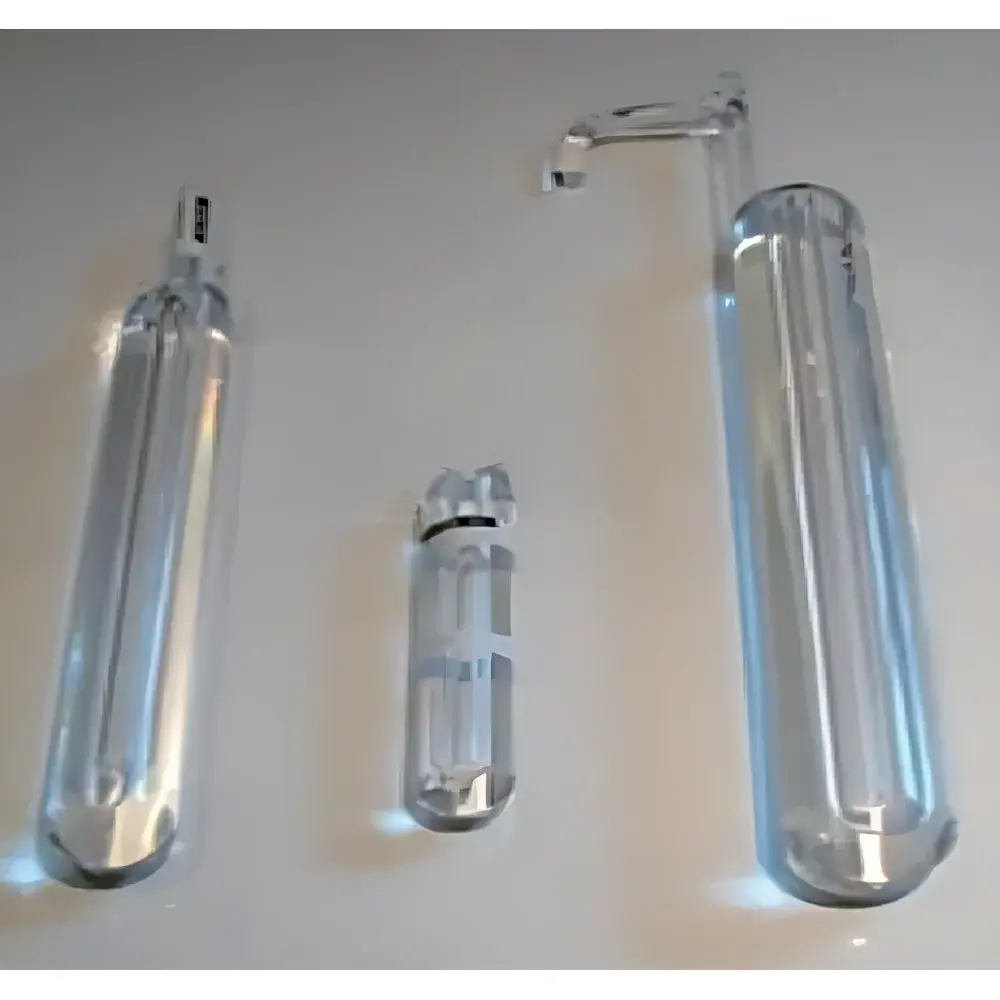
| Design Type | A-type (integrated handle for handling & pressure indication), B-type (100 mm extended inner tube for full immersion) |
| Purification | 12-step vacuum distillation |
Overview
The ISOTECH Water Triple Point Cell A11 and B11 are primary-standard fixed-point cells engineered for the precise realization of the water triple point—defined at exactly 273.16 K (0.01 °C) under equilibrium conditions of solid ice, liquid water, and water vapor. This thermodynamic fixed point serves as the cornerstone of the International Temperature Scale of 1990 (ITS-90) and is fundamental to national metrology institutes, calibration laboratories, and accredited temperature testing facilities worldwide. Unlike secondary reference devices, ISOTECH triple point cells operate on first-principles thermodynamics: they rely solely on the phase equilibrium of ultra-pure water, eliminating dependence on sensor drift or electronic interpolation. Each cell is constructed from fused quartz with a precisely controlled internal geometry, ensuring reproducible ice mantle formation and minimal thermal hysteresis during freeze-thaw cycles.
Key Features
- Ultra-high-purity water: Produced via 12-stage vacuum distillation; isotopic composition certified equivalent to VSMOW (Vienna Standard Mean Ocean Water), meeting ISO/IEC 17025 traceability requirements for primary standards.
- A11 configuration: Integrated curved quartz handle above the neck—designed for ergonomic handling, mechanical stability during insertion into dry-well or bath furnaces, and passive local atmospheric pressure monitoring via meniscus displacement.
- B11 configuration: 100 mm upward extension of the inner quartz tube—enables complete submersion in temperature-controlled preservation baths, minimizing axial thermal gradients and suppressing conductive heat leakage across the ice mantle interface.
- Long-term stability: Cells exhibit <0.1 mK repeatability over 100+ freeze-thaw cycles when operated per ITS-90 Annex C protocols; validated through inter-laboratory comparisons coordinated by EURAMET and BIPM.
- UKAS-certified calibration option: Available with formal accreditation to ISO/IEC 17025, reporting expanded uncertainty ≤ 0.07 mK (k = 2) at the triple point, fully compliant with GLP/GMP documentation requirements.
Sample Compatibility & Compliance
These cells are not sample-dependent in the conventional sense—they contain no consumables other than the sealed, isotopically characterized water charge. No user refilling or reprocessing is permitted; each cell is a hermetically sealed, single-use primary standard. The quartz envelope complies with IEC 60751 Annex D for thermal shock resistance and meets ASTM E2877-22 specifications for triple-point cell dimensional tolerances. All units are supplied with CE marking and conform to EU Directive 2014/30/EU (EMC) and 2014/35/EU (LVD) for laboratory instrumentation safety. Documentation includes full manufacturing history, batch-specific purification logs, and optional UKAS certificate of calibration aligned with ISO/IEC 17025:2017 Clause 7.7.
Software & Data Management
While the triple point cell itself is a passive physical artifact, its integration into automated calibration systems requires strict procedural control. ISOTECH provides comprehensive operating instructions aligned with ISO/IEC 17025 Clause 7.8.2 for fixed-point cell use, including freeze-cycle timing, thermal soak duration, plateau detection criteria (e.g., ≤ 10 µK/min drift over 15 min), and plateau duration validation. When used with compatible digital thermometer readers (e.g., Fluke 1594A, Keysight 34970A with 7½-digit DMM modules), data acquisition can be scripted to enforce FDA 21 CFR Part 11-compliant audit trails—including operator ID, timestamped freeze/thaw events, plateau stability metrics, and raw resistance vs. time logs. ISOTECH does not supply proprietary software but publishes detailed SOP templates compatible with LabVIEW, Python-based pyvisa frameworks, and MET/CAL® environments.
Applications
- Primary calibration of Standard Platinum Resistance Thermometers (SPRTs) in accordance with ITS-90 Sections 4–5 and CCT-WG3 guidelines.
- Validation and verification of high-stability dry-block calibrators, liquid-bath calibrators, and precision temperature controllers used in pharmaceutical stability chambers and environmental test labs.
- Intercomparison reference in regional metrology networks (e.g., APMP T-CCT key comparisons) and national measurement system audits conducted by NIST, PTB, NPL, or NMISA.
- Uncertainty budget anchoring for temperature measurement chains where k = 2 expanded uncertainty below 0.1 mK is required—particularly in quantum thermometry R&D and cryogenic sensor characterization.
- Educational demonstration of thermodynamic equilibrium, phase diagrams, and metrological traceability in university physics and engineering laboratories.
FAQ
What is the expected service life of an ISOTECH water triple point cell?
With proper handling (avoiding mechanical shock, rapid thermal cycling, or exposure to contaminants), A11 and B11 cells maintain metrological integrity for ≥15 years. Annual verification against a master cell or intercomparison is recommended per ISO/IEC 17025 Clause 6.6.
Can the water charge be replaced or refilled by the user?
No. The cell is permanently sealed under vacuum after purification. Any attempt to open or refill voids calibration validity and violates ITS-90 Annex C requirements for primary standards.
Is the 452 Ice Mantle Freezer compatible with both A11 and B11 models?
Yes—the 452 freezer’s thermally optimized copper probe accommodates both neck geometries. Its low-thermal-gradient design ensures stress-free ice formation regardless of cell type, achieving stable plateaus in 20–30 minutes per cycle.
Do ISOTECH triple point cells require periodic recalibration?
They do not require recalibration in the traditional sense, but must undergo periodic verification (e.g., annual comparison with a reference cell or participation in proficiency testing) to confirm continued compliance with ≤0.07 mK uncertainty claims.
How is traceability to SI maintained for these cells?
Traceability is established through documented chain-of-custody from VSMOW-certified water source, ISO/IEC 17025-accredited purification facility, and UKAS-certified characterization—fully satisfying BIPM CIPM MRA requirements for national standard dissemination.