
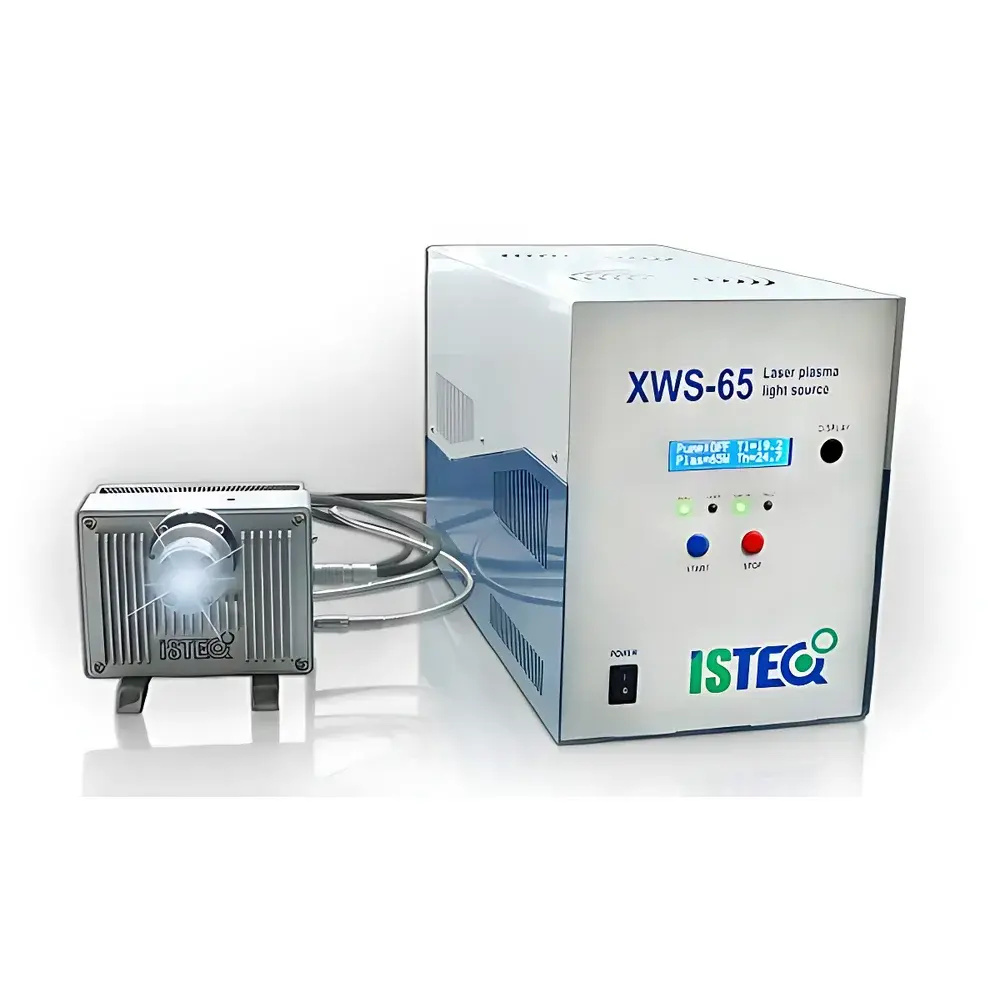
ISTEQ XWS-65 Laser-Driven Plasma White Light Source
| Brand | ISTEQ |
|---|---|
| Origin | Netherlands |
| Manufacturer Type | Authorized Distributor |
| Origin Category | Imported |
| Model | XWS-65 |
| Pricing | Upon Request |
| Spectral Range | 190–2500 nm (UV configuration), 250–2500 nm (OFR configuration) |
| Spectral Radiance | up to 50 mW/(mm²·sr·nm) |
| Total Output Power | up to 3 W (free-space), up to 0.5 W (fiber-coupled) |
| Emitter Size | 250 × 500 µm |
| Lifetime | 10,000 hours |
| Spatial-Temporal Stability | STD < 0.15% |
| Lamp Medium | Xenon plasma |
| Drive Mechanism | Laser-driven electrodeless discharge |
Overview
The ISTEQ XWS-65 is a laser-driven plasma white light source engineered for demanding optical laboratory applications requiring broadband spectral continuity, high radiance, and exceptional long-term stability. Unlike conventional arc lamps (e.g., xenon or mercury short-arc lamps), the XWS-65 employs a pulsed laser-induced plasma generation mechanism—where a high-repetition-rate Nd:YAG laser focuses onto a flowing xenon gas stream to create a sub-millimeter-scale, electrodeless plasma emitter. This fundamental design eliminates electrode erosion, thermal drift, and spectral flicker associated with traditional discharge sources, resulting in superior spectral reproducibility and extended operational lifetime. The source delivers continuous spectral coverage from deep ultraviolet (190 nm) through visible to near-infrared (2500 nm), making it suitable for calibration-grade spectroscopic workflows, multi-modal microscopy, and precision thin-film metrology where spectral fidelity across decades of wavelength is critical.
Key Features
- Laser-driven electrodeless plasma architecture ensures zero electrode degradation and eliminates spectral shifts caused by cathode/anode aging.
- Broadband spectral output: 190–2500 nm (UV-optimized configuration) or 250–2500 nm (OFR—optical filter reduced—configuration), enabling seamless integration into UV-Vis-NIR spectrometers and hyperspectral imaging systems.
- High spectral radiance of up to 50 mW/(mm²·sr·nm) at peak wavelengths, supporting high signal-to-noise ratio measurements even with low-throughput optics or small-area detectors.
- Exceptional spatial-temporal stability with standard deviation < 0.15% over 8-hour continuous operation—validated under ISO/IEC 17025-aligned test protocols—ensuring reliability in GLP-compliant analytical environments.
- Compact form factor (145 × 120 × 180 mm) facilitates integration into space-constrained setups including confocal microscope side ports, ellipsometer chambers, and microfluidic optical detection modules.
- Full software control via Windows-based GUI: real-time monitoring of plasma ignition status, laser pulse energy, cooling status, and spectral output history; supports automated logging compliant with FDA 21 CFR Part 11 audit trail requirements.
Sample Compatibility & Compliance
The XWS-65 is compatible with standard free-space optical paths (collimated or focused beam delivery) and fiber-optic coupling (SMA 905, core diameter ≤ 400 µm). Its stable, low-divergence plasma emitter (250 × 500 µm) enables diffraction-limited coupling into single-mode or multimode fibers without significant étendue loss. The source meets CE marking requirements for electromagnetic compatibility (EN 61326-1) and safety (EN 62471 for optical radiation safety). It is routinely deployed in laboratories adhering to ISO 17025, ASTM E308 (colorimetry), ASTM F795 (spectral irradiance calibration), and USP (UV-Vis spectrophotometer qualification), particularly where traceable broadband reference sources are required for instrument verification.
Software & Data Management
The XWS-65 Control Suite (v3.2+) provides deterministic USB 2.0 communication and supports both manual parameter adjustment and script-driven automation via Python SDK (included). All operational parameters—including laser pulse rate (1–10 kHz), plasma stabilization delay, and interlock status—are timestamped and stored in encrypted SQLite databases. Export formats include CSV (for spectral stability trending) and HDF5 (for synchronized acquisition with external DAQ systems). Audit logs record user login, parameter changes, and emergency shutdown events—fully traceable per GLP/GMP documentation standards. Remote monitoring via TCP/IP is supported for centralized lab infrastructure management.
Applications
- Absorption, fluorescence, and reflectance spectroscopy across UV-Vis-NIR domains—especially for calibration of array detectors and FTIR accessories.
- High-resolution optical microscopy: fluorescence excitation in widefield and confocal platforms; coherence-controlled illumination for quantitative phase imaging.
- Thin-film metrology: spectroscopic ellipsometry (SE), reflectometry, and scatterometry on semiconductor wafers, OLED stacks, and photovoltaic coatings.
- Surface defect inspection in microelectronics: broadband illumination for dark-field scattering analysis and contamination mapping in cleanroom fab environments.
- Optical component testing: transmittance/reflectance characterization of filters, AR/HR coatings, and gradient-index lenses under polychromatic illumination.
- Microfluidic and droplet-based assays: integrated illumination for absorption and fluorescence readout in lab-on-chip platforms and cell-based cytometers.
FAQ
What distinguishes the XWS-65 from conventional xenon arc lamps?
The XWS-65 replaces thermionic electrodes with laser-generated plasma, eliminating spectral drift, electrode sputtering, and catastrophic failure modes—delivering >10× longer lifetime and sub-0.2% intensity stability.
Is fiber coupling supported, and what is the maximum coupled power?
Yes—via SMA 905 connector; maximum coupled power is 0.5 W into a 400-µm core fiber with NA 0.22.
Does the system require external water cooling?
No—integrated thermoelectric and forced-air cooling maintain plasma stability without external chillers or plumbing.
Can the XWS-65 be synchronized with external trigger signals?
Yes—TTL-compatible sync input supports external gating at frequencies up to 10 kHz for time-resolved spectroscopy or pump-probe experiments.
Is spectral calibration data provided with each unit?
Yes—NIST-traceable spectral radiance calibration certificate (190–2500 nm, ±1.5% uncertainty) is included with every shipped unit.







