
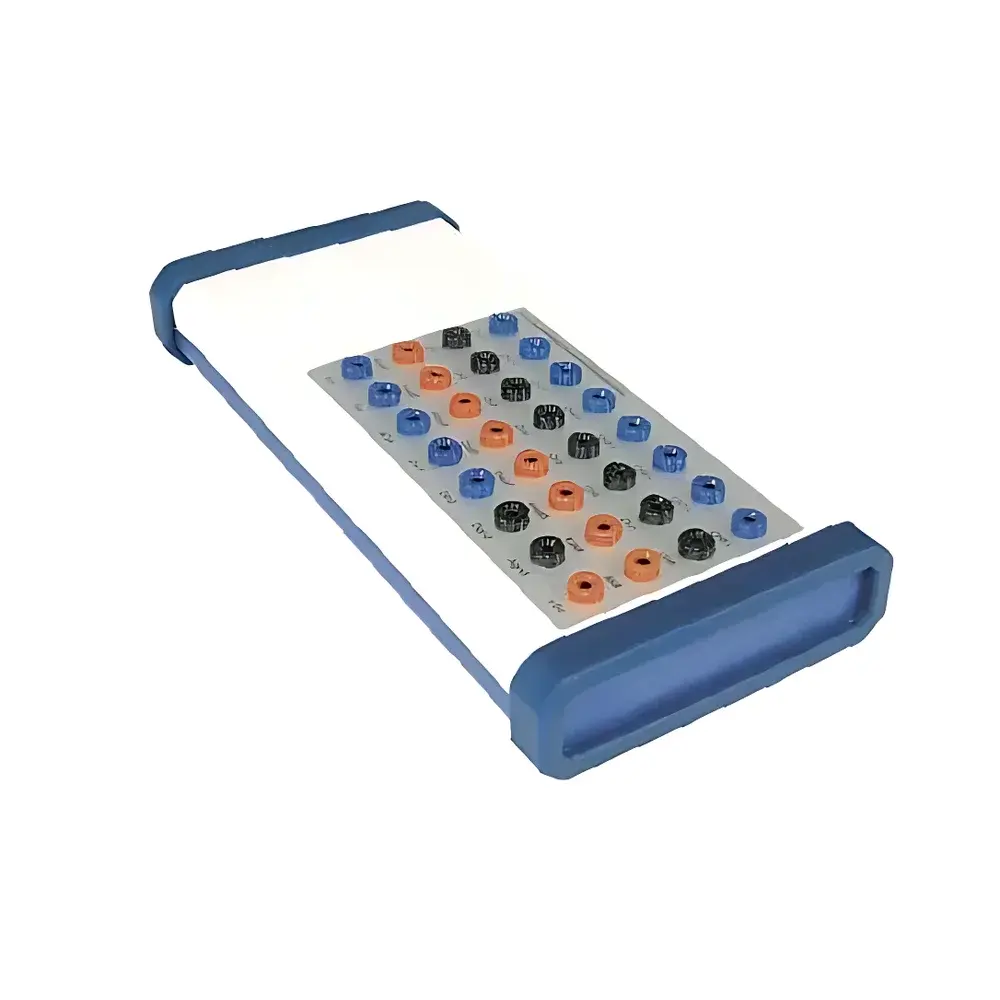
Ivium Peripheral Port Expander (PPE)
| Brand | Ivium |
|---|---|
| Origin | Netherlands |
| Model | Peripheral Port Expander |
| Type | Electrochemical Instrument Accessory |
| Function | External Signal I/O Expansion Module |
| Analog Inputs | 8 channels |
| Analog Outputs | 2 channels |
| Digital Inputs | 2 channels |
| Digital Outputs | 3 channels |
| Dedicated Outputs | Current (I-out), Potential (E-out), AC Output (ACout) |
| Impedance Input Channels | X and Y (for lock-in or phase-sensitive detection) |
| Connector Type | Standard BNC and screw-terminal interfaces |
| Compatibility | Designed exclusively for Ivium electrochemical workstations (e.g., IviumStat, CompactStat, Vertex series) |
Overview
The Ivium Peripheral Port Expander (PPE) is a precision-engineered signal interface module designed to extend the peripheral I/O capabilities of Ivium electrochemical workstations. It serves as a hardware bridge between the main potentiostat/galvanostat unit and external measurement or control systems—enabling synchronized acquisition and generation of analog, digital, and phase-resolved signals during advanced electrochemical experiments. Unlike generic DAQ modules, the PPE is electrically and firmware-integrated with Ivium’s instrument architecture, ensuring deterministic timing, low-latency synchronization (<100 ns jitter), and galvanic isolation on all input channels. Its design supports time-critical applications such as multi-channel impedance spectroscopy, hybrid potentiostat-impedance-pH monitoring, and real-time feedback-controlled electrodeposition—where precise coordination between stimulus output and response acquisition is essential.
Key Features
- 32-pin configurable I/O interface with standardized BNC and screw-terminal connections for rapid integration into lab setups
- Eight high-impedance (≥10 GΩ), 16-bit resolution analog inputs—optimized for low-noise voltage sensing from reference electrodes, pH meters, temperature sensors, or auxiliary transducers
- Two isolated analog outputs (±10 V, 16-bit DAC) supporting programmable waveform generation (e.g., ramp, sine, pulse) for external biasing or actuator control
- Two opto-isolated digital inputs (TTL/CMOS compatible) for external trigger synchronization (e.g., from laser pulses, shutter controllers, or data loggers)
- Three solid-state digital outputs (5 V, sink/source capable) for driving relays, LEDs, or peripheral device enable lines
- Dedicated current output (I-out) and potential output (E-out) channels—buffered and calibrated to match Ivium’s internal signal scaling for seamless signal routing in multi-electrode or segmented cell configurations
- ACout channel provides a clean, low-distortion sinusoidal excitation signal (up to 1 MHz bandwidth) for external lock-in amplifiers or parallel impedance measurements
- X and Y impedance input channels support direct connection to external lock-in detectors or vector network analyzers, preserving phase integrity for advanced EIS and Mott-Schottky analysis
Sample Compatibility & Compliance
The PPE does not interact directly with chemical samples; rather, it expands the signal conditioning and routing infrastructure required for complex electrochemical cells—including rotating disk electrodes (RDE), flow cells, microfluidic electrolysis chambers, and multi-compartment battery test rigs. All analog input paths feature anti-aliasing filtering (10 kHz cutoff) and overvoltage protection (±30 V). The module complies with CE marking requirements under EMC Directive 2014/30/EU and Low Voltage Directive 2014/35/EU. Its electrical isolation meets IEC 61010-1:2010 safety standards for laboratory measurement equipment. When used within Ivium’s software environment (IviumSoft), audit trails, parameter logging, and user-access controls align with GLP and FDA 21 CFR Part 11 readiness—provided system-level validation is performed by the end user.
Software & Data Management
The PPE operates transparently within IviumSoft v10.x and later. No additional drivers are required—detection and configuration occur automatically upon USB enumeration. All I/O channels appear as assignable parameters in experiment scripts (e.g., “Set E-out = 0.45 V during OCP hold”), and acquired analog data is time-stamped and co-registered with primary electrochemical data streams (current, potential, frequency). Raw I/O values are stored in the native .idf binary format alongside metadata (calibration coefficients, channel gain settings, timestamp offsets). Export options include CSV (with header annotations), MATLAB (.mat), and HDF5—preserving hierarchical relationships between primary and auxiliary signals. Scripting via Python (via Ivium’s COM API) enables custom closed-loop protocols, such as dynamic adjustment of E-out based on real-time pH feedback from an analog input channel.
Applications
- Synchronized multi-sensor electrochemical monitoring (e.g., simultaneous EIS + in-situ pH + temperature profiling in corrosion studies)
- Hybrid electrochemical–spectroscopic setups, where ACout drives an external light source modulator while X/Y inputs capture photopotential responses
- Automated screening of catalyst libraries using digital outputs to sequence valve positions in combinatorial flow cells
- Real-time current-integrated coulometry with external integrator interfacing via I-out and analog input
- Phase-resolved interfacial analysis using external lock-in amplifiers connected to X/Y inputs for detection of non-faradaic capacitance harmonics
- Feedback-controlled electrodeposition, where digital inputs monitor deposition thickness (e.g., from eddy-current sensor) and trigger termination via digital output
FAQ
Is the PPE compatible with non-Ivium potentiostats?
No—the PPE is firmware-locked and electrically matched only to Ivium workstations. It lacks standalone operation capability and requires active communication with the host Ivium device via USB.
Can the analog inputs measure current directly?
No—current measurement must be performed internally by the Ivium potentiostat. Analog inputs accept voltage signals only (e.g., from external current-to-voltage converters or shunt-based monitors).
What is the maximum sampling rate for analog inputs when used with IviumStat?
Depends on the host instrument model and selected filter settings; up to 100 kS/s per channel is achievable on IviumStat HR with oversampling enabled, subject to total bus bandwidth constraints.
Does the PPE support thermocouple or RTD inputs?
Not natively—signal conditioning for thermocouples or RTDs requires external transmitters. However, the PPE can acquire their conditioned voltage outputs (e.g., 0–5 V or 4–20 mA converted to voltage) via its analog inputs.
Is calibration traceable to NIST standards?
Ivium provides factory calibration certificates (traceable to national metrology institutes) for analog I/O channels; users may perform field recalibration using IviumSoft’s built-in calibration utility and certified reference sources.
Related Products



