
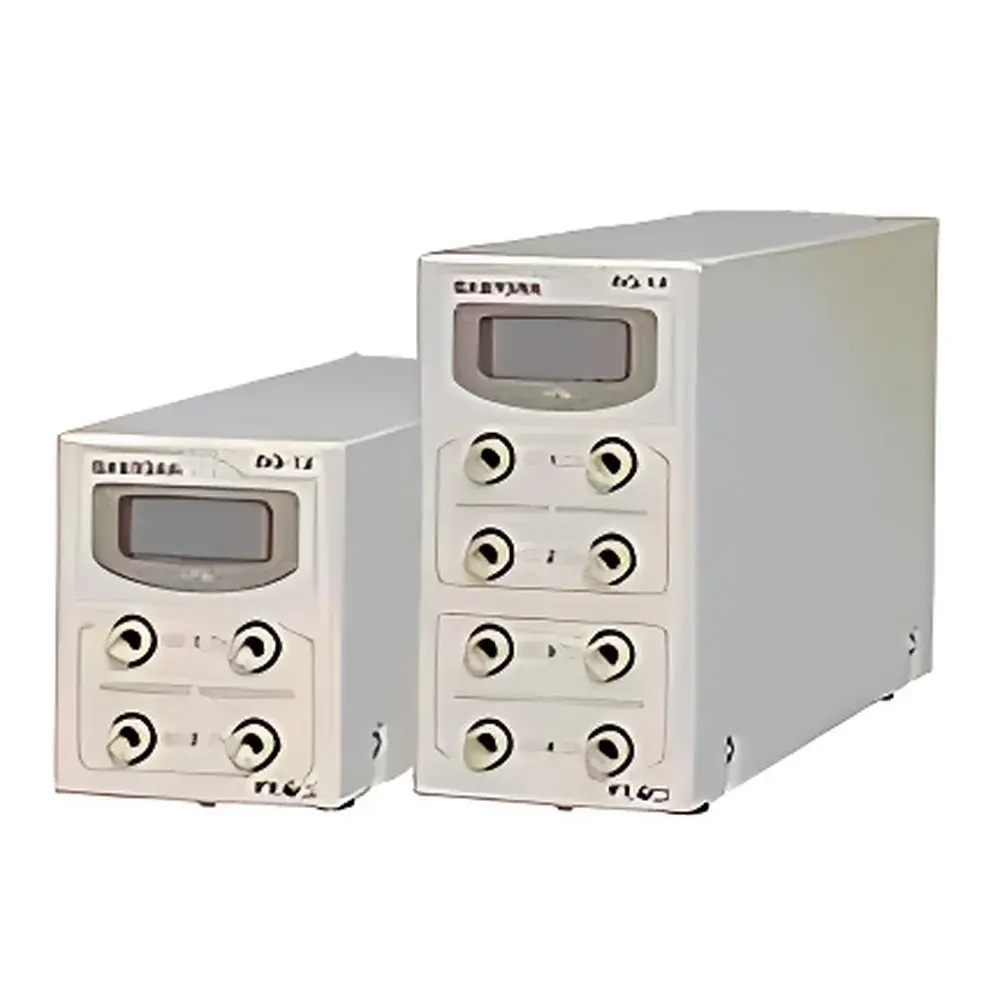
JAI GASTORR BG-12/14 Solvent Degassing System
| Brand | JAI |
|---|---|
| Origin | Japan |
| Model | GASTORR BG-12 / GASTORR BG-14 |
| Flow Paths | 2 / 4 |
| Internal Volume per Channel | 10.461 mL |
| Max. Flow Rate | 10.0 mL/min |
| Ultimate Vacuum | 100 hPa |
| Vacuum Control Precision | ±5 hPa |
| Wetted Materials | PTFE, ETFE, PPS |
| Leak Detection Method | Real-time Vacuum Monitoring |
| Dimensions (W×H×D) | 78×94×285 mm (BG-12) / 78×144×285 mm (BG-14) |
| Power Supply | AC 100–240 V, 50/60 Hz, 250 VA |
| Weight | 2.0 kg (BG-12) / 2.8 kg (BG-14) |
Overview
The JAI GASTORR BG-12 and BG-14 Solvent Degassing Systems are compact, vacuum-based inline degassers engineered for precise removal of dissolved gases—primarily oxygen and nitrogen—from organic and aqueous mobile phases used in high-performance liquid chromatography (HPLC), ultra-high-performance liquid chromatography (UHPLC), and preparative LC systems. Operating on the principle of membrane-free vacuum degassing, these units draw solvent through a sealed, temperature-stable chamber where reduced pressure lowers the partial pressure of dissolved gases, enabling their rapid and quantitative release without phase separation or solvent loss. Unlike sonication or helium sparging, this method delivers continuous, stable degassing with no risk of solvent evaporation, compositional drift, or introduction of external contaminants—critical for baseline stability, detector sensitivity (especially in UV, fluorescence, and electrochemical detection), and long-term column integrity.
Key Features
- Vacuum-controlled degassing architecture with real-time vacuum monitoring and automatic shutdown upon detected pressure deviation—ensuring operational safety and method continuity.
- Dual-channel (BG-12) or quad-channel (BG-14) independent flow paths, each with identical internal volume (10.461 mL) and optimized fluidic geometry to minimize hold-up volume and ensure consistent residence time.
- Chemically inert wetted materials—including PTFE, ETFE, and polyphenylsulfone (PPS)—guarantee compatibility with aggressive solvents such as THF, chloroform, acetonitrile, and concentrated acids/bases across pH 0–14.
- High-resolution vacuum regulation (±5 hPa) maintained via precision electromechanical vacuum control, supporting reproducible degassing performance even under variable ambient temperature or inlet pressure conditions.
- Integrated leak detection system that continuously monitors chamber vacuum integrity; triggers immediate pump stoppage and alerts if vacuum decay exceeds threshold—preventing solvent ingress into vacuum lines or instrument damage.
- Compact footprint (78 mm width × ≤144 mm height) and low power consumption (250 VA) enable seamless integration into benchtop LC workstations, autosampler racks, or modular sample preparation platforms.
Sample Compatibility & Compliance
The GASTORR series accommodates all common HPLC-grade solvents and solvent mixtures, including water/acetonitrile, water/methanol, isopropanol, tetrahydrofuran, and buffered aqueous systems. It supports flow rates up to 10.0 mL/min per channel with minimal backpressure (<0.5 bar at rated flow), making it suitable for both analytical and semi-preparative applications. The system complies with IEC 61010-1 for laboratory electrical equipment safety and meets CE marking requirements for electromagnetic compatibility (EMC) and low-voltage directives. Its design supports GLP and GMP workflows by enabling audit-ready operation logs when paired with compatible chromatography data systems (CDS); vacuum status and fault events are timestamped and exportable for 21 CFR Part 11-compliant record retention.
Software & Data Management
While the GASTORR BG-12/14 operates as a standalone hardware unit with front-panel LED indicators for vacuum status, power, and alarm conditions, it is fully interoperable with third-party CDS platforms via analog voltage output (0–10 V) representing real-time vacuum level (0–100 hPa). Optional RS-232 or USB-to-serial interface modules (sold separately) allow bidirectional communication for remote start/stop, vacuum setpoint adjustment, and event logging. All vacuum measurements are traceable to NIST-traceable pressure standards, and raw vacuum data can be synchronized with chromatographic runs in OpenLab CDS, Chromeleon, or Empower for correlation of baseline noise with degassing performance.
Applications
- Mobile phase degassing prior to HPLC/UHPLC analysis to eliminate bubble formation in pumps, detectors, and columns—reducing pressure fluctuations and false peaks.
- Pre-conditioning of solvents for gradient elution methods where compositional consistency directly impacts retention time reproducibility (RSD <0.1% over 24 h).
- Supporting electrochemical detection (ECD) and mass spectrometry (LC-MS) interfaces where residual oxygen quenches ionization efficiency or causes oxidative degradation of labile analytes.
- Enabling stable operation of low-volume microbore and capillary LC systems where even sub-microliter gas pockets disrupt flow splitting accuracy.
- Integration into automated sample preparation workflows requiring uninterrupted solvent delivery—e.g., online SPE-LC or derivatization-coupled assays.
FAQ
What vacuum level does the GASTORR achieve, and how is it maintained?
The system achieves an ultimate vacuum of 100 hPa (≈75 torr) with active regulation within ±5 hPa using a closed-loop feedback mechanism tied to a calibrated piezoresistive pressure sensor.
Can the BG-12/14 handle mixed aqueous-organic solvents without outgassing artifacts?
Yes—its sealed, single-chamber design eliminates vapor-phase equilibration artifacts common in membrane-based degassers, ensuring uniform degassing across all solvent ratios without foaming or solvent fractionation.
Is validation documentation available for regulated environments?
JAI provides Factory Acceptance Test (FAT) reports including vacuum calibration certificates, material compliance statements (USP Class VI, FDA 21 CFR 177.2470), and IQ/OQ protocol templates for user-executed installation and operational qualification.
How does the leak detection system function without additional sensors?
It leverages the intrinsic relationship between chamber vacuum stability and system integrity: any leak induces measurable vacuum decay rate exceeding 1 hPa/sec, triggering immediate pump halt and visual/audible alert—no external transducers required.
What maintenance is required for long-term reliability?
No consumables or routine maintenance is needed; the oil-free diaphragm vacuum pump has a rated service life of >15,000 hours. Annual verification of vacuum sensor linearity and seal integrity is recommended per ISO/IEC 17025 guidelines.



