
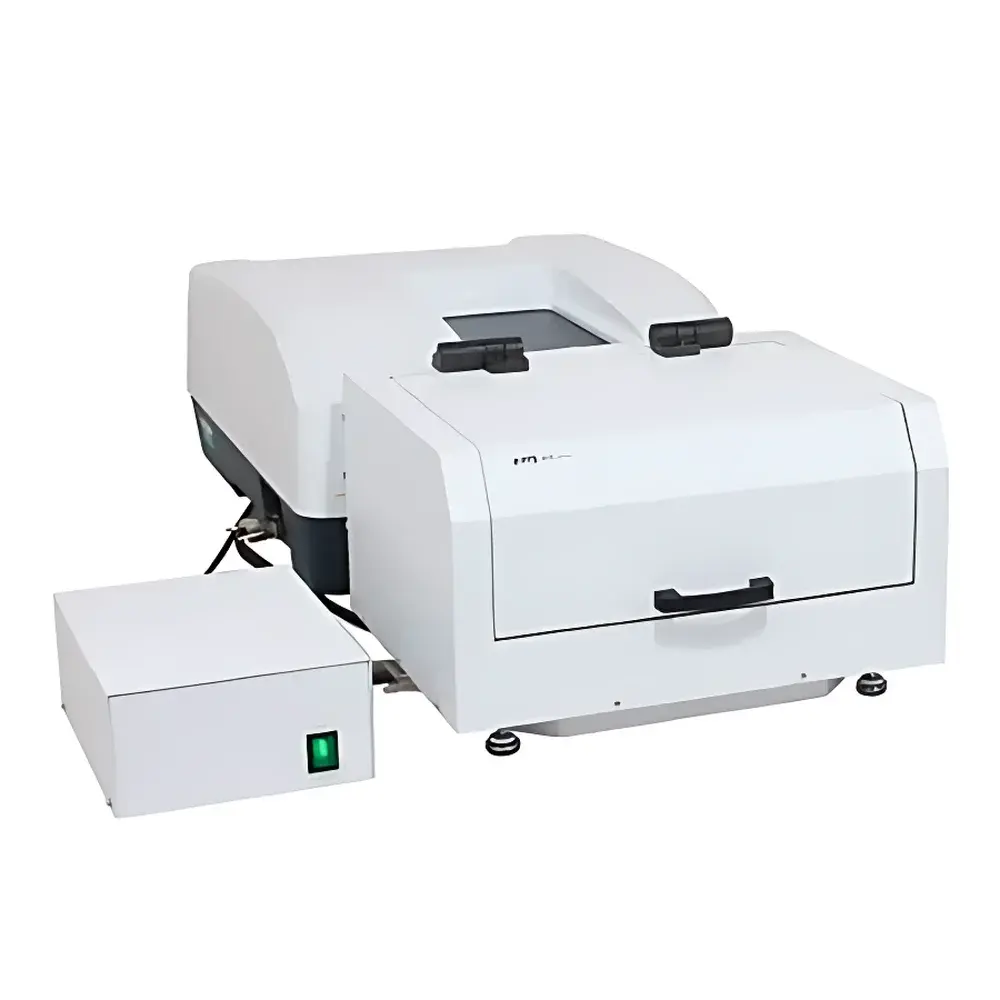
JASCO V-700 Automatic Absolute Reflectance Measurement System
| Brand | JASCO |
|---|---|
| Origin | Japan |
| Manufacturer Type | Authorized Distributor |
| Origin Category | Imported |
| Instrument Configuration | Double-beam |
| Detector | Photomultiplier Tube (PMT) |
| Automation Level | Motorized Wavelength Scanning |
| Wavelength Range | 250–2000 nm |
| Stray Light | ≤0.003% T |
Overview
The JASCO V-700 Automatic Absolute Reflectance Measurement System is a high-precision, double-beam UV-Vis-NIR spectrophotometer engineered for quantitative optical characterization of solid-state materials. Unlike conventional transmittance/reflectance accessories, this system implements a rigorously calibrated absolute reflectance methodology based on the integrating sphere principle—enabling traceable, angle-resolved spectral measurements without reliance on reference standards. Its core architecture integrates motorized sample rotation, programmable detector positioning, and synchronized polarization control to support bidirectional angular scanning (incident and collection angles independently adjustable), making it uniquely suited for ellipsometric-like analysis, thin-film metrology, and anisotropic optical property mapping. Designed for compliance with ISO 9001-certified laboratory workflows and compatible with GLP/GMP documentation requirements, the V-700 delivers reproducible data across the full 250–2000 nm range with stray light performance ≤0.003% T—critical for low-reflectance semiconductor coatings and anti-glare optical films.
Key Features
- Motorized dual-angle control: Independent computer-driven rotation of both sample stage and integrating sphere detector enables precise, repeatable incidence (−60° to +80°) and collection angle (0° to 60°) configuration.
- Polarization-resolved measurement: Integrated rotating polarizer allows sequential acquisition of p- and s-polarized spectra at user-defined azimuthal angles, supporting Mueller matrix approximations and birefringence screening.
- Simultaneous absolute reflectance & transmittance: Single-system validation eliminates inter-instrument calibration drift; both parameters are acquired under identical optical path conditions and temperature-stabilized environment.
- High-fidelity UV-Vis-NIR detection: Dual-range PMT detector optimized for 250–900 nm and InGaAs array for 900–2000 nm ensures signal-to-noise ratio >10⁵ at 550 nm with <0.1 nm wavelength accuracy.
- Automated spectral acquisition: JASCO Spectra Manager™ II software coordinates wavelength scanning, angle stepping, polarization sequencing, and data logging in predefined method templates compliant with ASTM E275 and ISO 13468-2 protocols.
Sample Compatibility & Compliance
The V-700 accommodates flat, rigid solid samples up to Ø30 mm × 10 mm thickness—including silicon wafers, ITO-coated glass, OLED encapsulation layers, dielectric mirror stacks, and privacy filter laminates. Sample mounting uses non-contact vacuum chucking to prevent surface deformation or contamination. All mechanical movements meet ISO 10110-7 surface flatness tolerances (λ/10 PV), and thermal drift is actively compensated via internal reference photodiode feedback. The system conforms to IEC 61000-4-3 EMC immunity standards and supports 21 CFR Part 11-compliant audit trails when operated with validated Spectra Manager™ II v3.5+ configurations. Routine verification follows NIST-traceable SRM 2036 (reflectance standard) and SRM 2035 (transmittance standard).
Software & Data Management
Spectra Manager™ II provides full instrument control, real-time spectral visualization, and batch processing of angular datasets. It includes built-in algorithms for Fresnel correction, film thickness estimation (via interference fringe analysis), and angular transmittance/reflectance interpolation (e.g., for viewing angle quantification per ISO 13468-1). Raw data exports as ASCII (.txt), CSV, and JCAMP-DX formats; processed reports generate PDFs with embedded metadata (operator ID, timestamp, calibration certificate ID, environmental logs). Audit trail functionality records all parameter changes, user logins, and data modifications with digital signature capability—fully aligned with FDA-regulated QC environments.
Applications
- Solar cell R&D: Quantifying front-surface reflection losses and anti-reflective coating performance across AM1.5G spectrum.
- Optical thin-film metrology: Determining refractive index dispersion (n, k) and layer thickness of multilayer dielectrics using variable-angle reflectance modeling.
- Display privacy filter validation: Measuring angular-dependent transmittance profiles (e.g., ±32.5° cutoff for 65° viewing cones) and spectral uniformity across oblique angles.
- Semiconductor process control: Monitoring native oxide growth kinetics via in-situ reflectance change at 633 nm during thermal annealing.
- Advanced material characterization: Polarization-sensitive analysis of chiral metamaterials, plasmonic nanostructures, and anisotropic 2D materials (e.g., MoS₂ monolayers).
FAQ
Can the V-700 measure diffuse reflectance of rough surfaces?
Yes—the integrating sphere geometry inherently captures both specular and diffuse components; however, absolute calibration requires use of a certified diffuse reflectance standard (e.g., Spectralon® SRM 2036) at each measurement angle.
Is fiber-optic coupling supported for remote sampling?
No—the system relies on free-space beam delivery to maintain polarization fidelity and angular resolution; fiber coupling would introduce modal noise and depolarization errors.
How is stray light minimized below 300 nm?
Through triple-stage grating monochromator design, order-sorting filters, and PMT cathode coating optimized for deep-UV quantum efficiency—verified per ASTM E903.
Does the system support in-situ temperature-controlled measurements?
Not natively; however, third-party cryo- or thermo-stages (e.g., Linkam LTS420) can be integrated into the sample compartment with custom mounting fixtures and external temperature logging synchronization.
What is the minimum measurable reflectance value with stated uncertainty?
At 550 nm, the system achieves ±0.05% absolute reflectance uncertainty (k=2) down to 0.1% R, validated against NIST SRM 2036 and traceable to SI units via primary radiometric calibration.




