
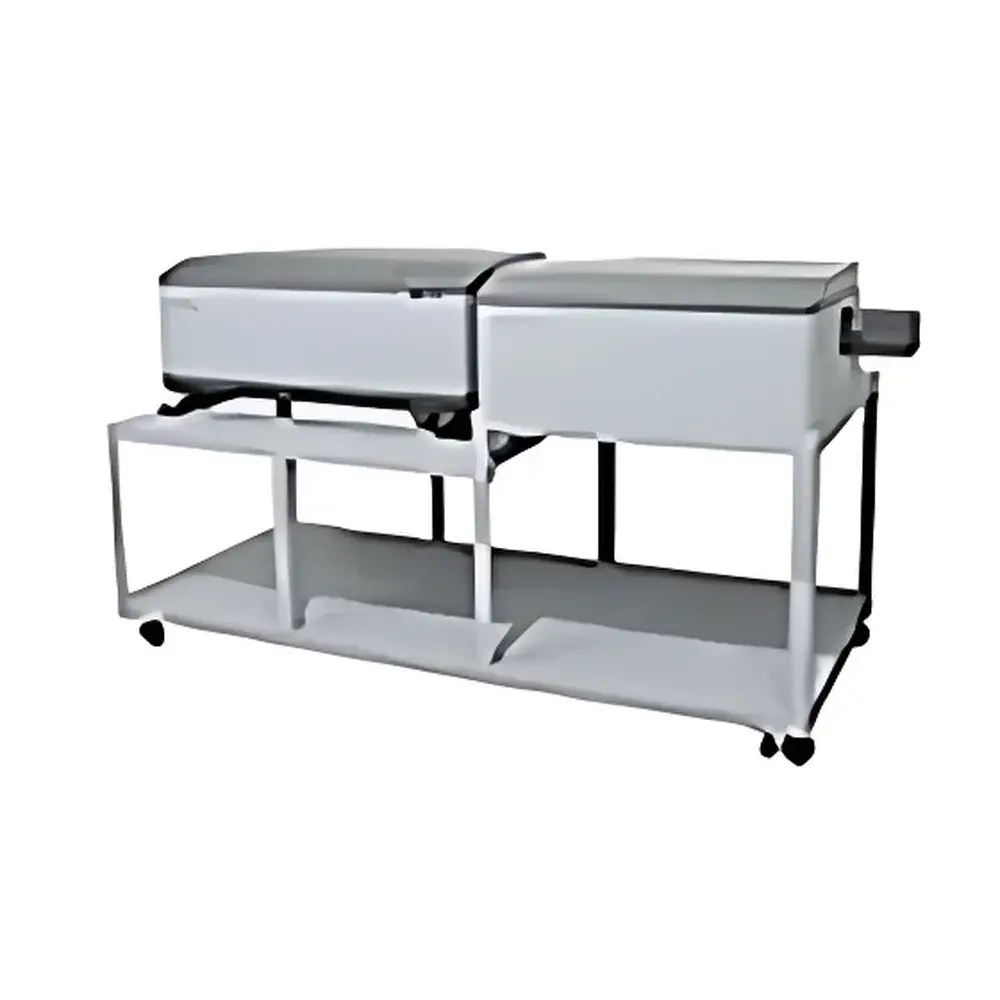
JASCO CPL-300 Circularly Polarized Luminescence Spectrometer
| Brand | JASCO |
|---|---|
| Origin | Japan |
| Manufacturer Type | Authorized Distributor |
| Origin Category | Imported |
| Model | CPL-300 |
| Pricing | Upon Request |
Overview
The JASCO CPL-300 is a high-sensitivity, research-grade circularly polarized luminescence (CPL) spectrometer engineered for quantitative chiroptical characterization of emissive chiral systems in the excited state. Unlike conventional electronic circular dichroism (ECD), which probes ground-state structural asymmetry, CPL measures the differential emission intensity of left- and right-handed circularly polarized light (ΔI = IL − IR) following photoexcitation—providing direct insight into the stereochemical integrity, conformational dynamics, and symmetry-breaking mechanisms of chiral fluorophores under electronic excitation. The CPL-300 implements Steinberg’s original 180° fluorescence collection geometry, minimizing polarization artifacts from sample scattering, reflection, or optical alignment drift. Its dual-prism monochromator architecture—on both excitation and emission paths—eliminates grating-induced stray light, higher-order diffraction, Wood’s anomalies, and linear polarization contamination, ensuring intrinsic spectral fidelity across the UV–Vis–NIR range (typically 200–900 nm). Designed as part of JASCO’s comprehensive chiral analysis platform, the CPL-300 integrates seamlessly with complementary instrumentation including CD, VCD, and OR spectrometers for multi-state chiroptical correlation studies.
Key Features
- Dual-source excitation system: Standard 150 W ozone-free xenon lamp (200–2000 nm) with optional Hg/Xe lamp module for in situ wavelength calibration and line-source validation.
- 180° non-polarized direct-excitation geometry: Enables artifact-free CPL measurement of heterogeneous samples—including solutions, thin films, powders, and insoluble aggregates—without orientation-dependent bias or depolarization errors.
- Double-prism monochromators on both excitation and emission arms: Achieves <0.0001% stray light rejection; eliminates grating-specific polarization distortions critical for accurate glum (ΔI/I) quantification.
- Synchronous dual-channel detection: Simultaneously acquires unpolarized fluorescence (F) and CPL (ΔI) spectra in real time; software-automated conversion to dissymmetry factor (glum = 2ΔI/F) with baseline-corrected, noise-suppressed output.
- Modular optical design: Compatible with temperature-controlled cuvette holders (−40 to +120 °C), solid-sample stages, integrating spheres, and fiber-coupled external light sources for advanced experimental configurations.
Sample Compatibility & Compliance
The CPL-300 supports a broad spectrum of chiral luminescent materials, including lanthanide/actinide complexes, chiral organic emitters (e.g., binaphthyls, helicenes), chiral perovskite nanocrystals, AIE-active dendrimers, and supramolecular assemblies exhibiting aggregation-induced CPL (AICPL). Sample formats include standard 1-cm quartz cuvettes (solution), KBr pellets (solid), spin-coated films, and microcrystalline suspensions. Instrument control and data acquisition comply with GLP-aligned operational protocols. All spectral metadata—including lamp status, monochromator positions, slit widths, integration times, and detector gain—are automatically embedded in proprietary .jws files. Audit-trail functionality supports traceability requirements aligned with ISO/IEC 17025 and FDA 21 CFR Part 11 when deployed in regulated QC environments.
Software & Data Management
Operation is managed via JASCO Spectra Manager™ II v3.x, a Windows-based platform supporting instrument calibration, method scripting, kinetic CPL mapping, and multi-dimensional data overlay (e.g., CD/CPL/UV-Vis superposition). The software includes built-in algorithms for glum error propagation analysis, signal-to-noise ratio optimization, and polarization crosstalk correction using reference standards (e.g., camphorquinone). Raw and processed datasets export to ASCII, CSV, and JCAMP-DX formats for third-party analysis (OriginLab, MATLAB, Python SciPy). Data security features include user-level access control, electronic signature logging, and encrypted project archiving—facilitating compliance with analytical data integrity frameworks.
Applications
- Excited-state conformational analysis of chiral pharmaceutical intermediates and asymmetric catalysts.
- Structure–property correlation in chiral OLED emitters and CP-OLED device layer characterization.
- Monitoring chirality transfer and amplification in supramolecular polymerization and self-assembly processes.
- Quantitative evaluation of enantiomeric excess (ee) in catalytic asymmetric photoreactions via CPL intensity ratios.
- Time-resolved CPL (TR-CPL) coupling with pulsed laser sources for probing excited-state racemization kinetics in triplet emitters.
FAQ
What is the primary advantage of the 180° collection geometry over 90° detection?
It eliminates angular dependence of scattering-induced depolarization and avoids Fresnel reflection artifacts at air–glass interfaces—critical for reliable glum values in turbid or highly scattering samples.
Can the CPL-300 measure absolute glum without external calibration?
Yes—the system incorporates factory-characterized polarization optics and NIST-traceable photometric calibration routines, enabling absolute glum determination within ±0.0002 uncertainty under optimal signal conditions.
Is the CPL-300 compatible with low-temperature measurements?
Yes—when paired with JASCO’s optional cryostat interface (LN2 or closed-cycle He), it supports CPL acquisition down to 4 K, enabling resolution of vibronic fine structure in rigid chiral matrices.
How does the dual-prism design improve CPL accuracy compared to grating-based systems?
Prisms avoid polarization-dependent efficiency variations, zero-order leakage, and higher-order diffraction—sources of systematic glum bias that cannot be corrected post-acquisition in grating instruments.
Does the software support automated batch processing for high-throughput screening?
Yes—Spectra Manager II includes macro scripting (VBScript/JScript) and API hooks for integration into LIMS and robotic sample-handling workflows.




