
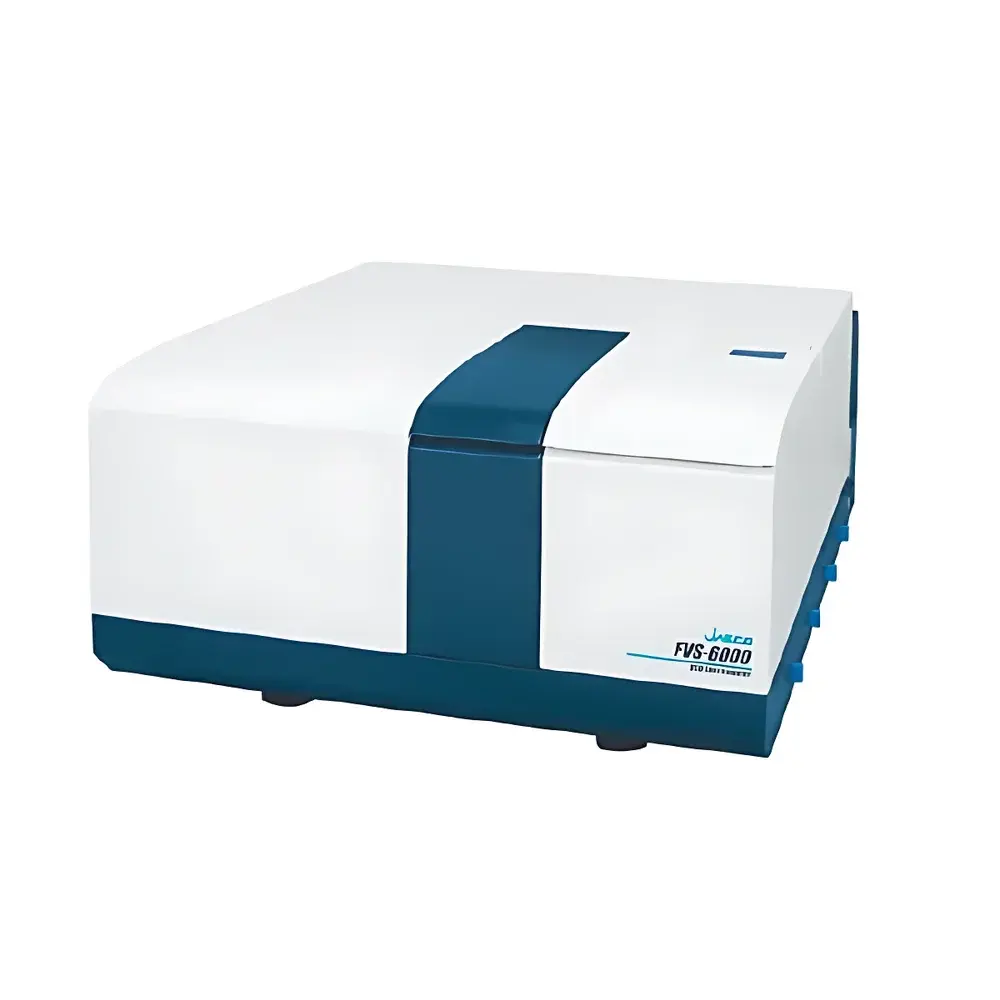
JASCO FSV-6000 Vibrational Circular Dichroism (VCD) Spectrometer
| Brand | JASCO |
|---|---|
| Origin | Japan |
| Model | FSV-6000 |
| Measurement Range | 850–3200 cm⁻¹ (expandable to 750–4000 cm⁻¹) |
| Detector | Liquid Nitrogen-Cooled MCT |
| Incident Angle | 28° Michelson Interferometer |
| Optical System | Purgeable (N₂ or dry air) |
| Light Source | High-Intensity Ceramic IR Source |
| Optional Feature | Narrowband VCD-optimized Bandpass Filters |
| Compatibility | Fully Integrated with JASCO FT/IR-4000 & FT/IR-6000 Series as VFT-4000 Expansion Module |
Overview
The JASCO FSV-6000 is a high-performance, research-grade Vibrational Circular Dichroism (VCD) spectrometer engineered for the stereochemical characterization of chiral molecules in the mid-infrared region. Unlike electronic circular dichroism (ECD), which probes UV–VIS transitions, VCD measures the differential absorption of left- and right-circularly polarized infrared light during vibrational transitions—providing direct, bond-specific information on absolute configuration, conformational equilibria, and intermolecular interactions. The FSV-6000 operates on the principle of Fourier-transform interferometry with polarization modulation, enabling precise measurement of the small VCD signal (typically 10⁻⁵–10⁻⁶ of the parent IR absorbance) under rigorously controlled optical conditions. Its design centers on signal fidelity, baseline stability, and spectral reproducibility—critical for quantitative interpretation in structural biology, asymmetric catalysis, and pharmaceutical development.
Key Features
- Liquid nitrogen-cooled mercury cadmium telluride (MCT) detector ensures ultra-low thermal noise and long-term baseline stability—essential for detecting weak VCD signals over extended acquisition times.
- Optimized 28° incident-angle Michelson interferometer maximizes throughput and fringe visibility while minimizing polarization-dependent artifacts across the spectral range.
- Full-system purging capability (optical path, sample compartment, and detector housing) eliminates atmospheric water vapor and CO₂ interference—enabling reliable measurements in the fingerprint region (1500–900 cm⁻¹) without vacuum requirements.
- High-intensity ceramic IR source delivers superior photon flux across 750–4000 cm⁻¹, supporting both standard and extended-range VCD experiments with improved signal-to-noise ratio.
- Digital Signal Processing (DSP)-based polarization modulation and real-time phase correction minimize instrumental artifacts and enhance measurement repeatability.
- Automated alignment and self-calibration routines reduce operator dependency and ensure consistent instrument performance between users and laboratories.
- Modular architecture allows seamless integration as the VFT-4000 expansion unit onto JASCO’s FT/IR-4000 or FT/IR-6000 platforms—preserving existing IR infrastructure while adding VCD capability.
Sample Compatibility & Compliance
The FSV-6000 accommodates solid (KBr pellets, mulls), liquid (sealed cells, CaF₂ or BaF₂ windows), and solution-phase samples—including aqueous systems with appropriate pathlength control. It supports standard 1–10 cm⁻¹ resolution settings and is routinely employed for stereochemical analysis of natural products (e.g., terpenes like camphor and α-pinene), carbohydrates, peptides, and metal–organic chiral catalysts. The system complies with ISO/IEC 17025 calibration traceability requirements for analytical instrumentation. Data acquisition and processing workflows are compatible with GLP/GMP environments when implemented with audit-trail-enabled software configurations (e.g., JASCO Spectra Manager™ with 21 CFR Part 11 compliance modules).
Software & Data Management
Controlled via JASCO Spectra Manager™ v2.x or later, the FSV-6000 provides synchronized acquisition of co-registered IR absorbance and VCD spectra, real-time FFT-based signal averaging, and integrated baseline correction algorithms. Raw interferograms are stored in vendor-neutral formats (e.g., JCAMP-DX), and processed spectra support export to ASCII, CSV, and OPUS-compatible formats for third-party analysis (e.g., Gaussian, ORCA, or SpecAlign). Advanced features include automated peak deconvolution, band intensity ratio analysis, and spectral subtraction tools optimized for VCD difference spectroscopy. All acquisition parameters, calibration logs, and user annotations are embedded in metadata—facilitating full experimental traceability per FDA and EMA regulatory expectations.
Applications
- Determination of absolute configuration of chiral organic molecules without crystallization or derivatization—particularly valuable for flexible or low-symmetry compounds where X-ray crystallography is inconclusive.
- Conformational analysis of biomolecules (e.g., secondary structure of peptides in membrane-mimetic environments) through amide I′ and II′ VCD band patterns.
- Monitoring enantioselective reaction kinetics and catalyst binding modes via time-resolved VCD in flow or stopped-flow configurations.
- Characterization of chiral supramolecular assemblies and host–guest complexes using signature VCD couplet patterns in C=O, C–H, and C–O stretching regions.
- Validation of computational predictions (DFT, TD-DFT) by direct comparison of simulated and experimental VCD spectra—supporting quantum-chemical assignment protocols recommended by IUPAC.
FAQ
What is the minimum sample concentration required for reliable VCD measurement?
Typical concentrations range from 0.1–1.0 M for small organic molecules in 100 µm pathlength cells; lower limits depend on molecular extinction coefficient and instrument configuration.
Can the FSV-6000 be used for aqueous samples?
Yes—with CaF₂ or BaF₂ windows and careful pathlength selection (e.g., 10–25 µm) to mitigate strong water absorption; spectral subtraction or H₂O/D₂O exchange strategies are commonly applied.
Is the FSV-6000 compliant with 21 CFR Part 11 for regulated laboratories?
When deployed with Spectra Manager™ v2.6+ and validated electronic signature/audit trail packages, it meets core technical requirements for Part 11 compliance—including secure user authentication, immutable data records, and operation logs.
How does the FSV-6000 differ from conventional CD spectrometers?
It measures vibrational (not electronic) transitions in the IR region, delivering structurally diagnostic, functional-group-specific chiroptical data—complementing but not replacing UV–VIS CD instruments.
What maintenance is required for long-term operational stability?
Routine purging with dry nitrogen, annual MCT detector re-cooling verification, and biannual interferometer alignment validation using certified reference standards (e.g., polystyrene film) are recommended.






