
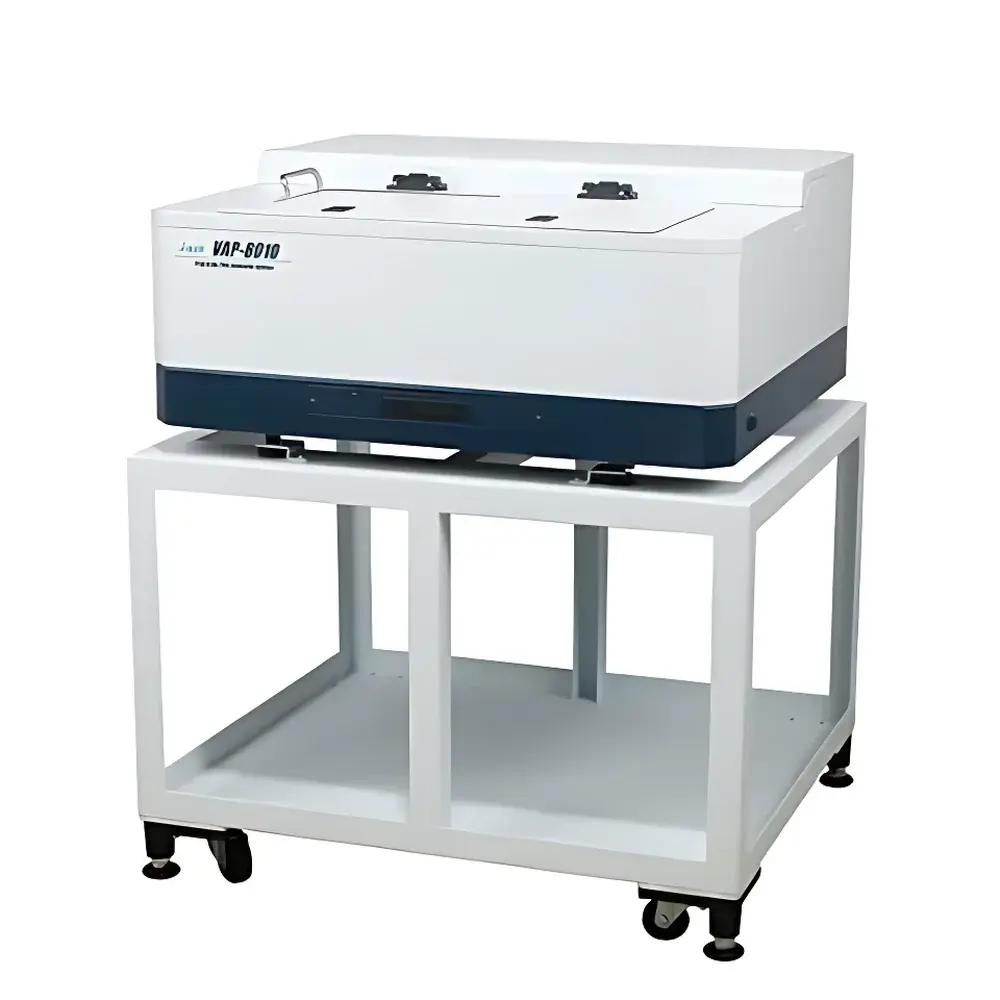
JASCO VAP-8010 Polarization Film Evaluation System
| Brand | JASCO |
|---|---|
| Origin | Japan |
| Manufacturer Type | Authorized Distributor |
| Origin Category | Imported |
| Model | VAP-8010 |
| Pricing | Available Upon Request |
Overview
The JASCO VAP-8010 Polarization Film Evaluation System is a dedicated optical characterization platform engineered for high-precision analysis of polarizing films used in liquid crystal display (LCD) manufacturing, OLED lighting modules, and advanced photonic components. It operates on the fundamental principle of crossed and parallel Nicol configuration spectroscopy—leveraging controlled polarization states of incident light and precise angular alignment to quantify intrinsic anisotropic optical properties. The system integrates a double-beam UV-Vis-NIR spectrophotometer with motorized rotating polarizers, a programmable sample stage, and a calibrated integrating sphere detector. Designed for R&D laboratories and inline QC environments, it delivers traceable, repeatable measurements compliant with ISO 15397 (optical characterization of birefringent materials) and ASTM E308 (computation of colorimetric data from spectral reflectance/transmittance). Its architecture supports both static and dynamic evaluation modes, enabling full spectral acquisition across 190–1100 nm with 0.1 nm wavelength resolution and <0.001 AU photometric accuracy.
Key Features
- Automated Cross-Nicol Axis Detection: Scans polarizer rotation in 0.01° increments while monitoring transmittance at multiple wavelengths; identifies exact orthogonal orientation between sample axis and incident polarization with sub-degree repeatability.
- Dual-Mode Sample Configuration: Supports single-sample + reference polarizer mode or dual-sample comparative mode—enabling differential analysis of laminated stacks, adhesive-bonded layers, or multi-layer retardation films.
- Variable Integrating Sphere Distance Control: Adjustable source-to-sphere and sphere-to-sample distances accommodate thickness variations (0.05–5 mm) and minimize edge diffraction artifacts in large-area film samples (up to 100 × 100 mm).
- High-Speed Spectral Acquisition Engine: Optimized optical path and synchronized motor control reduce full-spectrum (350–800 nm) measurement time to ≤4 seconds per orientation state, supporting throughput requirements in pilot-line validation.
- Robust Mechanical Architecture: Precision-ground air-bearing rotation stages, thermally stabilized optical bench, and vibration-damped enclosure ensure long-term stability under continuous operation in factory-floor environments.
Sample Compatibility & Compliance
The VAP-8010 accommodates rigid and flexible polarizing films—including PVA-based iodine-dyed, dye-based, and wire-grid types—as well as stretched polymer retardation plates and dichroic coatings. Sample holders accept standard 25 × 38 mm cutouts or custom fixtures for roll-to-roll slit sampling. All measurement protocols adhere to GLP documentation standards, with audit-trail-enabled instrument logs, user-authenticated method files, and timestamped raw spectral datasets. Software-generated reports include compliance statements referencing ISO 13660 (optical density uniformity), JIS K 7105 (transmittance of transparent plastics), and IEC 62341-6-3 (OLED polarizer specifications). Data export formats support CSV, XML, and ASTM E2935-compliant structured metadata for LIMS integration.
Software & Data Management
Control and analysis are executed via JASCO’s PolarFilm Analysis Suite v3.2—a Windows-based application with dual-mode interface: wizard-driven workflows for routine QC operators and scriptable command-line mode for automated batch processing. Real-time visualization includes overlaid parallel/cross transmittance spectra, polarization degree (P = (T∥ − T⊥) / (T∥ + T⊥)) heatmaps, and orientation-corrected dichroic ratio plots. All calculations—including dichroic ratio (DR), birefringence index difference (Δn), and orientation dispersion index—are performed using NIST-traceable algorithms. Audit trails record operator ID, calibration timestamp, environmental sensor readings (temperature/humidity), and raw spectral checksums. The system supports 21 CFR Part 11-compliant electronic signatures and role-based access control (RBAC) with password-protected method editing.
Applications
- Quantitative assessment of polarization extinction ratio (PER) and angular half-width in PVA-iodine films for TFT-LCD backlight units.
- Batch-to-batch consistency verification of dichroic absorption profiles in automotive HUD polarizers exposed to thermal cycling (−40°C to +85°C).
- Correlation of draw-ratio-induced molecular orientation with measured dichroism in PET-based stretched films.
- Failure analysis of delamination-induced depolarization in laminated circular polarizer stacks used in VR headsets.
- Validation of coating uniformity across 200 mm × 200 mm substrates via raster-scanned point mapping (optional motorized XY stage).
FAQ
What wavelength range does the VAP-8010 cover for polarization analysis?
The system operates from 190 nm to 1100 nm, with optimized performance in the visible region (380–780 nm) for LCD-grade film evaluation.
Can the VAP-8010 measure films with adhesive backing or protective layers?
Yes—the variable integrating sphere geometry and spectral deconvolution routines allow separation of substrate, adhesive, and active layer contributions when reference spectra of individual components are available.
Is cross-Nicol auto-alignment compatible with curved or flexible substrates?
The system requires flat, planar sample mounting; slight curvature (< ±0.5 mm over 25 mm) is tolerated via Z-axis focus compensation, but significant warpage necessitates mechanical flattening jigs.
Does the software generate ISO/IEC 17025-compliant uncertainty budgets?
Uncertainty estimation modules are included for Type A (statistical repeatability) and Type B (calibration certificate, alignment tolerance, wavelength accuracy) components, outputting combined expanded uncertainty (k=2) per measurement parameter.
How is system calibration maintained between user sessions?
A built-in NIST-traceable quartz polarizer reference and tungsten-halogen lamp standard enable daily verification; full recalibration is recommended every 6 months or after mechanical impact events.




