
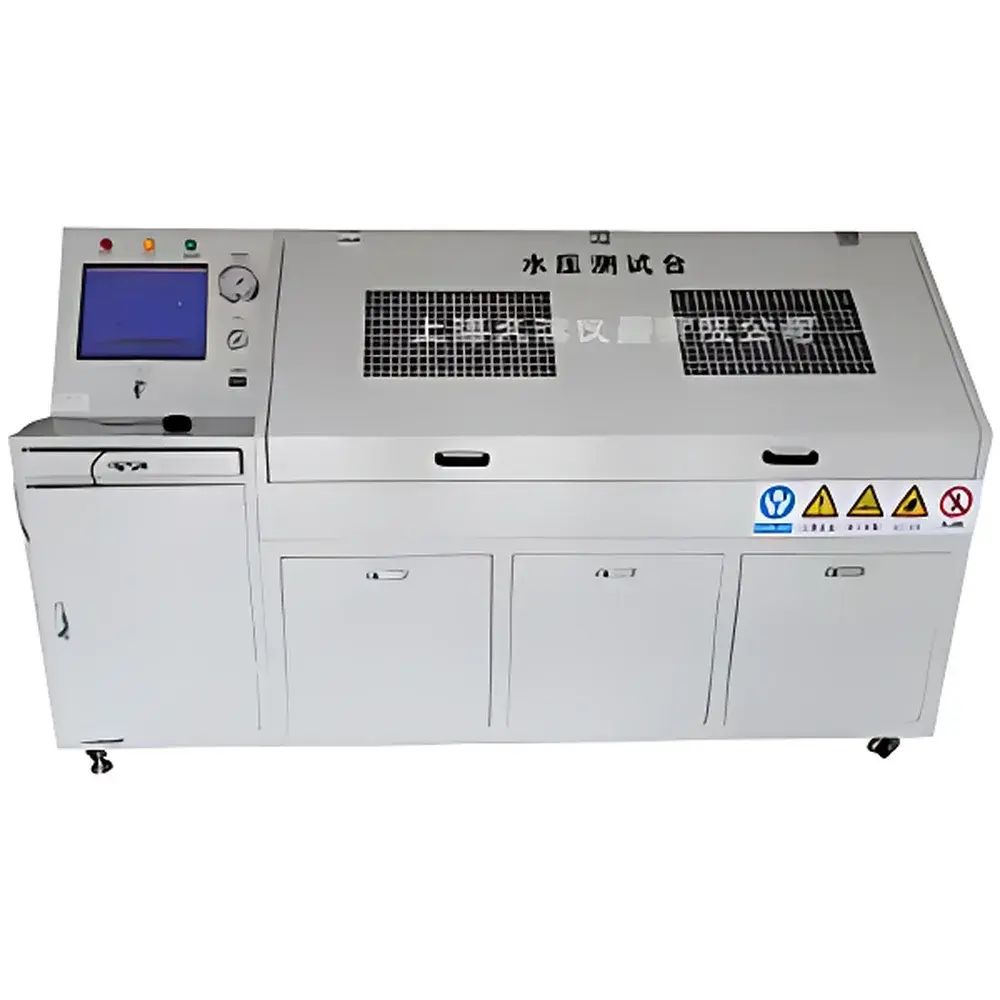
JB-Brookfield JB-150-BK Hydraulic Burst Test System for Automotive Airbag Inflators
| Brand | JB-Brookfield |
|---|---|
| Origin | Shanghai, China |
| Model | JB-150-BK |
| Test Medium | Water or Compatible Liquids |
| Max Test Pressure | 0–250 MPa |
| Pressure Ramp Rate | 100–6000 bar/min (adjustable) |
| Pressure Measurement Accuracy | ±0.5% FS (high-stability piezoresistive transducer) |
| Drive Medium | Compressed Air (3–6.9 bar, ≥2 Nm³/min) |
| Power Supply | 220 V AC, 50 Hz, 0.15 kW |
| Control Cabinet Dimensions | 800 × 700 × 1500 mm |
| Test Chamber Dimensions | 2000 × 900 × 1200 mm (2 mm steel + energy-absorbing lining) |
| High-Pressure Port | 1 × G1/4 internal thread (600 bar rating) |
| Auto-Depressurization | Yes |
| Seal Fixture Type | Dedicated non-marring clamping system for high-pressure steel tubing |
Overview
The JB-Brookfield JB-150-BK Hydraulic Burst Test System is an engineered solution for structural integrity validation of automotive airbag inflator components under extreme hydrostatic pressure conditions. Designed in accordance with ISO 17842-2 (Inflator Performance Testing), SAE J2603 (Airbag Inflator Burst Pressure Requirements), and aligned with OEM-specific validation protocols (e.g., Ford WSS-M99P1111-A, GM GMW14872), this system performs controlled, dynamic hydraulic burst testing on high-pressure gas generator housings, hybrid inflator casings, and inflation tubing used in driver-side, passenger-side, and side-curtain airbag systems. The test principle relies on quasi-static pressurization of sealed components using deaerated water as the test medium—eliminating compressibility effects and ensuring direct correlation between applied hydraulic stress and material failure response. Unlike pneumatic burst testers, the JB-150-BK avoids adiabatic heating artifacts and provides superior repeatability in failure pressure determination due to its low-compressibility fluid path and dual-pump architecture.
Key Features
- Dual-stage hydraulic intensification: Low-pressure fill pump (for rapid initial filling) and high-pressure intensifier pump (air-driven, 0.69 MPa supply) operate in sequence to achieve smooth, controllable ramping from ambient to 250 MPa without pressure overshoot.
- Non-destructive tube clamping system: Precision-machined stainless-steel collet fixtures with elastomeric sealing inserts prevent surface marring and eliminate extraneous mechanical constraint—ensuring burst pressure reflects intrinsic material strength rather than fixture-induced stress concentration.
- Real-time pressure profiling: Integrated Class 0.5 pressure transducer (IEC 61298-2 compliant) samples at 1 kHz, capturing transient pressure spikes and creep behavior during hold phases; raw data synchronized with timestamped event markers (valve actuation, leak detection, rupture onset).
- Automated pressure maintenance: Closed-loop control enables sustained hold at target pressure (±10 bar tolerance) for duration-based leakage evaluation per ISO 11452-8 and USCAR-2.
- Fail-safe containment architecture: Reinforced test chamber constructed from 2 mm structural steel with integrated energy-dissipating liner—certified to contain fragments from catastrophic failure up to 250 MPa burst events.
- Modular pneumatic drive interface: Accepts regulated compressed air (3–6.9 bar, min. 2 Nm³/min) with integrated moisture and particulate filtration—compatible with standard industrial air supply networks.
Sample Compatibility & Compliance
The JB-150-BK accommodates cylindrical and tapered metallic housings (stainless steel, Ti-6Al-4V, cold-forged 4130 alloy) with outer diameters ranging from 12 mm to 65 mm and wall thicknesses from 0.8 mm to 3.5 mm. It supports both end-cap sealed configurations and open-tube pressurization via swaged or threaded connections. All wetted components—including high-pressure manifolds, quick-disconnect couplings, and burst disc holders—are fabricated from ASTM A276 Type 316 stainless steel with minimum yield strength ≥520 MPa. The system meets CE Machinery Directive 2006/42/EC requirements for hazardous pressure equipment and incorporates EN 13445-3 design verification principles for pressure boundary integrity. Calibration traceability follows ISO/IEC 17025:2017 through accredited third-party pressure calibration labs.
Software & Data Management
Control and acquisition are managed via JB-TestSuite v4.2—a Windows-based application supporting deterministic real-time operation (deterministic loop timing 5 bar/minute = leak failure), and export of ASCII CSV and PDF-formatted reports compliant with 21 CFR Part 11 Annex 11 requirements. Audit trails record operator ID, parameter changes, calibration events, and emergency stop triggers. Raw time-series data (pressure, temperature, elapsed time) are stored in HDF5 format for post-test statistical analysis using MATLAB or Python-based reliability modeling tools.
Applications
- Qualification testing of pyrotechnic and hybrid gas generators per FMVSS 208 and ECE R94 regulatory mandates.
- Design validation of inflator housing geometry and weld integrity during APQP Stage 3 (Production Part Approval Process).
- Lot acceptance testing for Tier-1 suppliers producing inflators for Toyota, Hyundai-Kia, and Stellantis platforms.
- Root cause analysis of field returns involving premature casing rupture or slow-leak degradation.
- Material selection support for next-generation lightweight inflator designs incorporating aluminum alloys and composite liners.
FAQ
What test standards does the JB-150-BK support out-of-the-box?
The system includes preloaded test templates for ISO 17842-2, SAE J2603, USCAR-2, and GMW14872, with configurable parameters for ramp rate, hold duration, and pass/fail criteria.
Can the system be integrated into an existing MES or PLM environment?
Yes—via OPC UA server interface (IEC 62541 compliant) and RESTful API endpoints for automated job dispatch, result ingestion, and electronic signature workflows.
Is third-party calibration documentation provided with shipment?
Each unit ships with a factory calibration certificate (NIST-traceable pressure reference) and a full dimensional inspection report per ASME BPE-2022 Section 5.2.
What safety interlocks are implemented?
Dual-channel monitored door switch, overpressure cut-off (275 MPa hard limit), chamber vacuum verification prior to pressurization, and redundant solenoid valve isolation—all validated per ISO 13849-1 PL e / SIL 2 requirements.
Does the system support cyclic fatigue testing?
While primarily configured for single-cycle burst validation, optional firmware upgrade (JB-Fatigue Module v2.1) enables pressure cycling between 10–200 MPa at frequencies up to 0.5 Hz with strain-gauge feedback for crack propagation monitoring.



