
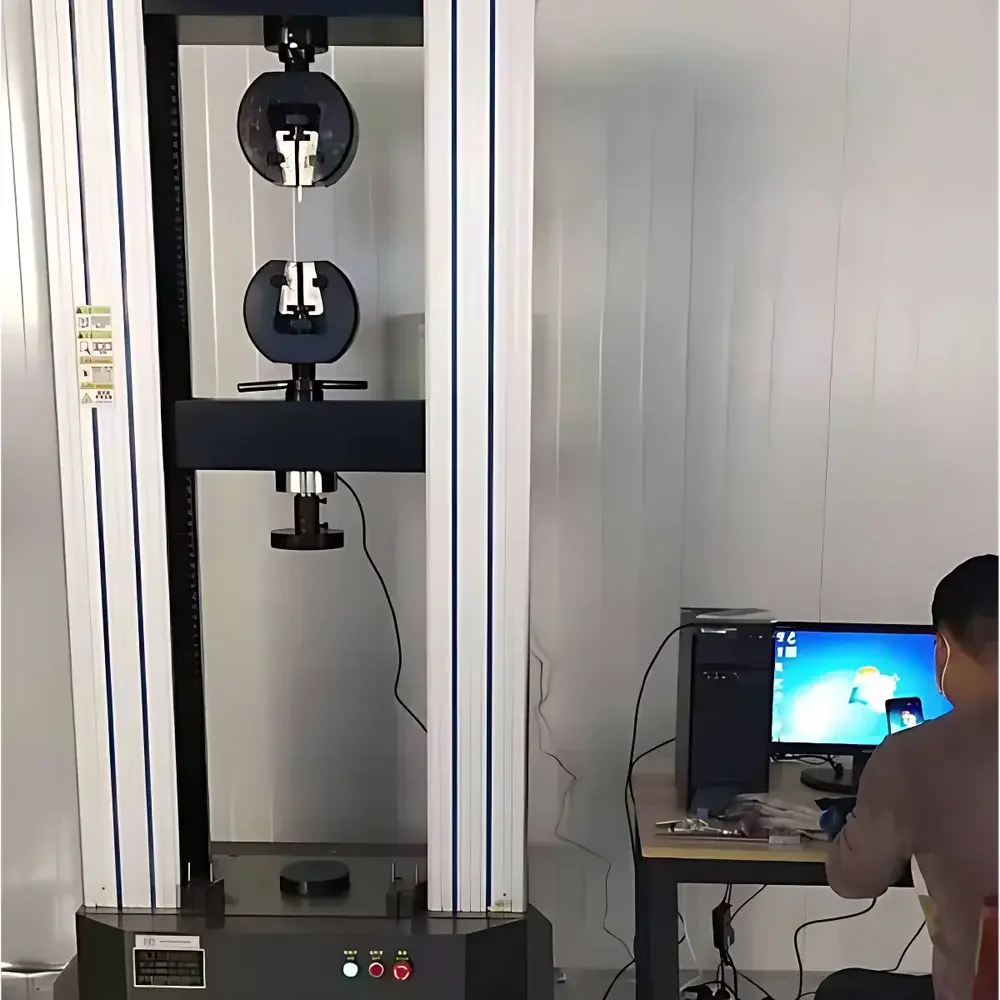
JByq JB-119 Universal Testing Machine for Sintered Metallic Materials
| Brand | JByq |
|---|---|
| Origin | Shanghai, China |
| Model | JB-119 |
| Type | Electromechanical Universal Testing Machine |
| Max Test Load | 10 kN / 20 kN / 50 kN / 100 kN (customizable) |
| Accuracy Class | 0.5 or 1 |
| Force Range | 0.5–100% FS |
| Force Resolution | 1/200,000 |
| Force Accuracy | ±0.5% or ±1% |
| Displacement Error | ±0.5% of reading |
| Deformation Error | ±0.5% of reading |
| Speed Range | 0.01–500 mm/min |
| Crosshead Travel | 600 mm |
| Drive System | Stepper or Servo Motor with Precision Ball Screw |
| Control System | Domestic or Imported Motion Controller |
| Weight | ~600 kg |
Overview
The JByq JB-119 Universal Testing Machine is an electromechanical static testing system engineered for high-reproducibility mechanical characterization of sintered metallic materials—including friction composites, porous metal preforms, and structural sintered alloys—under controlled uniaxial loading conditions. It operates on the principle of force-controlled or displacement-controlled quasi-static loading, where load is applied via a precision ball-screw-driven crosshead actuated by a servo or stepper motor, and measured using high-stability load cells traceable to national metrological standards. Designed in accordance with ISO 7500-1 (static calibration of tensile/compression testing machines) and aligned with ASTM E4, ASTM E8/E8M, and ISO 6892-1 for general metallic material testing, the JB-119 delivers repeatable, audit-ready data for R&D labs, quality control departments, and third-party certification bodies engaged in powder metallurgy product development and validation.
Key Features
- Automatic crosshead stop upon specimen fracture, minimizing post-failure over-travel and ensuring operator safety and data integrity.
- Multi-range force transduction with auto-ranging capability—seamlessly switching between predefined load cell spans to maintain optimal signal-to-noise ratio across test regimes.
- Modular test condition storage: users can save standardized parameter sets (e.g., strain rate, hold duration, preload threshold) as reusable templates for batch testing of identical sintered specimens.
- Programmable speed profiling: crosshead velocity may be defined in segments (e.g., pre-load at 1 mm/min, ramp to target strain rate, dwell, then unload), supporting complex protocols such as creep-recovery or cyclic loading sequences.
- Automated system calibration routine compliant with ISO 376, enabling periodic verification of force channel linearity, zero drift, and hysteresis without external reference weights.
- Real-time synchronized acquisition of force, displacement, and optional extensometer-derived strain—captured at ≥1 kHz sampling rate and stored with time-stamped metadata.
- Dual-stage mechanical and software-based limit protection: hardware end-switches coupled with programmable travel and overload thresholds (3–5% above full-scale capacity) prevent actuator damage and specimen misalignment.
- Full digital control architecture with Ethernet or RS-232 interface, supporting integration into centralized lab management systems and automated reporting workflows.
Sample Compatibility & Compliance
The JB-119 accommodates standard and non-standard geometries of sintered metals per GB/T 7964–1987 (tensile bars), GB/T 6525–2019 (cylindrical compression specimens), GB/T 5319–2002 (transverse rupture test bars), and GB/T 10423–2002 (friction material tensile coupons). With optional fixtures—including compression platens, three-point bending supports, shear adapters, and wedge-grip assemblies—it extends applicability to wrought metals, ceramics, polymers, and fiber-reinforced composites. All test methods implemented satisfy requirements for GLP-compliant documentation: audit trails record user ID, timestamp, calibration status, environmental conditions (if externally logged), and raw data checksums. The system supports 21 CFR Part 11–compliant electronic signatures when paired with validated software modules and role-based access controls.
Software & Data Management
The JB-119 is operated via a Windows-based native application offering bilingual UI (English/Chinese), intuitive menu navigation, and context-sensitive help. Test configuration, real-time visualization (force–displacement, stress–strain, load–time), curve replay, and point-wise data interrogation are fully integrated. Post-test analysis includes automatic yield point detection (0.2% offset method), modulus calculation (secant/tangent), ultimate strength, elongation at break, and compressive yield plateau identification. Export formats include CSV, XML, PDF (with customizable report templates), and binary .tdms for LabVIEW interoperability. Raw data files are immutable; modifications require versioned annotation with user attribution and timestamp—enabling full traceability for internal audits or regulatory submissions.
Applications
- Mechanical qualification of sintered iron-copper-graphite friction linings per GB/T 10423 and GB/T 10424.
- Compression strength evaluation of porous stainless steel filters and catalyst substrates under ISO 5725–2 precision criteria.
- Elastic modulus determination of sintered tungsten heavy alloys using bending deflection measurements per GB/T 5166.
- Transverse rupture strength assessment of sintered aluminum matrix composites in three-point flexure per GB/T 5319.
- Quality conformance testing of production lots against AQL sampling plans per ISO 2859–1.
- Research-grade investigation of densification–strength relationships in pressureless-sintered Ni–Fe compacts.
FAQ
What standards does the JB-119 support for sintered metal testing?
It natively implements GB/T 6525, GB/T 7964, GB/T 5166, GB/T 5319, GB/T 10423, and GB/T 10424, with method libraries configurable for ASTM B925, ISO 2738, and EN 10295 equivalents.
Can the system be validated for ISO/IEC 17025 accreditation?
Yes—the mechanical subsystem, load cell calibration chain, and software audit trail functionality meet ILAC-P14 requirements when deployed with documented SOPs, uncertainty budgets, and annual third-party verification.
Is extensometer integration supported?
Yes, both clip-on and non-contact video extensometers (with sub-pixel resolution) are compatible via analog voltage or digital encoder inputs.
What is the recommended maintenance interval?
Preventive maintenance—including ball screw lubrication, drive belt tension check, and sensor zero verification—is advised every 500 operational hours or semiannually, whichever occurs first.
Does the system provide raw data export for statistical process control (SPC)?
Yes, ASCII-delimited output files include all acquired channels with millisecond timestamps, enabling direct import into Minitab, JMP, or custom SPC dashboards.



