
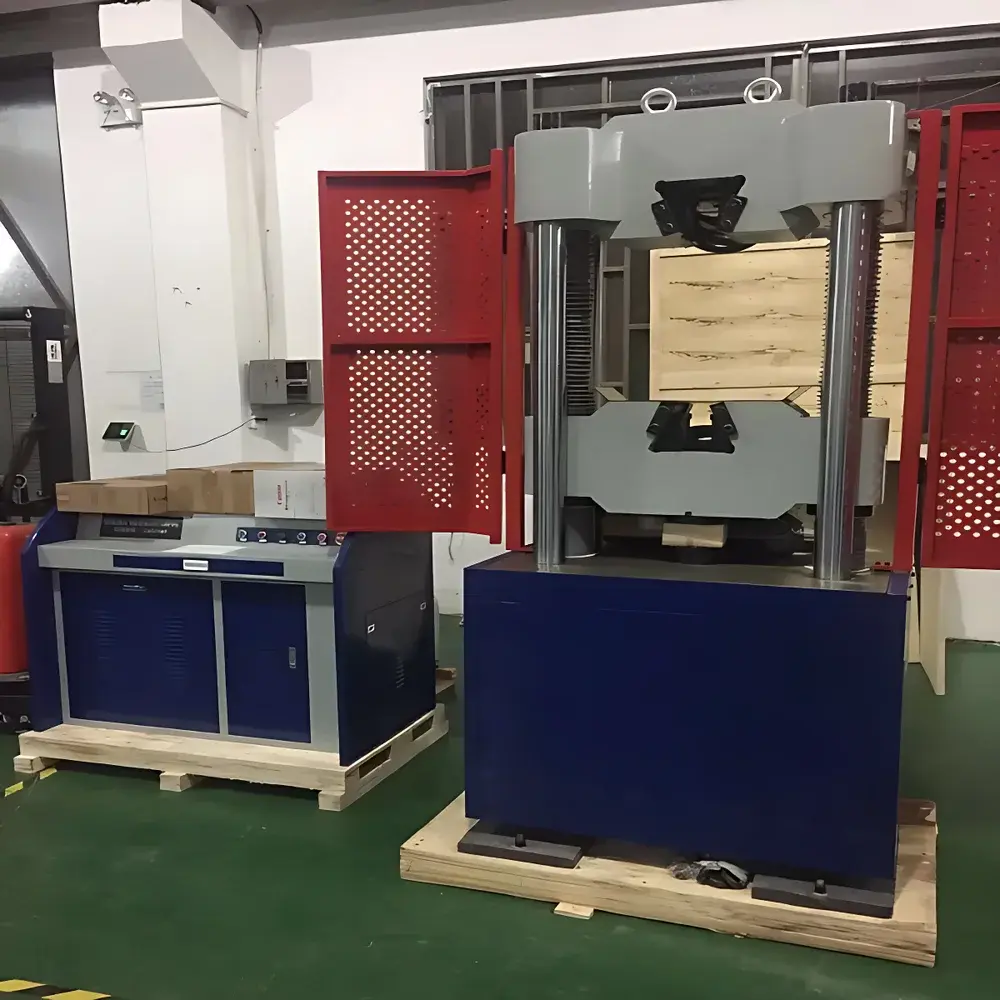
Qinji QJWE-1000KN Hydraulic Universal Testing Machine
| Brand | Qinji |
|---|---|
| Origin | Shanghai, China |
| Model | QJWE-1000KN |
| Load Capacity | 1000 kN |
| Load Accuracy | ±1% |
| Relative Resolution | ≤0.5% |
| Compression Space | 700 mm |
| Tensile Space | 700 mm |
| Round Specimen Clamping Range | φ20–70 mm |
| Flat Specimen Clamping Range | 0–40 mm |
| Piston Stroke | 250 mm |
| Bending Support Span | 400–1000 mm |
| Shear Specimen Diameter | φ30 mm |
| Dimensions (W×D×H) | 1255×866×4700 mm |
| Motor Power | 3.25 kW, 3-phase |
| Machine Weight | 6600 kg |
Overview
The Qinji QJWE-1000KN Hydraulic Universal Testing Machine is a high-capacity, microcomputer-controlled electro-hydraulic servo testing system engineered for precision mechanical property evaluation of structural materials under static loading conditions. Based on the principles of hydraulic force generation and closed-loop proportional control, the machine delivers stable, repeatable load application across tension, compression, bending, and shear modes—fully compliant with ASTM E4, ISO 7500-1, and GB/T 228.1 standards. Its oil-cylinder-underneath configuration enables flexible adjustment of test zones while maintaining rigidity and alignment integrity. The system integrates high-accuracy load cells (imported), displacement transducers, and strain measurement channels to simultaneously capture force, displacement, and deformation data at sampling rates sufficient for quasi-static characterization. Designed for industrial QA/QC labs and accredited material testing centers, it supports both routine compliance verification and advanced mechanical behavior studies—including yield point determination, modulus calculation, ultimate strength assessment, and fracture analysis.
Key Features
- Electro-hydraulic servo (proportional) fully digital closed-loop control architecture for precise load/strain/displacement regulation
- Adjustable test space: 700 mm tensile clearance and 700 mm compression height—optimized for large-scale structural specimens
- Wide-range specimen gripping capability: round specimens up to φ70 mm; flat specimens up to 40 mm thickness
- High-stiffness frame with reinforced base and crosshead assembly, minimizing deflection during high-load testing
- Integrated piston stroke of 250 mm ensures full engagement for long-stroke deformation tests (e.g., concrete creep or ductile metal elongation)
- Modular bending fixture support spans from 400 mm to 1000 mm, accommodating standardized beam geometries per ASTM C78 and ISO 1099
- Shear testing module compatible with φ30 mm cylindrical specimens per ASTM D732 requirements
- 3.25 kW three-phase motor provides consistent hydraulic pressure delivery across full load range (0–1000 kN)
Sample Compatibility & Compliance
The QJWE-1000KN accommodates metallic alloys (steel, aluminum, titanium), ferroconcrete composites, precast cementitious elements, thermosetting polymers, and fiber-reinforced laminates. Its clamping geometry and load train alignment meet ISO 2041 and ASTM E1012 requirements for geometric fidelity and lateral load minimization. All calibration procedures follow ISO/IEC 17025 guidelines, and the system supports traceable calibration via NIST-traceable load cells. Data acquisition complies with GLP and GMP documentation practices, including audit trails for operator actions, parameter changes, and result modifications—enabling readiness for FDA 21 CFR Part 11–aligned environments when paired with validated software configurations.
Software & Data Management
The machine operates with a Windows-based proprietary control and analysis suite supporting real-time curve plotting (force vs. displacement, stress vs. strain), multi-channel synchronized data logging, and automated report generation in PDF/Excel formats. Software features include programmable test profiles (load rate, hold steps, cyclic ramps), digital filtering for noise suppression, automatic yield point detection using the 0.2% offset method, and modulus calculation via linear regression over user-defined strain intervals. Raw datasets are stored in encrypted binary format with timestamping and operator ID tagging. Export functions support ASTM E1435-compliant data exchange protocols and seamless integration into LIMS platforms via ODBC or CSV interfaces.
Applications
- Mechanical certification of structural steel plates, rebars, and welded joints per ASTM A615/A615M and EN 10080
- Compressive strength evaluation of concrete cylinders and prisms (ASTM C39/C109)
- Bending performance assessment of railway sleepers, bridge girders, and prefabricated beams (EN 13225, ASTM C78)
- Shear resistance testing of fasteners, rivets, and composite laminates (ASTM D732, ISO 3597)
- Quality conformance testing for aerospace-grade aluminum extrusions (AMS 4027, AMS 4102)
- R&D-level investigation of creep behavior, relaxation kinetics, and plastic flow thresholds in high-strength alloys
FAQ
What standards does this machine comply with for calibration and operation?
It conforms to ISO 7500-1 (static calibration), ASTM E4 (verification of force-measuring instruments), and GB/T 228.1 (metallic materials tensile testing). Calibration certificates are issued with NIST-traceable references.
Can the system perform cyclic or fatigue testing?
No—the QJWE-1000KN is designed exclusively for quasi-static loading. For dynamic or high-cycle fatigue applications, a dedicated servo-hydraulic fatigue testing system is recommended.
Is third-party validation support available for regulatory submissions?
Yes. Qinji provides IQ/OQ documentation templates and can coordinate on-site qualification services with certified metrology partners for ISO 17025 or FDA audit readiness.
What maintenance intervals are recommended for hydraulic components?
Hydraulic oil replacement every 2,000 operating hours or biannually; filter cartridges every 1,000 hours; annual verification of seal integrity and cylinder leakage rates per ISO 4406 cleanliness standards.
Does the system support remote diagnostics or firmware updates?
Remote access is enabled via secure VPN connection for troubleshooting and software patch deployment, subject to customer IT policy approval and firewall configuration.



