
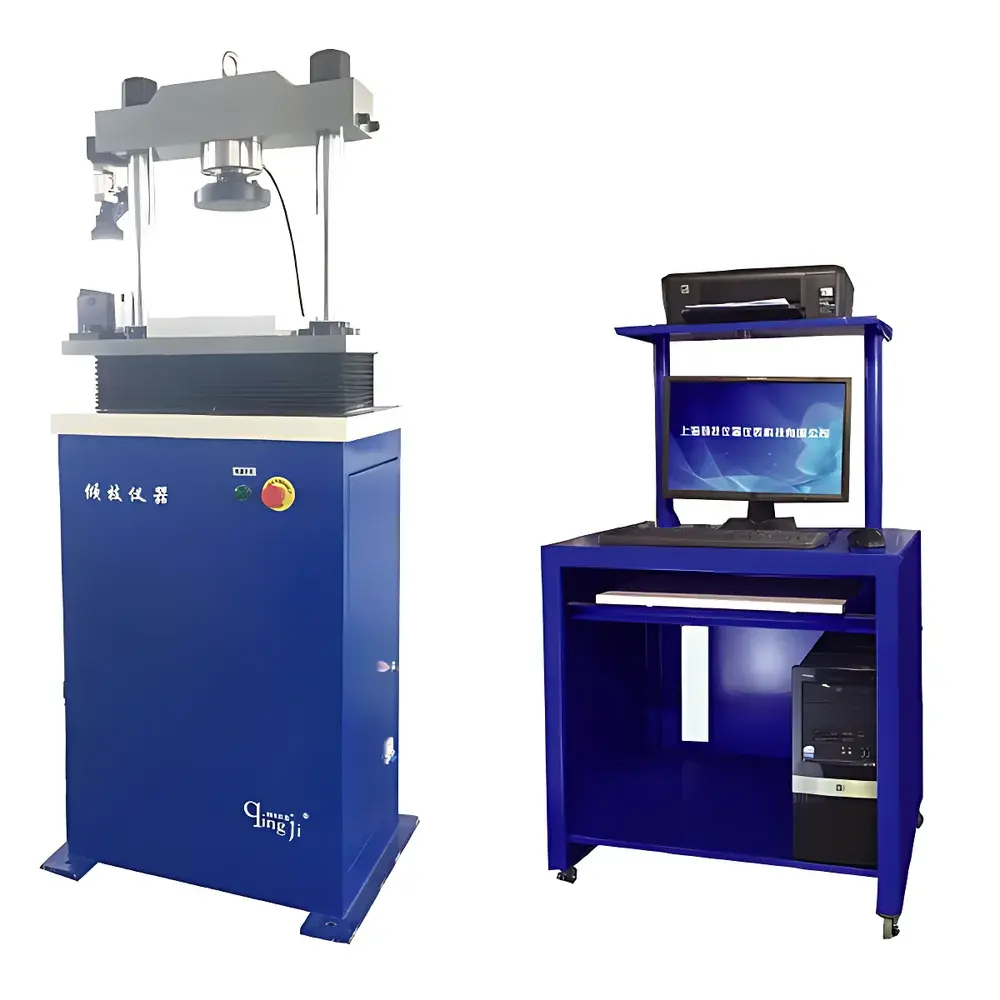
QJYL872 Universal Compression and Flexural Testing Machine for Mortar, Cement, and Building Materials
| Key | Origin: Shanghai, China |
|---|---|
| Manufacturer Type | Authorized Distributor |
| Country of Origin | China |
| Model | QJYL872 |
| Max. Compression Load Capacity | 300 kN |
| Max. Flexural Load Capacity | 10 kN |
| Load Application Rate (Compression) | 0–10 kN/s |
| Load Application Rate (Flexure) | 0–0.075 kN/s |
| Relative Indication Error | ±1% |
| Platen Spacing | Customizable |
| Platen Dimensions | Customizable |
Overview
The QJYL872 Universal Compression and Flexural Testing Machine is an electromechanical testing system engineered for standardized mechanical evaluation of construction materials—including cement mortars, hydraulic cements, fired clay bricks, concrete specimens, and structural ceramic or metallic components. It operates on the principle of controlled uniaxial force application via a servo-controlled hydraulic or electro-mechanical actuation system (configuration dependent on regional delivery specification), enabling precise measurement of compressive strength, flexural (third-point or three-point) strength, and load–deformation response under quasi-static loading conditions. Designed in strict accordance with ISO 7500-1 (Class 1 accuracy), ASTM C109/C348/C39, and GB/T 17671–1999 (equivalent to EN 196-1), GB/T 50081–2002, and GB 13544–2000, the system delivers repeatable, traceable, and audit-ready test data essential for quality control laboratories, prefabrication plants, civil engineering QA/QC departments, and academic research facilities engaged in building materials science.
Key Features
- Dual-mode testing architecture supporting both compression (up to 300 kN) and flexural (up to 10 kN) evaluations within a single frame—eliminating need for separate dedicated machines.
- High-stiffness, four-column load frame with precision-ground platens and self-aligning bearing interfaces to minimize eccentric loading and ensure uniform stress distribution across specimen surfaces.
- Real-time closed-loop load control with adjustable ramp rates (0–10 kN/s for compression; 0–0.075 kN/s for flexure), compliant with rate-dependent standards such as GB/T 50081–2002 and ASTM C39.
- Integrated digital load cell calibrated to ISO 376 Class 1 accuracy, providing relative indication error ≤ ±1% across full scale—validated annually per ISO/IEC 17025 requirements.
- Modular fixture interface accommodating standardized anti-friction rollers (for three-point flexure per GB/T 17671), compression platens (150 mm × 150 mm standard, customizable), and auxiliary adapters for brick, tile, and small-section metal specimens.
- Compact footprint (< 1.2 m² floor space) and low-noise operation suitable for shared lab environments, including university teaching labs and municipal quality supervision stations.
Sample Compatibility & Compliance
The QJYL872 accommodates standard prismatic mortar beams (40 mm × 40 mm × 160 mm), cubic cement paste or concrete specimens (100 mm, 150 mm, or 200 mm edge length), solid/hollow clay bricks (240 mm × 115 mm × 53 mm), and cylindrical or cuboidal metallic test pieces up to 300 mm in height. All test routines adhere to mandatory national and international regulatory frameworks: GB/T 17671–1999 (cement flexural/compressive strength), GB/T 50081–2002 (concrete mechanical properties), GB 13544–2000 (burnt clay bricks), and harmonized ISO 679, ISO 4012, and EN 772-1 protocols. The system supports GLP-compliant documentation workflows when paired with certified software—meeting audit requirements for CNAS-accredited testing laboratories and provincial construction material inspection centers.
Software & Data Management
Equipped with Windows-based control and analysis software compliant with FDA 21 CFR Part 11 (electronic signature and audit trail modules available upon configuration), the QJYL872 enables automated test sequence execution, real-time curve plotting (load vs. displacement), peak load capture, modulus calculation, and export of ASCII/CSV/XLSX reports. Raw data files include timestamped metadata (operator ID, environmental temperature/humidity if sensor-integrated, calibration certificate ID, and test standard reference). Software supports multi-user role permissions (administrator, technician, reviewer), automatic backup to network drives, and optional integration with LIMS platforms via OPC UA or RESTful API interfaces.
Applications
- Routine compressive strength verification of Portland cement mortars at 3-day and 28-day curing intervals per GB/T 17671.
- Three-point flexural testing of cementitious prisms to determine bending tensile strength and fracture behavior.
- Compliance validation of fired clay bricks and concrete masonry units against dimensional stability and crushing resistance thresholds.
- Pre-qualification testing of precast concrete elements, grouts, and repair mortars prior to field deployment.
- Teaching laboratory exercises in civil engineering curricula covering stress–strain relationships, elastic modulus derivation, and failure mode classification (brittle vs. ductile).
- Support for R&D initiatives evaluating novel admixtures, supplementary cementitious materials (SCMs), or fiber-reinforced composites.
FAQ
Does the QJYL872 comply with ISO/IEC 17025 accreditation requirements for testing laboratories?
Yes—the machine’s metrological performance, calibration traceability (to NIM or equivalent NMIs), and documented uncertainty budgets align with ISO/IEC 17025:2017 Clause 6.4 and 6.5 for mechanical testing equipment.
Can the system be upgraded to support automated specimen positioning or robotic handling?
While the base configuration is manually loaded, the frame design includes standardized mounting interfaces (ISO 10360-compliant) for integration with third-party robotic arms or auto-positioning stages—subject to site survey and firmware revision.
What documentation is provided for regulatory audits?
Each unit ships with Factory Calibration Certificate (traceable to Chinese National Institute of Metrology), CE Declaration of Conformity (for EU-distributed variants), GB-compliant Operation Manual, Maintenance Logbook template, and Software Validation Report (IQ/OQ protocol summary).
Is remote diagnostic support available during the warranty period?
Yes—secure remote access (via TeamViewer Enterprise with 256-bit AES encryption) is enabled for firmware updates, parameter optimization, and troubleshooting by certified service engineers.
Are platen customization options limited to size, or do surface finish and hardness specifications also apply?
Both—custom platens can be supplied with hardened 60 HRC tool steel faces, ground flatness ≤ 0.02 mm/m, and optional carbide-coated wear surfaces for high-cycle brick or aggregate testing.



