
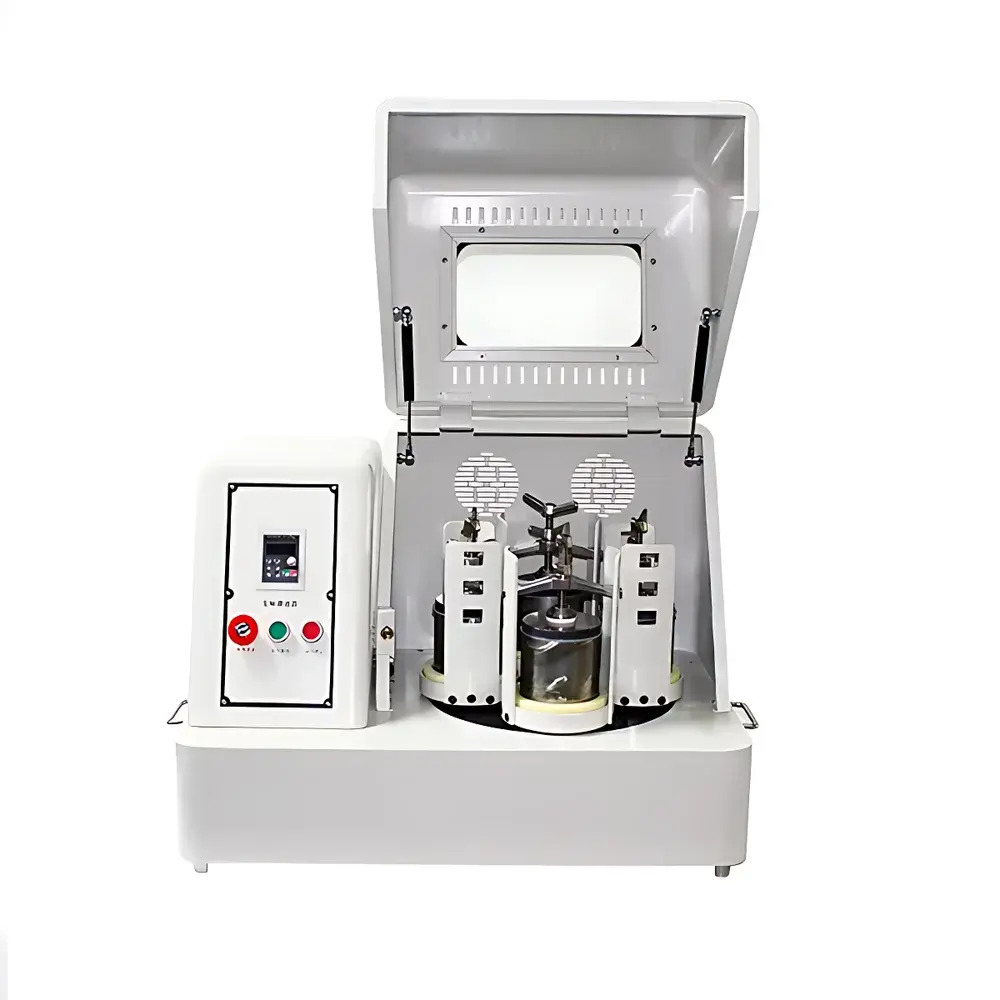
JByq JB Planetary Ball Mill
| Brand | JByq |
|---|---|
| Origin | Shanghai, China |
| Manufacturer Type | Authorized Distributor |
| Product Category | Domestic |
| Model | JB |
| Instrument Type | Planetary Ball Mill |
| Sample Applicability | Hard & Brittle Materials |
| Maximum Output Particle Size | ≤0.1 µm (under optimized conditions) |
| Standard Jar Capacity | 5–50 L per jar (2–4 jars operational simultaneously) |
| Feed Size | ≤10 mm for soils |
| Drive Mechanism | Precision Gear Transmission |
| Compliance | Designed for ISO/IEC 17025-aligned laboratory environments |
| Software Interface | Standalone digital controller with programmable speed/time profiles |
| Safety Features | Dual-lock lid mechanism, overload protection, emergency stop |
Overview
The JByq JB Planetary Ball Mill is a high-energy mechanical alloying and size-reduction system engineered for precision grinding, homogenization, and mechanochemical synthesis of advanced functional materials. Operating on the principle of planetary motion—where grinding jars rotate around their own axes while simultaneously revolving around a central sun wheel—the device generates intense centrifugal and Coriolis forces that accelerate impact energy transfer between grinding media and sample material. This dual-axis kinematic configuration enables efficient particle refinement down to sub-micron levels (≤0.1 µm), making it suitable for R&D-scale preparation of nanomaterials, ceramic precursors, battery cathode powders, and catalyst formulations. Its compact footprint, low acoustic emission (<65 dB(A)), and four-jar parallel operation capability support reproducible small-batch processing in academic labs, QC/QA facilities, and pilot production lines compliant with GLP and GMP pre-validation requirements.
Key Features
- Four independent grinding stations with synchronized planetary motion for parallel sample processing and statistical process validation
- Robust cast aluminum planetary disk with CNC-machined gear train using hardened alloy steel gears for long-term torque stability and minimal vibration
- Modular jar mounting system with spring-loaded clamping and dual mechanical interlocks ensuring secure containment under high-speed operation (up to 400 rpm nominal)
- Vacuum-compatible jar options (stainless steel, agate, tungsten carbide, zirconia) enabling inert-atmosphere or oxygen-sensitive milling
- Digital microprocessor controller with adjustable rotational speed (50–400 rpm), time setting (1 min–99 h 59 min), and reverse rotation mode for uniform wear distribution
- Integrated thermal monitoring and automatic shutdown upon temperature threshold exceedance or motor overload
Sample Compatibility & Compliance
The JB Planetary Ball Mill accommodates a broad spectrum of hard, brittle, and moderately ductile inorganic and composite feedstocks—including oxides (Al2O3, ZrO2, Y2O3), ferrites (Ni-Zn, Mn-Zn), lithium transition metal oxides (LiCoO2, LiMn2O4), piezoelectric ceramics (PZT, BaTiO3), and rare-earth phosphors. It supports ASTM C773 (standard test method for particle size analysis of ceramic powders by laser diffraction) sample prep workflows and meets mechanical safety requirements per IEC 61000-6-2 (EMC immunity) and IEC 60204-1 (electrical equipment of machines). Optional documentation packages include traceable calibration records and FAT/SAT protocols for regulated environments subject to FDA 21 CFR Part 11 or EU Annex 11 data integrity expectations.
Software & Data Management
The mill operates via an embedded standalone control unit—not cloud-dependent—ensuring deterministic real-time response and audit-trail readiness. All parameter inputs (speed, duration, direction sequence) are logged with timestamp and operator ID into non-volatile memory. Exportable CSV logs support integration with LIMS platforms and comply with ALCOA+ principles (Attributable, Legible, Contemporaneous, Original, Accurate, Complete, Consistent, Enduring, Available). No proprietary software installation is required; configuration remains accessible through front-panel keypad navigation with LED status feedback.
Applications
This instrument serves critical roles across materials science and industrial R&D: synthesis of metastable phases via solid-state reaction, preparation of homogeneous electrode slurries for Li-ion battery prototyping, attrition milling of sintering aids for multilayer ceramic capacitors (MLCC), particle size reduction of PTC/NTC thermistor compositions, and mechanochemical activation of heterogeneous catalysts. It is routinely deployed in university materials engineering departments, national metrology institutes conducting interlaboratory comparisons, and corporate innovation centers developing next-generation dielectrics and energy storage materials.
FAQ
What jar materials are compatible with this mill?
Stainless steel (304/316), agate, tungsten carbide, zirconia, and polyethylene jars are supported—selection depends on contamination sensitivity, chemical reactivity, and target particle hardness.
Can the mill operate under inert gas or vacuum?
Yes—vacuum-sealed jars with O-ring gaskets and external vacuum line ports are available as optional accessories.
Is speed calibration traceable to national standards?
Factory calibration certificates reference NIST-traceable tachometer verification; field recalibration kits and procedures are provided upon request.
What maintenance intervals are recommended?
Gear oil replacement every 2,000 operating hours; visual inspection of jar clamps and drive belts prior to each use; annual torque verification of planetary disk fasteners.
Does the system meet electromagnetic compatibility requirements for lab environments?
Yes—compliant with IEC 61000-6-2 (immunity) and IEC 61000-6-3 (emission) Class B limits for residential/commercial settings.



